Lotourism: a new philosophy of travel

My friend Tom who works with the London Zoo created a new word that recently got added into the English Oxford Dictionary. He’s a post-doc researcher that works closely with penguins and became a self-acclaimed “penguinologist.” If you google the term, he’s the second hit.

Likewise, I had the idea to invent a new word. I have a dialect of English my friends call Katrin-speak, but this is isn’t a word I’m pulling from my bad English vocabulary – its more like a philosophy of travel that I’ve adopted. “Lotourism.” Its a theory of tourism that isn’t captured by any other, one word. After completing my MA thesis on the discrepancies between defined and actualized ecotourism, I realized the term ecotourism is a vague, green-washed term, whose definition is undecided among academics, and sometimes unidentifiable in practice.

I liked to think I was an ecotourist, also called an alternative tourist, sustainable tourist, or an environmentally friendly tourist. But then these terms lead us to more definition inconsistencies, since “eco” and “environmental” and “sustainable” are all buzzwords overused and often misunderstood.

I like to think I travel sustainably, but not just natural resource sustainably – Im financially resourceful, with minimal luggage, staying with locals, and traveling slowly but steadily over short-haul distances.

Im not really a backpacker, since I avoid hostels and hate being defined by the stuff in a bag on my back. Im not always a tourist, since I try my best to camouflage into my surroundings and see things from a local perspective. I’m definitely a traveler, but so is the American guy sitting in business class flying to Dubai for a 2 hour business meeting before returning to London via Dakar for dinner in England’s most authentic Turkish restaurant. So I’ve realized there are different types of travelers, doing different types of travel, and when asked how I travel, my new answer is “I’m a lotourist.”

Lotourism is, in a nutshell, is kind of like ecotourism, redefined and on a budget. It is travel that is low-impact, low-cost, localized, and lonely.

1.) Low-impact: your footprint on the natural environment is minimal, which means your carbon footprint is low, your use of exhaustible or non-renewable resources is low, you create minimal or no waste, you dont contribute to the degradation of natural environments, your touristic activities and choice of transport/accomodation/or anything else travel related is based on an educated, informed decision to be as low impact as possible. Your footprint on the local culture or host is minimal, which means you learn and engage in cultural exchange so far as you do not negatively impact any local traditions or customs, you are a low-profile and low-maintenance guest, imparting little change or judgement except for what is beneficial or desired.

2.) Low-cost: you travel on a tight budget, which requires you to avoid tourist traps like all-inclusive vacations, hotels, and organized tours. You avoid shopping and buy almost nothing but necessities, spend your money on simple travel (preferably terrestrial, like trains or buses, going short distances rather than long-haul flights), and stay with locals that you know through friends, family, or travel communities like couchsurfing.

3.) Localized: you stick around in an area long enough to know it, see every corner (especially outside the city center or touristic attractions) and the surrounding suburbs or country side. You stay where you want to be, living a day in the life there. You spend your money in such a way that financial resources go directly into the pockets of locals (locally-owned businesses, local guides, surrounding farms instead of imported/mass produced foods) and you support the local economy (avoid international tour operators or foreign-owned companies in all your purchasing decisions).

4.) Lonely: last but not least, travel alone. Travel by yourself to be better immersed in your surroundings, alone with your thoughts and feelings to fully take in, process, and understand your new environment. Be vulnerable, meet local people, avoid speaking your own language, catering to the needs of a travel companion, or doing anything that you don’t feel like doing or going anywhere you don’t feel like going.Leave your Lonely Planet at home and just ask people for help as you go, talking to as many strangers as you can. Don’t stay in hostels where you’ll get swallowed up into a group of other tourists, don’t travel with a tour group or on a big bus with “rich tourists, coming your way” printed on the license plate. Travel more spontaneously, irresponsibly even, at the mercy of a local tip, with the adrenaline-rush of taking the wrong bus or the long bus, ending up on the wrong train, showing up in a place you have no clue about, learning from scratch and not a guide book. You can go for as long or short as you want, book one-way tickets, have undefined destinations, a flexible schedule, and a trip planned only one day ahead at a time.

So, for any other lotourists out there, get the word out on the new word. And, if you get it and you like it, spread the word so more lotourism can exist in this traveling world of ours.
 

Holiday Feasting and Dysfunctional Families

My parents had 3 daughters together, all of us born in Iceland, but raised most of our lives by our mother in Canada. Though we kept many of our Icelandic traditions and some Icelandic culture, we lost the language and became more Canadian. My mother is Guyanese, and imparted much of her British Guyanese influence onto us as well, so we grew up in quite the international, multi-cultural home. She dated an Italian, a Brit, most recently a Chinese guy, and married and divorced an Indian Guyanese guy during the time we lived in Canada. But we never really had a man around the house, since my grandmother helped raise us and we were barely allowed to keep male company without being chastised.

I went through a tomboy phase in my teenage hood, had only male friends, dreamed of having a brother, and wished I had a father. When I graduated university, I decided to move back to Iceland and be with my dad back home. Since then, I had the dilemma every year to decide whether I should spend the holiday season in Canada or Iceland, and always hoped the family could have just one more Christmas together.

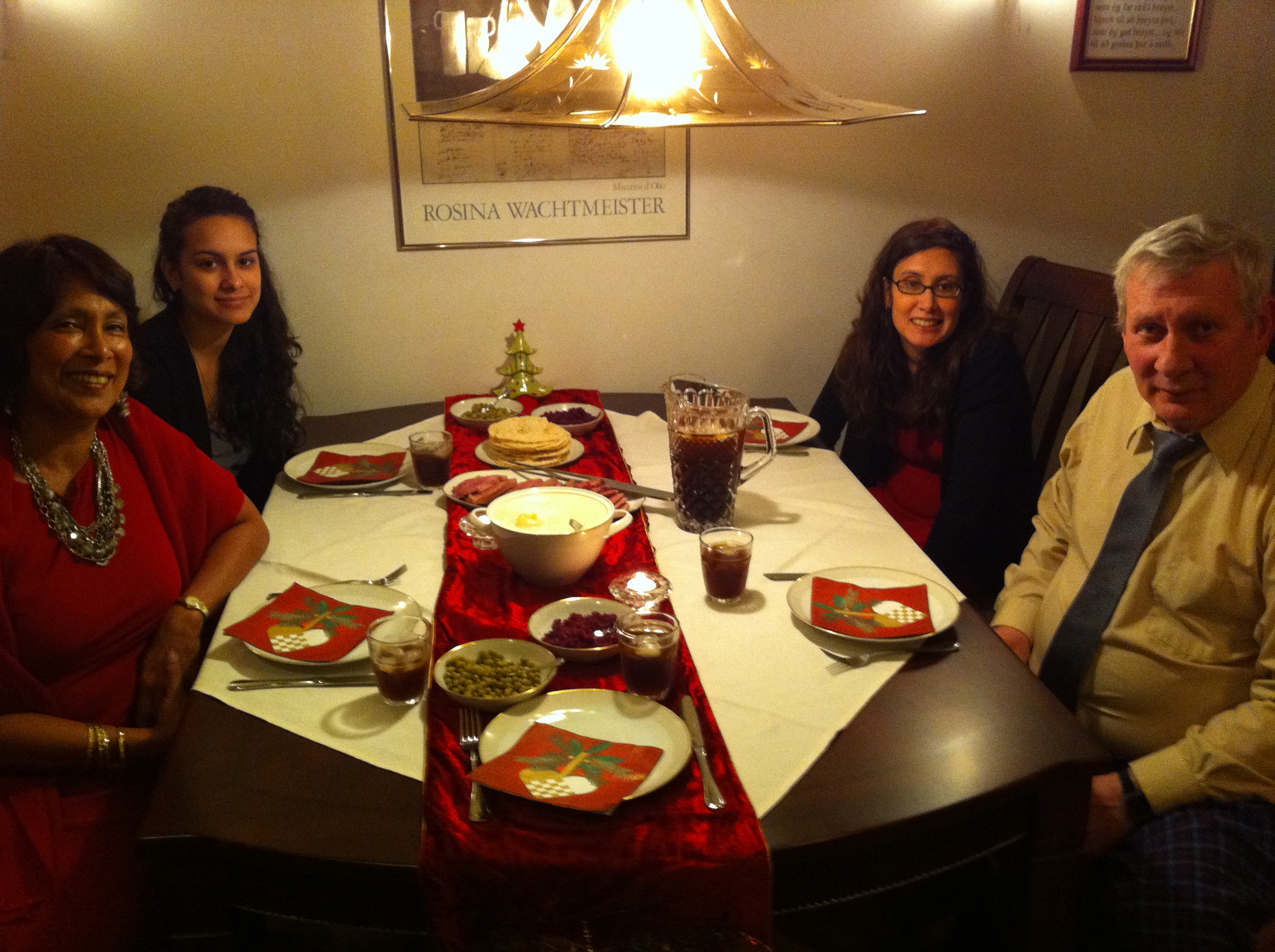
my family feast on Christmas Eve

This Christmas and New Years was the first I spent in Iceland together with my entire family since 1992. My mom, dad, sisters and I had Christmas together in Canada in 1994, but it didnt turn out so great since my parents had just recently divorced and my mom had emigrated us all to Canada without telling my dad. I guess time does heal all, so 17 years later, they talked about things other than custody or money, and us sisters all grown up appreciated having both our parents in the same room to contribute to another happy family memory.

It was quite the dysfunctional occasion though. My parents get a long okay when we’re around, but they couldn’t be left alone since my dad has no patience for my mom and my mom didn’t think it was appropriate to stay at his house. They both know they’re excellent cooks and want to parent us, but now we’re all grown up and scolded them more than they scolded us. My youngest sister is engaged to be married and somehow acts like she can’t wait to start her own (more normal) family. My eldest sister wanted everything to go smoothly but is an unspoken, passive aggressivist, and I ran around like a chicken with my head cut off trying to keep everyone busy and entertained… which wasn´t easy with record snow falls keeping us on the verge of getting stuck every time we had to go anywhere or park the car. But we only had a week and couldn´t let weather get in the way of or plans, so I was still the 24/7 driver, tourist guide, daily planner and phone secretary. However, I never minded since I was royally awarded with food feasts centered around family time every day they were here.

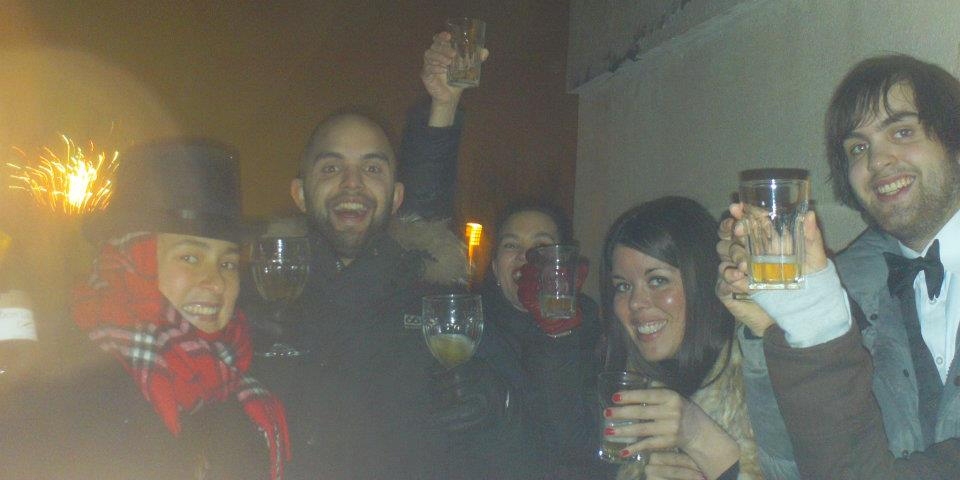
the first seconds of 2012

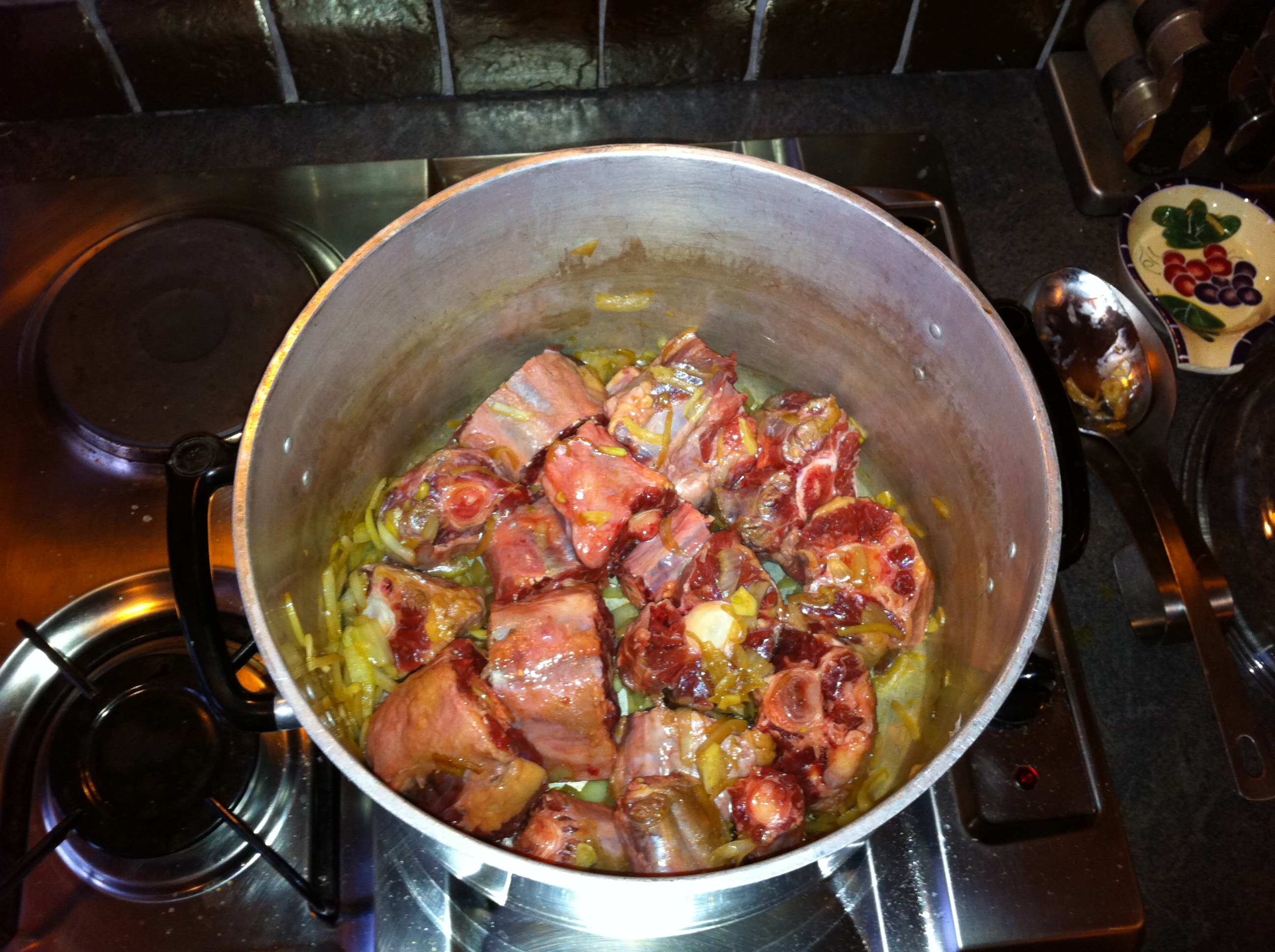
My mom has a sister in Iceland who married an Icelandic man and started a family here. My mom stayed with her and we visited our Aunty and cousins often for breakfasts, lunches and dinners prepared large enough for an entire army. We ate traditional smoked lamb with fixings, grilled leg of lamb with Icelandic mushroom gravy, lamb saddle and sheep head. On Christmas night we had lamb curry and roti, and Christmas morning we had Pepperpot, a delicious Guyanese dish made of oxtail and lamb

adding oxtail to the pepperpot

neck that takes days to cook. My friend Þráinn, one of the top chefs in Europe, came over and cooked some fine-dining langoustine for us one night. We tried every Christmas beer brewed in Iceland, and stuffed our bellies full of cookies and chocolate after every meal.

We visited our half brother, our old neighbours, and met many of my friends, including 3 hunters who fed us reindeer steak and reindeer carpaccio. We made it through the days with coffee and tea, leftover dinners, and hot dogs from hot dog stands. We rang in the new year with sparkling wine and almost got blown up by a wayward firecracker my cousin Svanur lit up too close to the balcony. We tried to make it to Vestmann Islands to visit our relatives from Dad´s side, but the weather wouldn´t allow it, or else we would have gotten to try some puffin and dried sea weed.

After a week of stuffing our faces and functioning like a family unit once again, we all had a great time secured by hundreds of photos to keep every moment of the holiday  memorable. I like watching Modern Family to remind myself we´re just one of many dysfunctional families, with an ever-evolving definition of family unit. I appeciate how unique my family is – growing up apart, getting divorced, getting engaged, living in different countries – and learnt that it doesn´t affect our family ties, since these are just the things that make us normal. I guess all families have some dirt under the carpet, with some weird element going on, so we’d be abnormal if we weren’t a little dysfunctional.

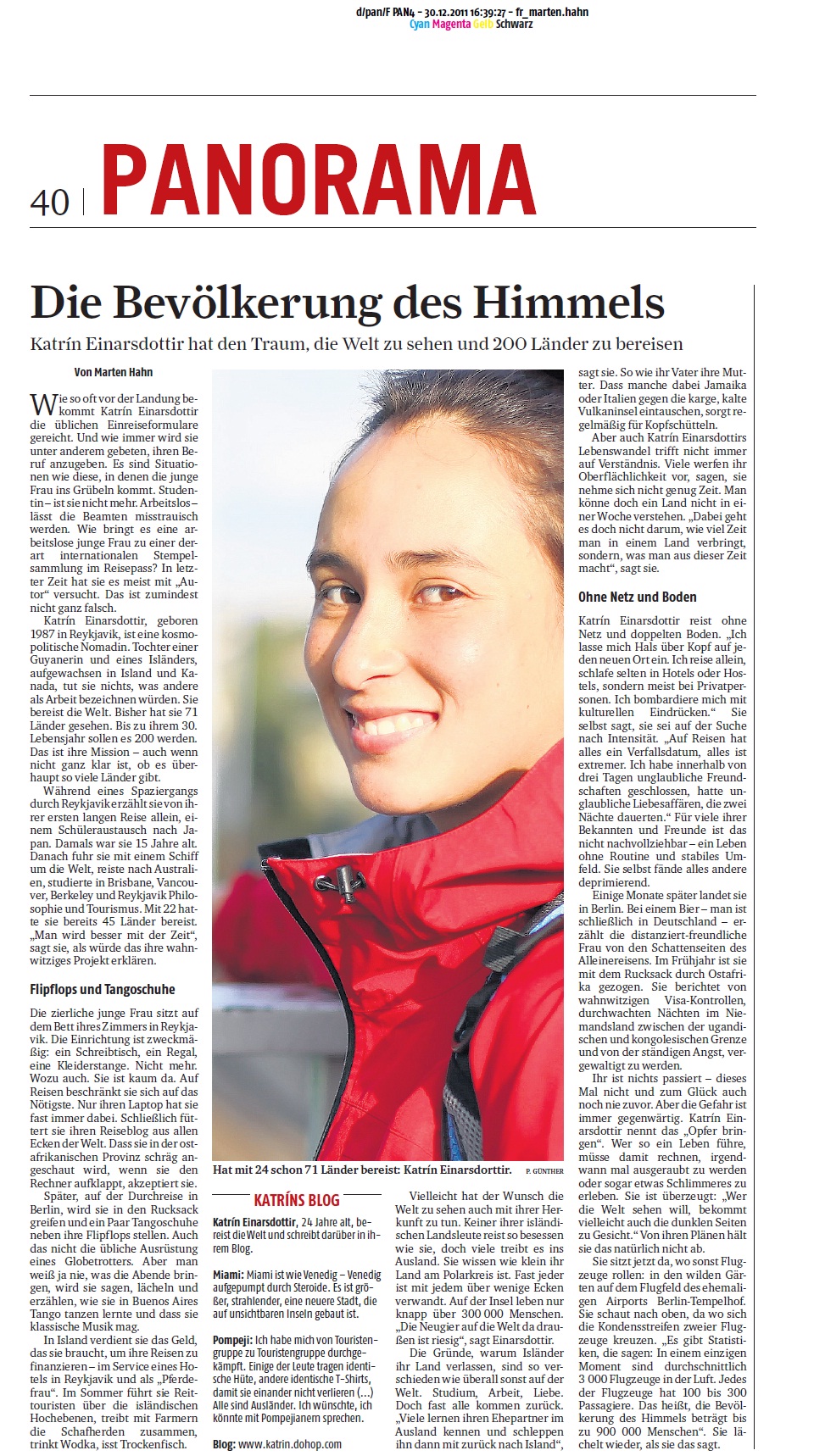
Panorama: an interview from the Frankfurter Rundschau

if you read German, enjoy this article written by journalist Marten Hahn


von Marten Hahn

Dear World: Everything I like about you

If you’re ever down or bored, try writing a list like this. And if you do, I’d love to read it! Leave your your “like” list in a comment to share 🙂


I like painting my toes red or purple. I like tango dancing in red shoes.

I like sleeping with 3 pillows. I like candle lit rooms. I like meditating in old churches.

I like when butterflies land on me. I like when puppies attack me with love.

I like smoking cigars lit with cedarwood. I like fireplaces that burn real firewood.

I like eating before I go grocery shopping so I don’t buy too much. I like having exact change.

I like swimming naked. I like doing yoga in steam baths. I like hottubbing in the snow. I like towels that are actually bathrobes.

I like walking on the sunny side of the street. I like walking barefoot in sand that squeaks under my steps.

I like hosting parties of 3 or more. I like when awkward things happen but no one feels awkward about it.

I like riding crazy horses. I like feeling my heart pulse in my fingertips. I like listening to music that gives me goosebumps.

I like meeting people for the first time but feeling like Ive known them forever. I like smiling at strangers. I like people who have smile wrinkles around their eyes.

I like when my hair tickles my face from being blown around. I like watching the rain fall from under an umbrella, staying dry.

I like swinging in a hammock strung between two palm trees. I like balconies with a view of the sea.

I like spraying my scarf with 5 different perfumes at duty free shops so I smell really good, but not quite like anyone else. And that’s easy to do since I often find myself stuck in airports with huge duty-free shops where I can go wild experimenting with scent chemistry.


What do I do?

I dislike the question “What do you do?” very much since I don’t really have an answer. Well, I have the long-winded response, since I like to do a lot and only for short periods of time. But I don’t really do any one thing, in the way people expect you to answer with a professional title or a job description. I get slightly hung up on customs forms every time I have to fill one out when entering a country, since the question “Occupation:” only has one line for you to answer. I kept writing “student” many months after I graduated, but realized I had to stop doing that now that I have no university to call home. Writing “unemployed” always got me into trouble, since the customs agents would drill me for an answer on how I funded all this travel, with pages of passport stamps working against me to prove I’m actually quite broke. It took me a while to embrace the “writer” identity, since being a writer by profession usually means you can make a living out of it, and my blog certainly doesn’t pay all my travel bills. But, it’s been working a bit better for me lately as I’ve realized most travel writers are also just starving writers writing for the sake of writing, traveling with money made from other side jobs.

My “side” job is at a Radisson Hotel in Reykjavik, working in the food and beverage department for a reasonable hourly wage. I enjoy doing this, since I meet a lot of tourists, and also get to work with food and drinks – two of my most favourite indulgences. The horse-rider identity hasn’t really been a profession until recently, since I’m now getting paid to do some types of riding and that just seems completely ridiculous to me – getting paid to ride has to be every horse person’s dream job! Horse back riding is like therapy for me, I would pay to do it, but instead the system is working in my favour. There is actually a lot of work to be done, both in tourism and farming, where riders get rewarded for this incredibly fun hobby which happens to also be a valuable skill.

The question “What do you do?” is too presumptuous, since it assumes you do something for work. Why can’t life be all play and no work? I try and avoid doing anything displeasurable, especially for work, since selling time for money never seemed to make sense, no matter how much money it is. I’d rather sell skills or knowledge, something valuable that I’ve paid to get. I’ve spent a lot of time, money and energy going to school, but not because I want to work in the field I studied, but simply for the sake of education itself. I finished my master’s a year ago and haven’t applied for a job yet, and the thought crossed my mind that I’m eligible for unemployment benefits, but only because the socialistic system in Iceland is too skewed for catering to lazy people. Getting a master’s in environmental science/tourism was just a silly mistake in the first place if I was looking for a job in tourism that required a graduate degree. Maybe one day all this over-education and travel can surmount to me being some sort of life-style advisor, teaching people how to work less, play more and learn unconventionally. I think this is a bit far-fetched, but there are actually people whose ‘professions’ are ‘life-coach’ – sounds almost as weird as ‘horse-rider.’

So, so far I’ve kind of established I’m an unemployed, writing, riding Master of Tourism, but I’m mostly just a traveling, nomadic, cosmopolitan. Sometimes I feel that I’m a fulltime friend, since my social life seems to take up all my time, and most of my travel revolves around visiting people scattered about from all sorts of different places. I’m also a dancer, a musician, an artist, a retired (or fired, rather) actress/model, and a philosopher by way of education (my BA). These identities transition in and out of my life as the years pass, and sometimes I try to reinvent them with slight morphosis. I’ve been a pianist for many years, studying and competing as one, but the life of a concert pianist didn’t appeal to me as much as learning the guitar for a while, and most recently, the violin (which I’ve yet to learn anything more than Twinkle Twinkle Little Star). Currently, Im transitioning from my ‘hestakona’ (horsewoman) identity back to backpacker, and to ease through the stage I’m experiencing what’s called the ‘post-ironic Fleetwood Mac appreciation stage.’ This is something my hunter friends have identified as the uncontrollable tendency to listen to the Fleetwood Mac Rumors cd over and over and over without getting sick of it.

So, if I do nothing, similar to those customs agents, you may still be wondering how I afford to finance my travels. The trick is just to travel for long periods of time in places where the cost of living is cheaper. Then you’ll sympathize with me how expensive it is to to stay in Iceland or Canada, since life just costs too much. Then, the question should be, how can I afford not to travel!?

An Interview with the Chilliwack Times and an Article in the Vancouver Sun

53 countries down, 147 to go for Chilliwack globetrotter

Travel blogger wants to see the world before she settles down at 30

By Cornelia Nay Lor, Chilliwack TimesSeptember 11, 2010

Take an Icelandic dad and a Guyanese mom, and it’s not surprising if you come up with a globe-trotting daughter.

That’s the case with local world traveller Katrin Einarsdottir.

“You start in Iceland and Guyana, and then you want to see what’s in between,” she said while back in Chilliwack before setting off again on an Alaskan cruise and then a two-month tour of Central America.

At age 23, the Sardis secondary grad has already been to 53 countries, and her goal is to visit 200 before she turns 30. Toward that end, she even has an Icelandic flight search-engine website, dohop. com, sponsoring her travel blog and funding at least part of her travels.

Not that Einarsdottir has ever let a lack of sponsorship keep her from seeing the world.

“I’ve just sort of always saved money for travels,” she said. “The money’s always being put in the bank for that next trip instead of a new car or rent.”

Since catching the travel bug during a month-long homestay in Japan when she was just 15, Einarsdottir has earned travel money by working summer jobs — including acting and modelling in Vancouver and guiding horse tours in Iceland — between years at high school and university.

Together with travel scholarships and, more recently, the money from dohop. com, it’s been enough to get her to all seven continents already. (Antarctica in January and February was the latest.)

What draws her abroad is novelty.

“Everything’s always new,” she said. “Every day you meet a new person or hear a new language or see a new place. It’s the constant novelty of seeing and experiencing something brand new.”

Coming back to Chilliwack and the 11-acre hobby farm she’s called home since middle school is all the sweeter after a long trip.

Einarsdottir’s travel-writing break with dohop. com came about a year and a half ago, when she was working on a master’s degree in nature tourism at the University of Iceland.

The company had sent out an e-mail to the school looking for travellers interested in blogging their experiences for the website, and she was a natural fit. With 147 countries still to visit in the next seven years, she’ll definitely have plenty of material.

“Politically there aren’t even 200 countries,” she said, “but that’s because places like Greenland are still politically Denmark, but I count Greenland as its own place.” (Yes, she’s been to Greenland.) Going by politics and geography, Einarsdottir figures there are 206 “countries,” but there are some she’ll probably be giving a miss — like politically impenetrable North Korea, remote South Pacific Vanuatu or the downright deadly Democratic Republic of Congo. Her mom is already skittish enough about her travels.

“She’s always a little worried, but she’s supportive, and my dad thinks it’s great,” said Einarsdottir.

“They worry about my safety a lot because it’s hard to travel alone as a female depending on where you are, and I’m often in places with no Internet or no phones.”

It may not always be easy, but one goal of Einarsdottir’s blog is to show would-be female travellers it can be done. And what will she do once she’s proved her point?

“When I’m 30, I think I’ll want to maybe settle down and meet a guy and do the other things you’re supposed to do in life,” she said. “But between now and then I just want to be totally independent, travelling.”

To read all about Einarsdottir’s travels, visit katrin. dohop. com or follow her on Twitter @katrinsif.

© Copyright (c) The Vancouver Sun

Read more: http://www.canada.com/vancouversun/news/westcoastnews/story.html?id=5004d013-b80a-4afa-a83b-94fd9a03d08f


LOLA: look, observe, learn, act.

September 11th came and went without any major catastrophes, although I didn’t even realize what day it was until I started writing this blog. I’ve often wondered why it’s worth spending any energy worrying about tomorrow when you’ve got today, and if you’ve got today and it’s going just fine, stay in the present and keep on keepin’ on. Of course this philosophy is good in theory, but it’s hard not to worry about the future and I often find myself stressing out about tomorrow, next week, next month, next year…

I like to think Im good and avoiding long-term planning, since Im certainly terrible at commitment and thrive for spontaneity. When I was doing a Semester at Sea, an undergrad exchange program that sails around the world, the motto was LOLA: look, observe, learn, act. The students, almost all Americans, were persuaded to try and travel with new eyes, focusing on the there and now, absorbing as much detail and life out of the present situation as possible. It was an interesting experiment, forcing our planning-oriented selves to exercise reckless abandonment, not worrying about our next move until we understood the present.

When traveling, I often get lost in time and place. I wake up after a long bus ride and try to remember where I am. Once I get a grip on that, I don’t bother to remember where I’ve come from or where Im going next, and I almost never think about what day of the week it is. Trying to remember what month it is is usually harder than remembering what year it is, but I often start dating blog entries with 200_ and realize its already 2011. People have asked my age, and I stutter “ugh, 23,” until a few moments later I disrupt the new topic of conversation with “no, I’m 24!”

What is time anyway? I think its just a way for people to synchronize with other people, for places to synchronize with the rest of the world, and keep a framework to which we can make plans for the future. Yet somehow, plans change but time keeps ticking, and it seems to speed up the older you get, the longer you live.

I was supposed to be moving to Montpellier, France in a couple weeks, but matters of the heart changed and now, one lonely French-American is living my dream life without me. I wanted to paint, play music, eat baguettes and cheese and chocolate, drink wine and ride a bicycle in a flowy dress, while never getting fat and only speaking french… but that will have to wait til later.

Have you ever looked at your own eyelashes? In that moment of being half awake, or when avoiding the bright rays of sun? I daydream a lot, sometimes consciously, and other times, in that surreal moment between being asleep and waking up when you’re not sure if your dreaming or living. Then it’s a bit awkward trying to separate your dreams from reality, especially the ones you’re never really sure if you dreamt them or lived them.

Im sitting in the sun now, sweating, squinching my eyes from the sunshine, checking out my eyelashes. Its almost 20 degrees in Reykjavik and I can see myself getting browner. I heard the wing flap of a raven flying high overhead, since its so completely still and silent here that the sound of me typing sounds like noise pollution.

Now I know what day it is, where I am and what I’m doing tomorrow, but I can’t wait to be alone on the road again, with my 35L backpack, lost in time and wondering where I am everytime I wake up in a new, unfamiliar place.

Freewaters Article – an update from Kenya's water project

A blog update from Projectfreewaters after my visit to Tulwet, Kenya, where they have their first major water-well digging project happening. Find out more information at http://www.projectfreewaters.org , or buy some sandals to support the cause at http://www.freewaters.com

Katrin Sif Einarsdottir, Freewaters Ambassador, visits Projectfreewaters

JUL13 2011 WRITTEN BY ELI

Katrin Sif Einarsdottir, Freewaters Ambassador and Product Tester, visited Projectfreewaters last week on her way through Africa.

Well, this pretty much sums it up: Katrin wearing our Vezpa sandals, standing on a new well apron in Kenya! The circle is complete!

Here you can see how the concrete apron directs surface water away from the pump head, ensuring that the clean ground water is never contaminated.

Kenyan team Leaders Barnabus and Franco demonstrate to Katrin how the well works.

This borehole is a typical example of where local families used to get their water. Because it is exposed to surface water, they are quickly contaminated and lead to a handful of water born diseases.

Locals report to our team that infant and senior mortality from water borne disease has virtually disappeared since ProjectFreewaters started back in December. Additionally, the distance for these families to walk to draw water has been reduced to 1km.

Katrin is a world travel blogger and a Freewaters Ambassador and Product Tester. Katrin, thank you and safe travels!! Check out her blog: katrin.dohop.com

see the full article: http://projectfreewaters.org/?p=207

Lost in Translation

When I was a child growing up in Iceland, I spoke Icelandic, perfectly and fluently. Then at age 8, after moving to Canada, I almost failed grade 2 because I couldn’t understand why noone would respond to my Icelandic. I eventually spoke english well enough to be comfortable speaking only English, but then forgot all my Icelandic. Then I learned french, a lot of French – one of the perks of emigrating to a bilingual country. I studied abroad, in France and Australia, majored in English, and came out a pretty good bilingual Canadian.

My first, biggest, (quasi) solo travel experience was participating in a 100-day circumnavigation of the world, peetering around the equator on the MV Explorer with 600 other students. The program is called Semester at Sea, and for anyone who has done it or is considering doing it, just know that it will either make you an OCD travel addict or, leave you feeling like you never need to travel again. The former happened to me, so the following summer I embarked on my first, true backpacking trip through South America and the Caribbean for 2 months. The two summers after that I also spent backpacking in South America, so then I learned Spanish. First, it was just travel-survival Spanish, but eventually, I started thinking in Spanish and forgetting my French, even English at times.

Then to make matters even worse, I decided to move back to Iceland in 2008, which was when I realized I’d have to relearn Icelandic. Three years later, Ive only spent a total of 11 months actually in Iceland, in chunks of a few weeks or months here and there, so its coming together, but falls apart every time I go to  a French or Spanish speaking country and my second-language confidence switches between the three. Worst of all, the longer I spend trying to sort out my secondary languages, my english deteriorates, and my handle on the language fluctuates from good to satisfactory, then back to okay. Good friends of mine know this as “Katrin-speak,” and even speak it fluently, since I regularily mix up my syntax, make up words, and switch between languages in a way that they’re used to.

Now, Ive had my first full year away from University, and if it wasn’t for reading and writing in English, Im not sure what would happen to my ‘first’ or ‘strongest’ language. My family in Canada tells me I speak English with an Icelandic accent, Icelanders tell me I speak good Icelandic for a foreigner, and everywhere else people wonder where Im from, and when I answer Iceland, compliment my English for being so strong. This used to go unnoticed, but before I considered it a compliment, realized that the flattery is only intended by those who believe I am an ESL speaker.

So, I clearly have a language identity issue. Now, to make things more interesting, I have a cultural identity issue on top of all this, maybe stemming from the first problem, or perhaps reconfirming it. I’m an Icelandic born, Canadian raised, (soon-to-be) triple-passport holding daughter of a Guyanese mother, and Ive spent more time traveling than staying in any one place for the last three years. In North America, people think I look native American, so when I tell people I’m from Iceland, they picture some northern/Greenlandic indigenous group that I’m most likely descendant from. I only correct them half the time, since when questioned by an Icelander, “Where are you from?” I say Canada, and they probably picture very similar looking native North American ancestors.

Elsewhere, people think I look latin or middle eastern, but in Latin America they call me gringa and in Egypt, a “white” person, which Ive come to learn is a generic term meaning “rich westerner.” When people notice I look darker than most “white” people, I accredit my tanned skin to my mother, who’s from Guyana. “Ghana?” some ask, “No, GUYana” I respond. Then a short pause is followed by “Oh, Guinea!” and again I say, “No, GUY-ANA.” Then to save face, they dismiss their total confusion by asking “what part of Africa is that?” at which point I have to explain its actually in South America, that its not French Guiana, and then ask whether or not they really thought I look African. If so, then I’ve got a real identity problem; one can’t really look ‘African’ since the term only correctly refers to someone who lives in Africa, and the continent encompasses such a diverse and complex mix (of millions) of people, including those infamous ‘whites.’

Harpa, Iceland's shiny new concert hall

a private concert in the big red room of Vikingur rehearsing Grieg's Piano Concerto

It really is quite new and shiny, with those stories and stories of diagonal glass panes and only officially opened since Saturday. It has a kind of rocky history, with funding issues and construction halted for months following the economic collapse, but elves had nothing to do with it so no need to worry about any of that bad stuff from the past. There was also a bit of confusion with the first concerts, since the ‘opening’ concert was May 6th, but it sold out so quickly that they added two more shows May 4th and 5th. So, May 4th, its arguable´opening date´blew the crowd away with a Grieg piano concerto performed by Juilliard´s Vikingur and Beethovens 9th Symphony conducted by no other than Valdimir Ashkenazy himself, but gave spectators only a sneak peak of the barely functional, half finished Harpa.

Then, last Friday there was another ‘opening concert´, and Saturday May 14th was the ´open house,´ and so now after a lot of openings, its open alright, as well as all its bars and restaurants and halls functional, but still not complete.

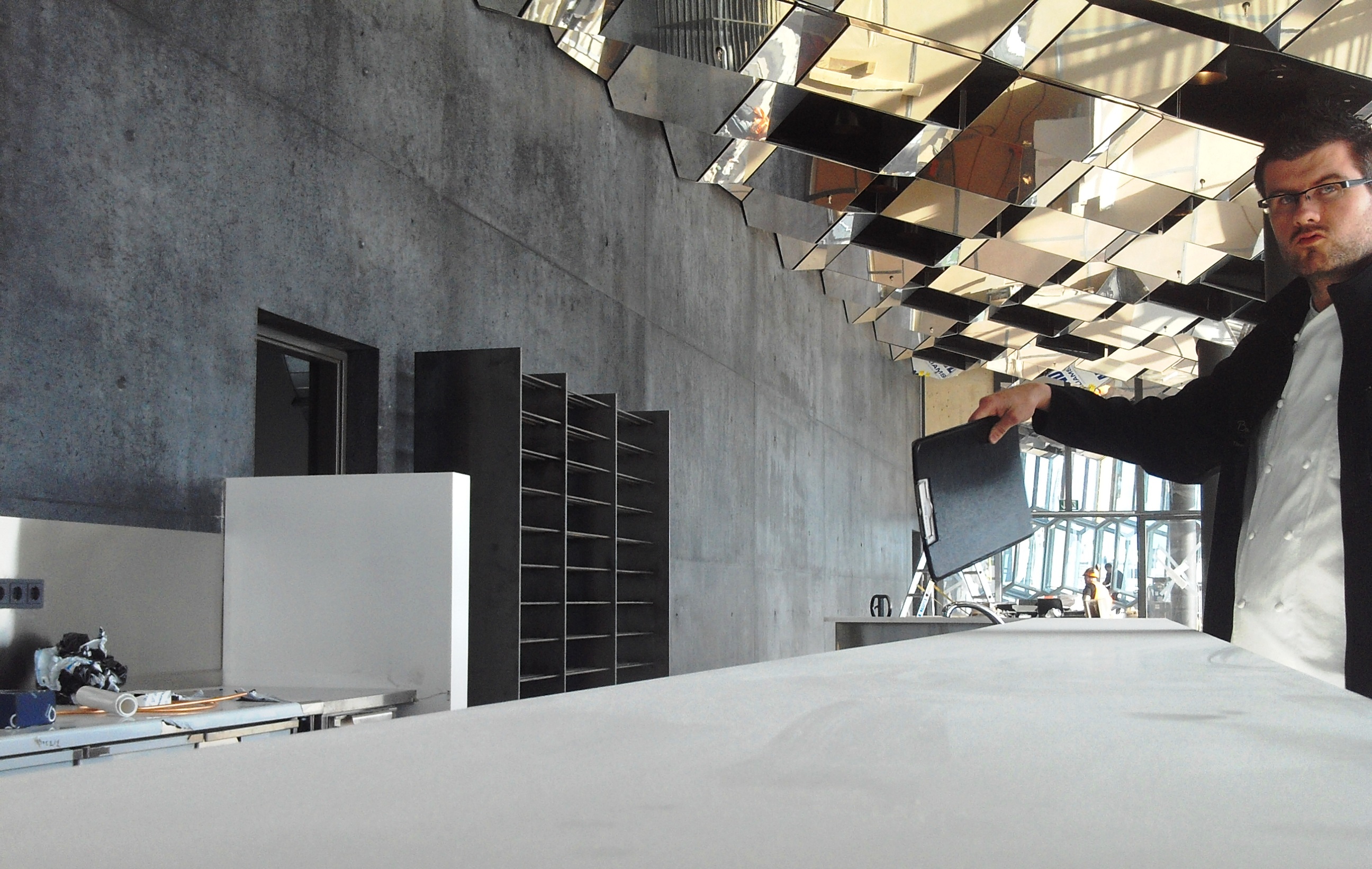
May 3rd, the bar and restaurant not quite ready for opening night #1

From inside, you can still scrape your feet along construction dust and the entire front hall is still hidden behind plank wood instead of the glorious, multi-coloured glass panes. From outside, gravel and heavy machinery surround the building and the massive dug out pit to its left, yet, somehow none of this takes away from the excitement and excessive beauty Harpa represents.

24 hours before the house opened

I can´t wait to see local bands and world-renowned artists take the brightly-lit stages and big, red concert hall by storm; once the surrounding space and cultural amenities are all complete, it will be an epic extension of cozy little downtown Reykjavik to the grandeur new east harbour.

.

On my personal to-do list this summer: watch as many concerts as financially possible, eat nordic tapas at Munnharpan, and wine and dine at the fine Kolabrautin.

Join me?

Head chef Þráinn at Kolabrautin "then"; check out "now" at facebook.com/kolabrautin