These are a few of my favourite things

I like to make lists. I make a lot of lists; to-do lists, grocery lists, travel lists… I started making a list of my favourite things: (and I hope it keeps growing)

Indian rugs. Persian hospitality. French Merlot. Pinot Grigio.  Dirty martinis. Napolitan pizza. Japanese girls. Argentine Tango. Salsa dancing. Belly dancing. Beach volleyball. Snowboarding. Swinging hammocks. Galloping Thoroughbreds. Icelandic horses. Arabian horses.  Chopin nocturnes. Rachmaninoff piano concertos. Steinway grand pianos. Antique Instruments. Used bookstores. Old Maps. Polka dot bikinis. Nonconformity. Spontaneity. Adventure. Couchsurfers. Chimes. Happiness

Then I thought of making a list of things that aren’t my favourite, like when cockroaches fly; when condensation drips from a cold glass; when people drive crazy; when idiots boast; talking rudely to people; and I dislike being disliked. (but I like that this list is shorter)

I made a list of stupid things I once believed:

  • That brown cows make chocolate milk.
  • That you could kick a street lamp to turn it on.
  • That it was hottest in the south pole.
  • That smart phones were too smart for me.
  • That I could be a lot of things but never grow up.

And then I made a list of things I don’t understand (answer if you know):

  • Why doesn’t the moon cycle west to east?
  • Why do people underachieve greatness when they’re great?
  • Why is it normal to drink soft drinks with a straw but not beer?
  • Why don’t all pretty people know when they’re beautiful?
  • Why do I have man hands?

Themes of the Eastern Caribbean Islands

Colonial history. All the islands have similar stories – a long history of European powers changing hands, confused by the French, British, Dutch orDanish affiliations they once had. Now they have a mix up of languages, and place names seem to be repeated everywhere, a Soufriere, Marigot, Basse-terre, or Vieux Fort on each island, pronounced slightly differently in each place.

haunted cane mills in St. Kitts

rum float cocktail

Sugar cane.Cane fields and plantations galore, sugar mill ruins standing around in disrepair, and the slow forgetting of their biggest industry as tourism takes over the economy.

Rum.Cane rum, aged rum, white rum, spiced rum, flavoured rum, rum punch, Ti-punch, rum distilleries, rum chocolate, rum cake… a lot of rum.

Coconuts, coconut cookies and coconut cocktails, coconut milk and coconut shavings. They would literally fall at your feet (or on your head), wherever you went, on the beach, in the forest, and sold on the street to drink straight out of the husk for petty change.

BBQ, barbeque wings, barbeque pork, barbeque anything, sold as ‘the local’ food since it was popular, cheap, and in

BBQ ribs in St. John, yumm

abundance everywhere.

Roti, delicious bread stuffed with ground lentils or boneless chicken curry… which you realize is never actually boneless as you almost choke on a sharp sliver.

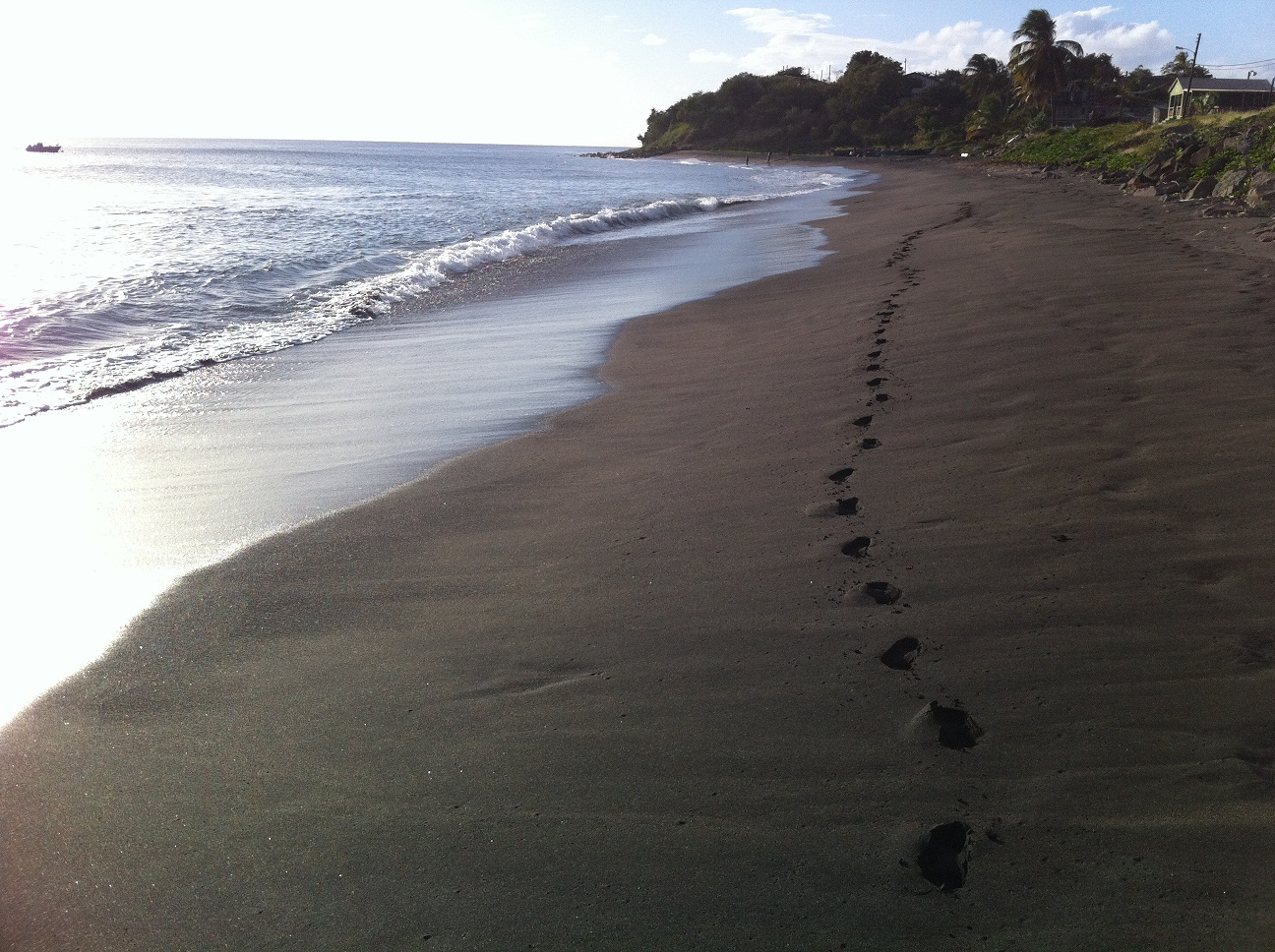
Beaches, black sand beaches near volcanoes, white sand beaches as fine as flour, brown sand beaches with grains like undissolvable brown sugar, and pink beaches filled only with billions of little pink shells.

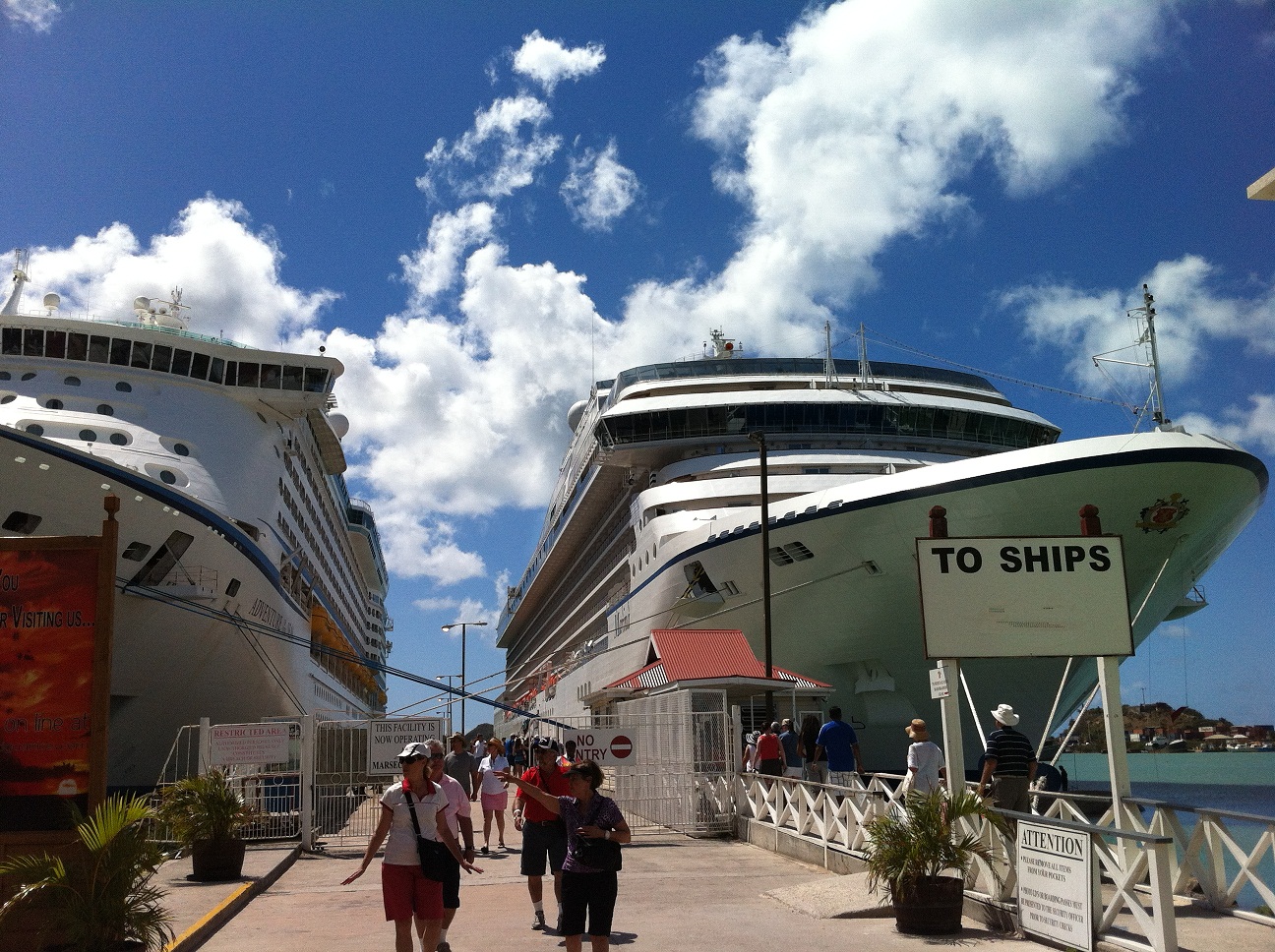
Cruise ships, polluting the port cities with thousands of tourists, sometimes 4 boats docked at a time. Battling through the city center for the 8 hours they were unleashed, buying jewelry and alcohol and overpriced souvenirs, and having to politely smile and explain you weren’t from a ship everytime someone asked ‘Which ship? or reminded you it was boarding time.

cruise ships in port, Antigua

Med Schools, med students and university campuses filled with Canadians and Americans who didn’t get accepted or couldn’t afford tuition in North America. And again, the questions ‘What semester are you?’ and the confused look on peoples faces when you insisted you were just visiting and not studying.

Stray dogs, everywhere, of all sizes, colours, shapes and health. In the French Islands, there were purse dogs and living teddybears who managed to become the chosen ones with homes and owners, which only struck me as weird given the animal abuse the rest of the dogs (some, just as cute) had to bear. I saw some sickly looking dogs, one with its ear cut off by a machete, and even harmless dogs snoozing in the street had to get up once in a while to dodge the cruel drivers who purposely tried to swerve towards them.

Stray roosters and scratching hens with a row of scraggly chicks in tow. And then the lucky roosters strong and healthy enough to become fighting cocks, treated like princes by their gambling owners.

Honking, by every bus driver, taxi, private car and motorcycle, as a means to communicate just about anything – hello, thank you, goodbye, get out of the way, or learn how to drive. So the streets were always singing in a chorus of honks.

Accents, sweet, sing-song accents of creole and patois with humorous vocabulary, unrecognizable slang and unusual ways of constructing sentences and tensing verbs. It was always so charming to see a latin lady speak Islander, a blonde guy speak Spanish, a Rasta speak American English, and children speaking Parisian French that I thought only mature adults could pull off.

black sand beach in St. Kitts


Island time. Schedules or opening hours are just suggestions, things happen slower, you can’t rush anyone no matter how hard you try, and the apparent disrespect for time is universal so you become the disrespectful one if you don’t have the time to wait. And people wait, and wait… and wait, sitting around with nothing to do but watch other people do nothing.

Status Update

I just arrived in St. Croix, USVI, on a one way ticket with nowhere to be til mid April. My college roomate and best friend Ursula spent the last week with me getting into all sorts of trouble.

We met nearly everyone on the island in a matter of a few days, and made it to St. John for a couple days. Then we visited St. Thomas for a few days where I investigated my grandfathers’ life and history that I had never known. He was born in 1921, his middle name was Archibald, and he was a quarter black. That makes me a sixteenth black and I have 5 other aunties I know nothing about, much less their children, my cousins.

My 25th birthday was on Sunday and we rang it in at midnight on Saturday with a big bang. I had a boneless chicken-stuffed roti for dinner at Singhs restaurant in Christiansted, and Mr. Singh himself came to The Courtyard club at midnight to buy us a birthday drink after treating us to oxtail and doubles for dessert. The Courtyard owner did the same, and invited us out for a boat cruise, snorkel tour and unlimited rum punch the next morning. So I turned a-quarter-of-a-century with a big fat smile on my face.

I was anxiously awaiting my Phd interview results from Copenhagen and just got my rejection letter about 45 mins ago. I placed 14th out of 22 interviewees in which only the first 11 were offered paid research positions. Im a little disappointed, to make an understatement, and now have no idea what my plan or purpose is for the next 3 years. I just spent half an hour talking to a corrections officer/ dog trainer who has been been to jail 3 times in 3 different countries, and he’s convinced me that life isnt a bowl of cherries all the time, so Im gonna chew up this sour grape and spit out some wine.

Cheers 🙂

10 Important things that travel has taught me

1.) Time Management: I´ve learned how to guess what time is by looking at the sun; I figured out flights don´t wait for you if you´re late, and they´re expensive to re-book; and seeing Rome in 3 days is impossible, so save sleep for some other time

2.) Math Skills: different numeric systems and currency values have made me good at calculating exchange rates off the top of my head, as well as translating Celsius to Fahrenheit, kilos to pounds, cm´s to inches, km´s to miles, and using a 24 hour clock instead of this am/pm business.

3.) Lower your hygiene standards – shower less, drink dirty water, eat street food, and poop in poopy holes in the ground. Your immunity just gets stronger, and you´ll realize you’re less susceptible to contagious diseases or an upset stomach.

4.) When your pee smells bad, you’re dehydrated. Drink more dirty water.

5.) Have incredible patience and tolerance for things that, in any other situation, would be crazy and cause for incredible alarm.

6.) Pack less stuff. The more luggage you have, the more your material world starts to weigh down on you, figuratively and literally. You start to realize you have too much, need much less, and that your back freaking hurts.

7.) Leave your guide book at home; you´ll just end up going, eating and staying at the exact same places as every other backpacker does. And, by the time its published, its outdated anyway.

8.) If you´re really brave, leave your map at home too. You´ll realize how strong and reliable your sense of direction has become. Besides, its more fun getting lost in strange places than in a place where you´re supposed to know where you are or where you´re going.

9.) Don´t get stuck behind your camera lens. Its much more impressive to stare at the Pyramids of Giza with your own two eyes than through a viewfinder or 2 inch LCD screen.

10.) You´ll always run out of time and money before you´re ready to go back home, so embrace homesickness as a good sign that you´ve managed to stay traveling long enough not to run out of either, and keep on going til you do!

How to speak Italian

I didn’t manage to learn Italian in 2 weeks, but I did try and disguise my Spanish to sound Italian-ish. I learned quickly that Spanish does work somewhat, and works even better if you wave your arms and use your hands a lot. Italian is more body language than spoken language, especially in Naples, where I felt conversations could be muted and still completely understood if you just watched.

I had this image of loud Italian women yelling at eachother across the street, perched up in their balconies laden with clothes-lines full of colourful clothes. I first arrived in Milan, where they have a municipal by-law against clothes lines on your balcony, so I didn’t see it there. The streets were also full of loud traffic, and the city center had mostly business and commercial offices filling the buildings. But in Naples, the historical city center is mostly apartments, full of this scene – narrow streets that you look down and see balcony after balcony with clothes that must never dry. In the morning and the evening, bickering ladies come out and yell, waving their arms a lot, and it always sounds like they’re arguing, but I’ve been told they’re saying very affectionate things.

The little streets, which I would have gotten totally lost in if I wasn’t following my Napolitan host, ring with the sound of scooters, driving just a little too fast and taking every corner and overpass just a little too close. Noone wears a helmet, and sometimes 3 adults squeeze onto one seat, bottoming out on every big cobblestone. You yell in Italian, with your hands, while youre driving too, which made me slightly uncomfortable when I was the passenger. Luckily my friend Adriano didn’t have a scooter, but while driving his hatchback, would let go of the steering wheel and flail his arms around, yelling something at everyone that cut him off. Even though the windows were shut and no one could hear him, they could see him, and thus, message communicated.

I picked up some pointers on speaking Italian with your hands and figured this much out: always move your arms about, even if you’re talking on the phone and the other person cant see you; move your hands in straight lines, up and down, or left to right; switch between having your palm faced upward or downward, but keep you fingers frayed; roll your forearms around eachother alot. To make a point, pout your middle and index finger to your thumb and shake your hand infront of your chest. If your boasting, tilt your head back, jut your jaw out and puff your chest up pompously. Tilt your head up and jut your jaw out while nodding your head if you agree with someone. Tilt your head up and jut your jaw out and shake your head if you disagree with someone, and if you have something to say to correct them, shut them up by grabbing their hands – since they can’t keep talking if you stop their hands from moving. If you want to make them stop talking a little more politely, or make your point more poignant, put the back of your hand on their chest and push a little til they stop.

The most important thing was to smile and laugh a lot, touch eachothers hands and arms a lot, and never stop communicating with your hands since they wont hear you if youre just talking with your lips… atleast they’ll stop listening or understanding you, whether or not you’re actually speaking Italian.

Thinking about German in Switzerland

German-speaking Europe is a confusing place. There are so many dialects of German that some German speaking people don’t even understand eachother. Some German words have only one vowel per six consonants, twisting your tongue in werid ways as you try to pronounce it (ie. Dirndls, schloss) The German word for “Austria” looks more like “ostrich” than Austria. English and Icelandic help me understand a lot, but I’ve been wishing I could speak more German– high German, low German, Bavarian Dialect – I don’t care which version.

The slopes in Flims

Switzerland doesn’t use euros, and their Swiss Franc is illogically abbreviated as CHF. Well, the “F” makes sense, but CH stands for “confederazione Hervatica” (which I now know is recognized as the mother of Switzerland). I like the way Swiss German sounds, it’s somehow softer and sweeter to the ear. I stayed with a friend, Ursina, in Flims, a picturesque ski town in the middle of the Alps, and in this region of Switzerland they have another official language called Romanish. It’s the closest language relative to Latin, and it sounds like old Italian poetry being recited.

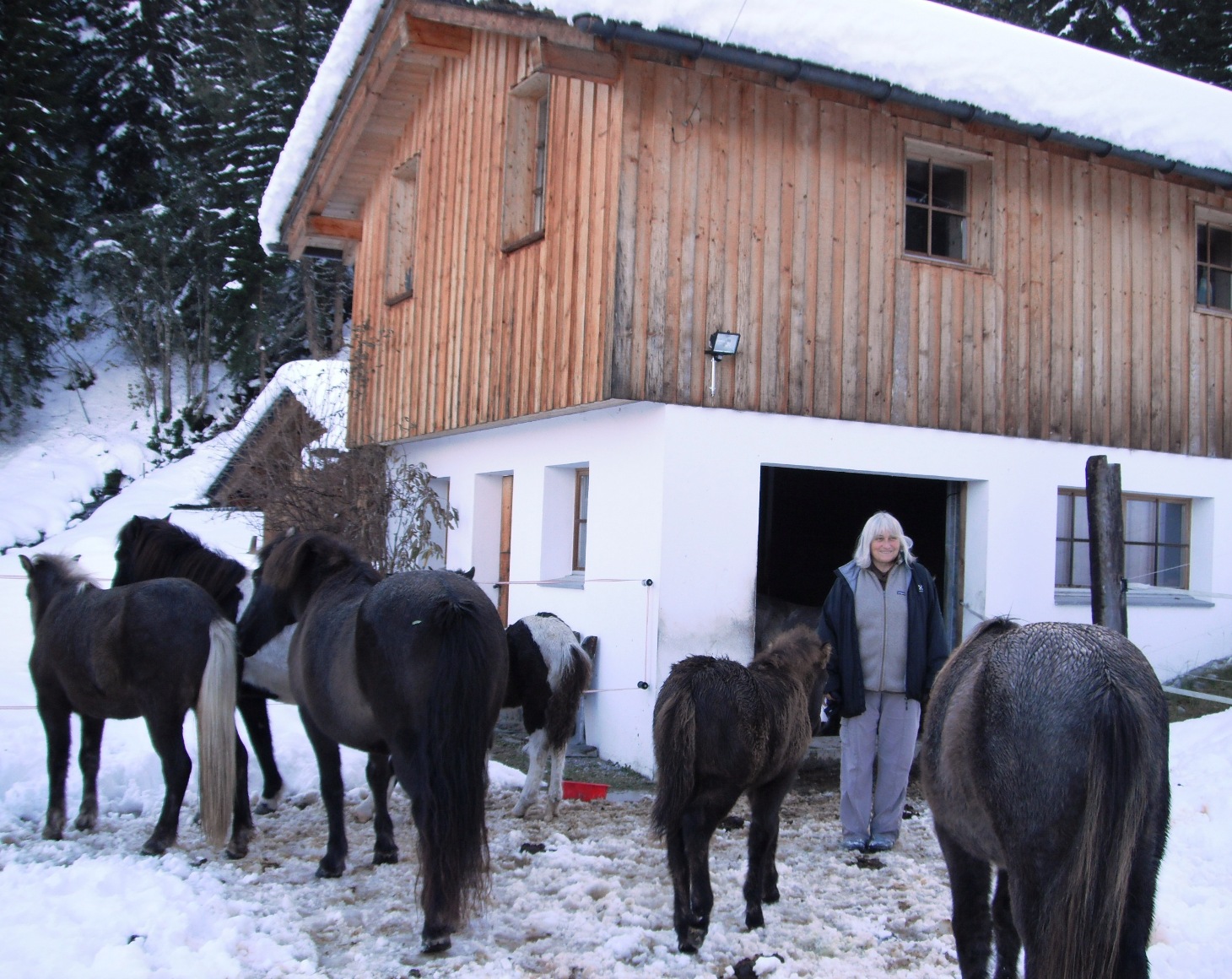
Ursina's mom with their Icelandic horses

Her family, the Isenbugels, is well known in Iceland because of their contribution and involvement with Icelandic horses. I visited her parents in their mountain hut near Laax, which we had to hike half an hour past ski lifts and through 2 feet of snow to get to. They had Icelandic horses there, mostly young yearlings and new foals with their mothers, and an Icelandic dog. Her father, who has eyebrows growing out like bangs, spoke English and some Icelandic. Her mother speaks Romanish, and also German with an accent I found easiest to understand.

I went with Ursina to her sisters Icelandic horse stable near Zurich, where we rode horses into the night. Gallopping through a forest without seeing anything was an adrenaline rush I hadn’t before

Zurich

experienced. I would love do it again, but Iceland lacks forests, and it doesn’t really get dark in June or July when Im riding most.

my horse, almost invisible in the black background

Everything in Switzerland costs more, even though you can drive quickly and easily past the German, Austrian or Italian border to buy the same thing for less. The doner kebab trumps McDonalds and Burger King combined as the king of fast food, and I’ve been using it as a base price economy marker. In Berlin, you can get one for €1.50. In Munich, €3.50. Vienna, around €4, and in Zurich, it costs as much as €8 for the exact same thing.

But I guess prices are all relative, to the people’s standard of living and places’ economy. What really puzzles me is how wine can be cheaper than water, and beer, almost always cheaper than coke. If only Iceland could pick up on that trend.


What do I do?

I dislike the question “What do you do?” very much since I don’t really have an answer. Well, I have the long-winded response, since I like to do a lot and only for short periods of time. But I don’t really do any one thing, in the way people expect you to answer with a professional title or a job description. I get slightly hung up on customs forms every time I have to fill one out when entering a country, since the question “Occupation:” only has one line for you to answer. I kept writing “student” many months after I graduated, but realized I had to stop doing that now that I have no university to call home. Writing “unemployed” always got me into trouble, since the customs agents would drill me for an answer on how I funded all this travel, with pages of passport stamps working against me to prove I’m actually quite broke. It took me a while to embrace the “writer” identity, since being a writer by profession usually means you can make a living out of it, and my blog certainly doesn’t pay all my travel bills. But, it’s been working a bit better for me lately as I’ve realized most travel writers are also just starving writers writing for the sake of writing, traveling with money made from other side jobs.

My “side” job is at a Radisson Hotel in Reykjavik, working in the food and beverage department for a reasonable hourly wage. I enjoy doing this, since I meet a lot of tourists, and also get to work with food and drinks – two of my most favourite indulgences. The horse-rider identity hasn’t really been a profession until recently, since I’m now getting paid to do some types of riding and that just seems completely ridiculous to me – getting paid to ride has to be every horse person’s dream job! Horse back riding is like therapy for me, I would pay to do it, but instead the system is working in my favour. There is actually a lot of work to be done, both in tourism and farming, where riders get rewarded for this incredibly fun hobby which happens to also be a valuable skill.

The question “What do you do?” is too presumptuous, since it assumes you do something for work. Why can’t life be all play and no work? I try and avoid doing anything displeasurable, especially for work, since selling time for money never seemed to make sense, no matter how much money it is. I’d rather sell skills or knowledge, something valuable that I’ve paid to get. I’ve spent a lot of time, money and energy going to school, but not because I want to work in the field I studied, but simply for the sake of education itself. I finished my master’s a year ago and haven’t applied for a job yet, and the thought crossed my mind that I’m eligible for unemployment benefits, but only because the socialistic system in Iceland is too skewed for catering to lazy people. Getting a master’s in environmental science/tourism was just a silly mistake in the first place if I was looking for a job in tourism that required a graduate degree. Maybe one day all this over-education and travel can surmount to me being some sort of life-style advisor, teaching people how to work less, play more and learn unconventionally. I think this is a bit far-fetched, but there are actually people whose ‘professions’ are ‘life-coach’ – sounds almost as weird as ‘horse-rider.’

So, so far I’ve kind of established I’m an unemployed, writing, riding Master of Tourism, but I’m mostly just a traveling, nomadic, cosmopolitan. Sometimes I feel that I’m a fulltime friend, since my social life seems to take up all my time, and most of my travel revolves around visiting people scattered about from all sorts of different places. I’m also a dancer, a musician, an artist, a retired (or fired, rather) actress/model, and a philosopher by way of education (my BA). These identities transition in and out of my life as the years pass, and sometimes I try to reinvent them with slight morphosis. I’ve been a pianist for many years, studying and competing as one, but the life of a concert pianist didn’t appeal to me as much as learning the guitar for a while, and most recently, the violin (which I’ve yet to learn anything more than Twinkle Twinkle Little Star). Currently, Im transitioning from my ‘hestakona’ (horsewoman) identity back to backpacker, and to ease through the stage I’m experiencing what’s called the ‘post-ironic Fleetwood Mac appreciation stage.’ This is something my hunter friends have identified as the uncontrollable tendency to listen to the Fleetwood Mac Rumors cd over and over and over without getting sick of it.

So, if I do nothing, similar to those customs agents, you may still be wondering how I afford to finance my travels. The trick is just to travel for long periods of time in places where the cost of living is cheaper. Then you’ll sympathize with me how expensive it is to to stay in Iceland or Canada, since life just costs too much. Then, the question should be, how can I afford not to travel!?

LOLA: look, observe, learn, act.

September 11th came and went without any major catastrophes, although I didn’t even realize what day it was until I started writing this blog. I’ve often wondered why it’s worth spending any energy worrying about tomorrow when you’ve got today, and if you’ve got today and it’s going just fine, stay in the present and keep on keepin’ on. Of course this philosophy is good in theory, but it’s hard not to worry about the future and I often find myself stressing out about tomorrow, next week, next month, next year…

I like to think Im good and avoiding long-term planning, since Im certainly terrible at commitment and thrive for spontaneity. When I was doing a Semester at Sea, an undergrad exchange program that sails around the world, the motto was LOLA: look, observe, learn, act. The students, almost all Americans, were persuaded to try and travel with new eyes, focusing on the there and now, absorbing as much detail and life out of the present situation as possible. It was an interesting experiment, forcing our planning-oriented selves to exercise reckless abandonment, not worrying about our next move until we understood the present.

When traveling, I often get lost in time and place. I wake up after a long bus ride and try to remember where I am. Once I get a grip on that, I don’t bother to remember where I’ve come from or where Im going next, and I almost never think about what day of the week it is. Trying to remember what month it is is usually harder than remembering what year it is, but I often start dating blog entries with 200_ and realize its already 2011. People have asked my age, and I stutter “ugh, 23,” until a few moments later I disrupt the new topic of conversation with “no, I’m 24!”

What is time anyway? I think its just a way for people to synchronize with other people, for places to synchronize with the rest of the world, and keep a framework to which we can make plans for the future. Yet somehow, plans change but time keeps ticking, and it seems to speed up the older you get, the longer you live.

I was supposed to be moving to Montpellier, France in a couple weeks, but matters of the heart changed and now, one lonely French-American is living my dream life without me. I wanted to paint, play music, eat baguettes and cheese and chocolate, drink wine and ride a bicycle in a flowy dress, while never getting fat and only speaking french… but that will have to wait til later.

Have you ever looked at your own eyelashes? In that moment of being half awake, or when avoiding the bright rays of sun? I daydream a lot, sometimes consciously, and other times, in that surreal moment between being asleep and waking up when you’re not sure if your dreaming or living. Then it’s a bit awkward trying to separate your dreams from reality, especially the ones you’re never really sure if you dreamt them or lived them.

Im sitting in the sun now, sweating, squinching my eyes from the sunshine, checking out my eyelashes. Its almost 20 degrees in Reykjavik and I can see myself getting browner. I heard the wing flap of a raven flying high overhead, since its so completely still and silent here that the sound of me typing sounds like noise pollution.

Now I know what day it is, where I am and what I’m doing tomorrow, but I can’t wait to be alone on the road again, with my 35L backpack, lost in time and wondering where I am everytime I wake up in a new, unfamiliar place.

East Africa Travel Advice: how to normalize

Learn to squat for hole-in-the-ground toilets, and always carry toilet paper.

Exercise patience (people talk and work very slowly), and learn to talk and do things slowly yourself.

If you’re going to Tanzania or Kenya, learn some Swahili. If you’re going to Burundi, Congo or Rwanda, learn a lot of French.

People speak quietly, unintelligibly even, so practice focused listening, and never yell or raise your voice to be better understood.

Expect variations on the English words used in different countires. For example, public tansport can be called either taxi, bus, matatu, or special car, but they all refer to slightly different things, ie. A mini-bus, a coach bus, a local bus or a private car. A hotel can refer to a bar, restaurant, or an actual hotel, and I haven’t quite worked out what hostel refers to since there’s lots of them, but the most hostel-looking hostels are usually called guesthouses or backpackers.

Be grammatically flexible: prepare for misspellings, ie. You’ll stay at a ‘resourt’ and buy meat at the ‘butcer,’ get used to different pronunciations, ie. Bon-shuu for bonjour, and some phrases like “hello” are often replied with wrong responses like “fine.” The internet is called “network,” as well as cell phone service, and  you won’t have either “network” in many places outside of urban areas. When you do have network, you’ll realize how much you took for granted the fast internet connections we’ve grown used to.

Bring a book to stay away from your ipod, and buy an unlocked cell phone from 2004 to avoid standing out with a fancy smart phone.

Passerby, independent travelers aren’t the norm yet; people will as where you live or work since East Africa is full of expats, so be prepared to explain your story of why you wanted to backpack through East Africa.

Be prepared for missionaries and their prophecies; many will ask if you are Christian, so either say you are with some evidence to back it up, or learn to enjoy spontaneous bible lessons. These can come from white, American Missionaries from Kentucky, or your bus driver from the Serengeti. Even the most indigenous tribes are often Christian, and Masai’s are often renamed at baptism, so get used to meeting a lot of James’ and John’s.

Throw your East Africa Lonely Planet out the window. The Africa shoestring book as more pages on the Congo and Burundi than the East African book (7 pages on Burundi, and 5 pages on the Congo, a country 40 times the size of Rwanda). My East Africa journey was the first solo-trip I’ve ever done without a guide, and although Frommers and Bradt may be ok, Id still say throw you guidebook out the window – facts and things are so variable and dynamic that by the time anything is published on prices or times or places, they’ve most likely changed, and one person’s recommendation for how, where, when or why to do anything is always different from anothers.

Embrace the beauty of chaos and revel in the disorganization of freedom. You can talk your way in or out of almost anything, remember that no never means no, and become friends with the hard working African mindset that anything can be done, either with enough time or money.

Get used to walking between countries, and always crossing two borders to get across. One to leave the country you’re in, and one to enter the county you’re going to, that will have a $25-100 visa payable only in US dollars.

For Rwanda, most countries need to preapply online for a visa, atleast 24 hours before you arrive. NOTE: this may only be true for a little while, or only true of some borders, but there is no way for me to confirm or deny what the real truth is since the transmission of knowledge seems to act like a skipping stone – only some are privy to the truth, others can only speculate what the next skip is as they sink out of sight. Most visas are around $50, and you can only pay with fresh, new US dollar bills. It’s a different year for each country, but I remember cut off mint dates being 2000, 2004 and 2006.

There’s supposed to be agreement between Uganda/Tanzania/Kenya to offer an informal East African Visa, but Ugandan authorities don’t seem to know anything about it and it only dismisses you from paying a single entry visa more than once while not having to preapply for a multi-entry visa when moving between Tanzania and Kenya. There is still rumor about an actual East Africa Visa among all the Lake Victoria bordering countries, but who knows if and when that will be available.

US Dollars in denominations of $5, $10 or $20 get worse exchange rates, about 25% less, than bills of $50 or $100. ATM’s often give you about 5% less than a cash exchange rate, so come with a lot of US cash, especially since ATMs aren’t so common anywhere but large towns or capital cities.

The entire country of Burundi is off the international banking grid, so no ATMs exist and you cannot use any type of debit or credit card.

I still cant remember straight, but some East African countries drive on the left, others on the right, and both right and left-hand drive cars are used in both environments so it gets very confusing if and when you’re on the wrong side of the road.

You can skip the malarone and other slightly-anti-malarial pills, but sleeping without a mosquito net is not ok- so bring your own for the hotels and homes you stay in that don’t have one. It won’t protect you from the sound of creepy, heavy crawlies around or under your bed, but it will keep small bugs from buzzing around your ears all night and biting up your forehead.

Theft is unusual, if there’s any chance of being caught, since stealing is a big deal, even punishable by death. There was an incidence where a farmer in Tanzania walked to Burundi and stole some cows, and 3 days later, had been found by the Burundian farmers and hacked to pieces with machetes, and another where a young man stole a motorbike, and once caught, was doused in fuel and burned to death, right in the middle of the street.

The buses will always say their leaving soon, but they aren’t. They’ll leave the engine idling so you believe they are, and despite high fuel costs, they make the sacrifice as a tactic to try and get the next passengers onboard, which will make their bus filled first, and thus, their bus leave first. If you ask how long a bus takes, seven people will tell you different times, and all will be telling you driving hours not including stops, or they’ll tell you the distance. Knowing the kilometers unfortunately doesn’t tell you anything, because it depends on the road quality, weather, type of car, and if they have to fill up on fuel or wait for a paid passenger after leaving the bus station.

You’ll miss mzungus, and at the sight of one, stop yourself from pointing/waving and yelling “MZUNGU!” like everyone else does to you since you start to think this is a normal reaction. Then when you do see one, you’ll feel strangely intruded, wondering “what are they doing here?” Other times youll feel relieved, have someone to talk to at a more familiar level.

Know you’ll be experience such intense sensory overload that you actually start becoming desensitized. One may also call this a normalization: Normality shifts, time slows, your reactions mellow, your hygiene standards vanish, your comfort boundary expands, and your tolerance for everything and anything increases. One may also call this transformation a rite of passage, since this is the one piece of advice that you can only really understand after having travelled through East Africa yourself.


East Africa so far

East Africa is worlds apart from South Africa, but strangely similar to parts of Central America, the Caribbean, or India. At times it seems I’ve been transported to Nicaragua; one-storey concrete homes are painted by Coca Cola and competing cell phone networks; rice and unidentifiable fried meat are staple; servitude is acceptable by hierarchical class distinctions reminiscent of the castes in India; and the chaos of road traffic and markets are just functioning in a different language by darker faces.  Reggae music creates the atmosphere of a Caribbean night as it blares from every street corner from the moment the town stirs awake at 7 am until the party stops in the wee hours of the following morning.

The biggest difference is the people: everyone here is unbelievably friendly and smiley! People always greet you and ask how you are, shake hands for a little too long and hug with extra rigor. Ive given up any notion of a personal bubble, since private space is invaded by almost anyone who talks to me; some latch onto my arm, stand within a few milimetres of me, and talk directly into my ear so close to my face that I cant actually turn to face them while they talk to me without knocking foreheads. Its only unfortunate when they have bad breath or you really do want to turn to face them to remember what they look like and you just cant.

People are genuinely interested in helping you, and will do so without expecting any sort of payment. Im not sure if its pity or curiousity, but the sight of a muzungu girl makes them think theres no way I’ll make it without their help, so everyone wants to know where Im going, do I know any Swahili, do I have a friend waiting for me, or what am I looking for. Upon giving an answer, it becomes their sole goal to help me find what, where or who I need and translate any language, directions, or pricing confusion.

Women wear beautifully colourful clothing, with elaborate pattern stamps in bright colours that shine in contrast to their dark skin. They’re quite modest, covering most of their body and head in wraps of cloth, and Ive learned that showing arms is ok, but leg-baring shorts causes me quite a bit of grief. That’s especially unfortunate since its so hot and Im constantly sweating through my jeans, and a little embarrassing since Ive seen few people break a sweat even in the most intense mid-day heat.

Its hot and dry here, with luscious green vegetation and red-mud huts covering all the rural areas. The dirt roads are bright red, contrasted dramatically by the green palms and crop fields. All the soil and spit up dust are also blood red, and it seems to keep most peoples clothes a little earthy coloured no matter how clean they are. Parts of Uganda and all of Rwanda are rolling, forever continuing hills, and almost every square foot of arable land is still exploited through terraced agriculture practice. When dirivng along the winding roads, its hard not to get car sick or frightened by the cliff-dropping heights, but the beautiful symmetry of the perfectly groomed hillsides makes for a very geometric scenery to enjoy.

I’ve decided to bus my way around East Africa, mostly to save money, but also to avoid the high end tourism market catered to with chartered flights. Terrestrial travel lets you see so much more, take in a scenic drive for hours instead of staring at the tops of clouds for 45 minutes. Traveling by bus is also better for the mind and body – it gives you time to adjust the changes in altitude, temperature, humidity, and the brain has more time to process its surroundings and sensual bombardment.

On most buses its impossible to sleep, and if you do, people immediately worry “are you feeling sick?” Preoccupying your conscious mind for 3 or 6 hours can either lead you to some new friends or some crazy ideas. Bus travel is supposed to be fairly safe, but I often get snapped out of my daydreams by an abrupt road block, since police checks are regular and they’ve always got important questions to ask. I can never understand what goes on, but their dialogue interchange is usually stern, slow, and results in an exasperated bus driver raising his voice and gesturing his hands in way that means to me “whatever, sorry, Ive got nothing!” Maybe their asking for registration papers, maybe a bribe, maybe illegal drugs… I’m not sure.

The buses have been less than luxurious, mostly due to overcrowding, but also an unshakeable uneasiness from excessive speeding and bold overtaking driving habits. Im still the only non-east African on every bust Ive taken, and this could be a warning Im refusing to take notice of but I’ll keep believing I truly enjoy the excitement and entertainment of each ride. I’ve had half-dead chickens in a box beside me, a 10L jug of water splashing at my feet, and a 5 kg bag of flour explode ontop of me. Most buses have assigned seating, but the taxi cars and mini-buses usually have two people per seat and a few more standing in between or shoved in the trunk. I’ve had children refuse to sit beside me, even though women plop them on my lap when they’ve got too many to fit on their own. Im not sure if they’re afraid or too shy, but other children can’t get enough of me as they grip at my skin to make sure Im real.