More on Ugandan Travel

I find it fun to get off the beaten track, or atleast avoid the tourist trail by taking local transport. So far Ive been the only non-east African on every bust Ive taken. Im also always the only person with a backpack, even on the 5 hour rides accross the country where the most people are carrying is a days worth of crops. When they do have something to carry and no bus to shuffle them to and fro, people hoist their possessions ontop of their heads, and I see people walking along the side of the roads in some of the most remote areas, at all times of day and even night.

In the mid heat of the day, its not unusual to see a 5 year old carrying something that’s probably bigger, heavier or longer than them, strolling along the side of a highway. Women carry huge reeds and stick piles on their heads, as well as buckets full of water that must weigh a ton. They carry suitcases, mattresses, upturned tables, watermelons and raw fish, some for sale and others to take home. Sometimes two share the load and carry 5 meter tree trunks on a shoulder each, to who knows where or even from where.

It seems most people walk everywhere, no matter how far, since horses, donkeys, camels, or even the wheel aren’t common labour aids. And sadly, they use the roads built for those rich enough to afford cars, buses or bikes, which proves to be quite dangerous since they usually have no sidewalks; car accidents hitting pedestrians are one of the leading causes of fatal accidents on the road.

The trees are probably being cut down for burning, since one environmental issue in Uganda is deforestation from dependency on coal. Coal is sold in bags on the side of the road, fairly cheaply, and as soon as nightfall hits, the smell of burning coals hits your nose from every direction. Families are using it to cook delicious food, boil water to drink and bathe, as a source of light and sometimes for heat.

There is amazing tilapia fish from Lake Victoria that you can buy fried as street food. Ethiopian food is also popular in Uganda and its so delicious and affordable. Local food almost always consists of matoke (mashed plantains, which they always call bananas), cassava, posho (a food staple made of maize flour) and rolex – a breakfast wrap made of eggs with a kind of chapatti bread feel. They have mini-bananas here, that are much sweeter than regular bananas, and eating them is more fun – although for one bite some get impatient to peel them, like my bus driver who just put them back, peel and all, in one big bite.

Being a former British colony, they also sell ginger beer, and the local beers are Nile Special, Bell and Club – all available for about $1USD per 500ml bottle. They apparently have Ugandan wine, which I haven’t tried in suspicion that its terrible, and a millet-based alcohol called Waragi that smells like gin.

One of the official languages here is English but not everyone is as comfortable in it as Luganda, the most widely spoken Ugandan language. But there are so many other dialects, sometimes totally unrelated, and its normal for people to speak 5 or 6 languages according to what languages nearby tribes speak.

Theres quite a Sudanese presence in Uganda, since the border they share is slowly getting safer after South Sudan declared independence from Sudan. They speak and dress quite differently, and are not to be confused with all the Indian decent locals who came to Uganda during British rule as labourers. There’s still some racist tension between the two groups, even though both are born and raised Ugandans.

Its been interesting to travel around here as a solo muzungu, and I certainly get a lot of strange stares. Sometimes people seem to think absolutely nothing at all, but just stop to stare to take in the strange sight. Other times, they’re inquisitively checking me out, from head to toe, wondering what the heck Im doing all alone, where Im from, and maybe what Im thinking. Meanwhile, Im noticing their gaze, and glancing back at the stares, wondering what they’re thinking, and I realize its just circular curiosity – we’re both just wondering what the other is thinking, equally baffled by what we’re seeing.
Lost in Translation

When I was a child growing up in Iceland, I spoke Icelandic, perfectly and fluently. Then at age 8, after moving to Canada, I almost failed grade 2 because I couldn’t understand why noone would respond to my Icelandic. I eventually spoke english well enough to be comfortable speaking only English, but then forgot all my Icelandic. Then I learned french, a lot of French – one of the perks of emigrating to a bilingual country. I studied abroad, in France and Australia, majored in English, and came out a pretty good bilingual Canadian.

My first, biggest, (quasi) solo travel experience was participating in a 100-day circumnavigation of the world, peetering around the equator on the MV Explorer with 600 other students. The program is called Semester at Sea, and for anyone who has done it or is considering doing it, just know that it will either make you an OCD travel addict or, leave you feeling like you never need to travel again. The former happened to me, so the following summer I embarked on my first, true backpacking trip through South America and the Caribbean for 2 months. The two summers after that I also spent backpacking in South America, so then I learned Spanish. First, it was just travel-survival Spanish, but eventually, I started thinking in Spanish and forgetting my French, even English at times.

Then to make matters even worse, I decided to move back to Iceland in 2008, which was when I realized I’d have to relearn Icelandic. Three years later, Ive only spent a total of 11 months actually in Iceland, in chunks of a few weeks or months here and there, so its coming together, but falls apart every time I go to  a French or Spanish speaking country and my second-language confidence switches between the three. Worst of all, the longer I spend trying to sort out my secondary languages, my english deteriorates, and my handle on the language fluctuates from good to satisfactory, then back to okay. Good friends of mine know this as “Katrin-speak,” and even speak it fluently, since I regularily mix up my syntax, make up words, and switch between languages in a way that they’re used to.

Now, Ive had my first full year away from University, and if it wasn’t for reading and writing in English, Im not sure what would happen to my ‘first’ or ‘strongest’ language. My family in Canada tells me I speak English with an Icelandic accent, Icelanders tell me I speak good Icelandic for a foreigner, and everywhere else people wonder where Im from, and when I answer Iceland, compliment my English for being so strong. This used to go unnoticed, but before I considered it a compliment, realized that the flattery is only intended by those who believe I am an ESL speaker.

So, I clearly have a language identity issue. Now, to make things more interesting, I have a cultural identity issue on top of all this, maybe stemming from the first problem, or perhaps reconfirming it. I’m an Icelandic born, Canadian raised, (soon-to-be) triple-passport holding daughter of a Guyanese mother, and Ive spent more time traveling than staying in any one place for the last three years. In North America, people think I look native American, so when I tell people I’m from Iceland, they picture some northern/Greenlandic indigenous group that I’m most likely descendant from. I only correct them half the time, since when questioned by an Icelander, “Where are you from?” I say Canada, and they probably picture very similar looking native North American ancestors.

Elsewhere, people think I look latin or middle eastern, but in Latin America they call me gringa and in Egypt, a “white” person, which Ive come to learn is a generic term meaning “rich westerner.” When people notice I look darker than most “white” people, I accredit my tanned skin to my mother, who’s from Guyana. “Ghana?” some ask, “No, GUYana” I respond. Then a short pause is followed by “Oh, Guinea!” and again I say, “No, GUY-ANA.” Then to save face, they dismiss their total confusion by asking “what part of Africa is that?” at which point I have to explain its actually in South America, that its not French Guiana, and then ask whether or not they really thought I look African. If so, then I’ve got a real identity problem; one can’t really look ‘African’ since the term only correctly refers to someone who lives in Africa, and the continent encompasses such a diverse and complex mix (of millions) of people, including those infamous ‘whites.’

Identifying with India

My grandmother on my moms side is actually 100% descended from Indian blood. This is a short story I wrote after my first visit to India, in 2006. Things haven’t changed much.

_________________________________________________________

Here I am in the motherland. I am here for only one-hundred-and-nine hours, and that isn’t near enough time to absorb any of this country. I have been forewarned that India is so ugly, I’ll love it. I am surrounded by poverty and disgusted by filth, but there really is something so charming about the discomforts I feel. My experiences are only skin deep, my five senses bombarded, and I have yet to recover from the initial shock. After a while my mind overloads and sensations stop registering at all. This is when I close my eyes, inhale, exhale, and start over, just to feel again.

*                                  *                                  *

I am here in India surrounded by chocolate-colored faces that look wise and worn with crusted Hindi dots between their eyes. Heads like coffee-beans float comedically in their bobble-head shakes, but I have yet to figure out what the nod really means. All the women wear saris, each a different shade of the rainbow adorned with some form of sparkly trim. In Jaipur, the row of markets are equally dazzling in their broad array of bright colors, but when I get closer, I notice the thin film of dirt and dust covering all the items, even the shop owners.

Maneuvering through the streets is a constant struggle. I am easily side tracked by the large array of vehicles encircling me, perplexed at how camels, donkey-carts, 3-wheeled yellow rickshaws, cars, motorcycles and pedestrians can share the road in an organized way. When I think it may be safer to take a rickshaw, I’m nauseated at the abrupt stop/go braking and the last minute diversions from holy cows interrupting our path.

I try doubly hard to enjoy the tourist attractions while tourist-hungry locals intrude on  my peace. At the Taj Mahal in Agra, I give the same cold reaction to middle-aged men elbowing me in the breast trying to sell jingling anklets as I do little children tugging on my sides with the fingertips of one hand moving frantically from their lips to their stomach and back.

My senses again go into overdrive. Not even my imagination is flexible enough to understand the bewildering chaos around me. Blink, inhale, exhale, restart.

*                                  *                                  *

India is hot and sunny, with a beautiful coast line framing the south east city of Chennai. I dare not get too close and ruin the beauty and magic I believe to still exist there, but make sure to visit the beach late one night when everything is safely hidden in a blanket of blackness. I run barefoot across the sand that feels like cold diamonds under my soles and frolic in the shallow wake of the Indian Ocean that I am equally hesitant to see in the light of day. The wave sends a cold chill up my legs that is convincingly refreshing, so I chose not to think about how dirty I know the water really is.

The air in India is a sticky humid like sitting in the backseat of a car with no air-conditioning all day. It tastes like a lung full of carbon monoxide laden with piss and curry. My ears constantly ring with the sound of traffic and the occasional attacks in Hindi and Tamil for food, taxis, or just plain old hand-outs.  Cow shit and garbage blanket the curbs and walkways in a grandeur way, acting as a red carpet walkway for the locals to strut. The streets transform overnight into a large, never ending mattress as the homeless make beds of the concrete. Once the sun breaks, individuals claim parts of the sidewalk as private kitchens or public bathrooms, depending on which corner they wake up on.

Back at my hotel in New Delhi, my cold shower in a bathtub stolen from a spider is the only escape from the suffocating uncleanliness surrounding me. I feel like now I can finally breathe as more and more water streams over my face, down my body, eyes clenched shut.

*                                  *                                  *

The chaos and discomforts are so intense that they invigorate an awakened consciousness within me. I am enamored by all the overwhelming sensations because I have never felt more alive. By the time that I return to my temporary home on the MV Explorer, I’m exhausted.  I have forfeited any attempts to separate my memories, and given up trying to make sense of them. India has become one large sensual blur and I’ve left mentally dysfunctional.

*                                  *                                  *

The chaotic scramble across the country had plummeted my mind and body into thirty-six hours of unconscious recovery. I did not even leave my room to eat; I only woke to use the bathroom. I left India with an upset stomach, a high fever, orange stained henna across my hands and a complicated confusion mildly augmented by the few drinks I had had that last night. I truly had no understanding of what it meant to be part Indian until visiting India and experiencing the culture firsthand. Although I was not fully prepared for the intensity of India, I learned to find the beauty hidden within the layers of dirt and poverty. Even after being hurled into extreme culture shock, I could learn to love this place. As much as I wanted to leave and never return, there is an unconditional love that I have for my heritage that has maintained my affection for India. It’s in my blood, it’s part of who I am, staring me straight in the eyes, slapping me upside the head in a painful reality. Blink, inhale, exhale…

This is my heritage, this is my identity. I loved it as much as I hated it.

Miami in Transit

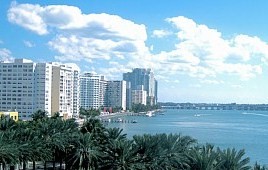
To start my 2 week journey back to Iceland, I flew from Cancun to Miami, which I had never considered that similar, but they definitely gave me a familiar feeling. The downtown area and beautiful beaches could verywell have been side by side, and the only real reminder I was in the USA was the big, multi-lane highways covered in shiny, new cars and oversized SUV´s. The Miami airport was almost totally employed by Spanish speakers, and even when I got to South Beach, many were still speaking Spanish. I just resorted to asking questions to retailers and bus drivers in Spanish again, and that went flawlessly. Different to the rest of Central America, people actually thought I was latina, so people assumed speaking to me in spanish was totally normal. I guess I wasn´t that far off from being confused at how everyone knew I was a gringa during my trip.

definitely one instance of "window-weather," as we say often in Iceland where it's actually common

Miami beach was shockingly cold, so even though Mexico hadn´t been that warm, sitting and starting out at the Caribbean Ocean on one of the sunniest days with temperatures at 5° C was really hard to comprehend. It was like a postcard picture of everyone´s expectations for South Beach, but then totally deserted except for a few people dressed in winter clothes and seagulls hovering way to close for comfort since I was the only person with tortilla chips in my hands. 

I was wearing my 2 month old tattered clothes, jeans with holes in the legs, a summery shirt, and flip flops, so I certainly wasn´t prepared for the weather. I also wasn´t dressed for walking around Lincoln Road Mall, since everyone was super hipster, fashion savy and dressed to kill, some even appropiately warm for the weather – I didn’t know Floridans (Floridians?) had winter fashion. I decided to go into a clothing store and buy an entire new outfit, and came out, successfully, with new boots, jeans, a sweater, a scarf, and a faux-leather jacket. I left my old outfit on the top of a garbage can, just incase anyone would have any use for it.

Memorable Impressions of Central America

I found it weird that Christmas was in full swing the minute after Halloween ended, and also weird that Halloween was any occasion in the first place. I didn’t see any trick or treaters, but I did crash a family Halloween party in Panama city with a lot of orange and black decorations and a dalmation dog wearing pumpkin lights. Christmas songs have been playing on the radio and Christmas lights have been on sale in the markets for all of November, and I guess that might have something to do with the fact that they don’t celebrate Thanksgiving or Rememberance day between the two holidays.  

I had to get used to the fact that a lot of men just carry around machetes strapped to their belts, both in town and in the lonely countrysides, occasionally convincing myself that they’re probably not used as weapons, just crop tools. Although it made me wish I carried around some functionable item that doubled as a weapon. My friend Jeff in San Jose, Costa Rica, lent me his umbrella one day that did just that, but they’re just to big and clumsy to travel with. Maybe they make sweet smelling pepper spray that can double as deodorant? Someone should patent that.

for the best market finds, pay only in cash, with small bills (or coins). Across from this market in El Salvador Guy paid $0.02 to use the internet for 5 mins, so dont say pennies are useless

Having to function in a new currency and exchange rate every week was fun, trying to figure out all the coins and bills and actual values of them. In Honduras, their lowest paper bill was 1lempira, which is the equivalent of 5.3 American cents, and they had bills in denominations of 2, 5, 10, as well as 5, 10,and 25 cent coins!

One reoccurring problem I always had was that people hate accepting big bills or making change. It may have something to do with the fact that things cost next to nothing, but even if you were paying with a bill with the equivalent value of 2 euros, people would scratch at it and hold it up to a light to make sure it wasn’t fake before grumbling about having to give you change.

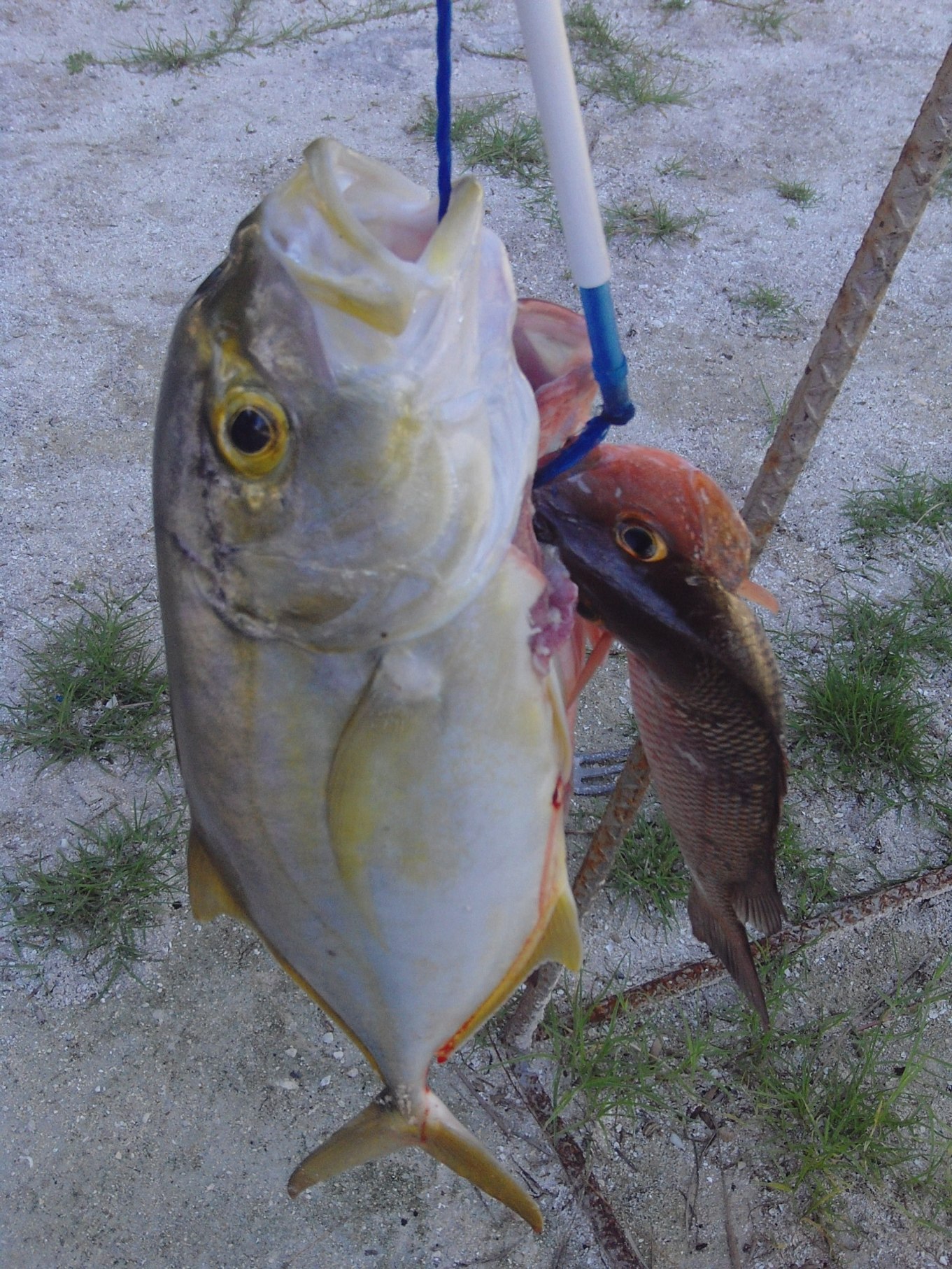
the one time you dont need cash for dinner is when you fish it yourself - these catches in Caye Caulker thus tasted even better

Cash seems to be the only way to go as well, with atm’s and banks nonexistent at borders, replaced by a bunch of businessy looking men strapped with the biggest wad of cash their hands can hold. I guess there’s no point in using VISA for $0.25 purchases, but then when you want to buy something expensive, the only way to get it at a reasonable price is to pay in cash or else they charge weird visa surcharges. To make sure I always get the haggling discount, I had to visit in ATM every week or so to minimize the amount of cash I had to carry around, and of course they only dispense big bills for big withdrawls. Shockingly though, one ATM in El Salvador dispensed $10, $5 and $1 US bills – $1 US bills out of an ATM!

Tongue Twisting Place names: An Excercise for your Spanish Pronounciation

I have to admit that all my memories of different places have sort of melded into one big impression of Central America. Even though each country has had its own quirks and isms, things kind of start to feel the same after a while. Not in a boring way, but in a  comforting, familiar type of way. As my spanish has improved I’ve also gotten more comfortable in all the new places, and a little bit more confident in my travels alone.

Every time I open my lonely planet Central America shoestrings book, I have to think for a second what chapter to open to because I can never remember what country I’m in. Trying to remember the name of the town I’m in would take even longer, but one can always rest assured that every single city has a parque central with an iglesia (or two or three) within walking distance, with all the things, information or amenities you could ever need all in one square.

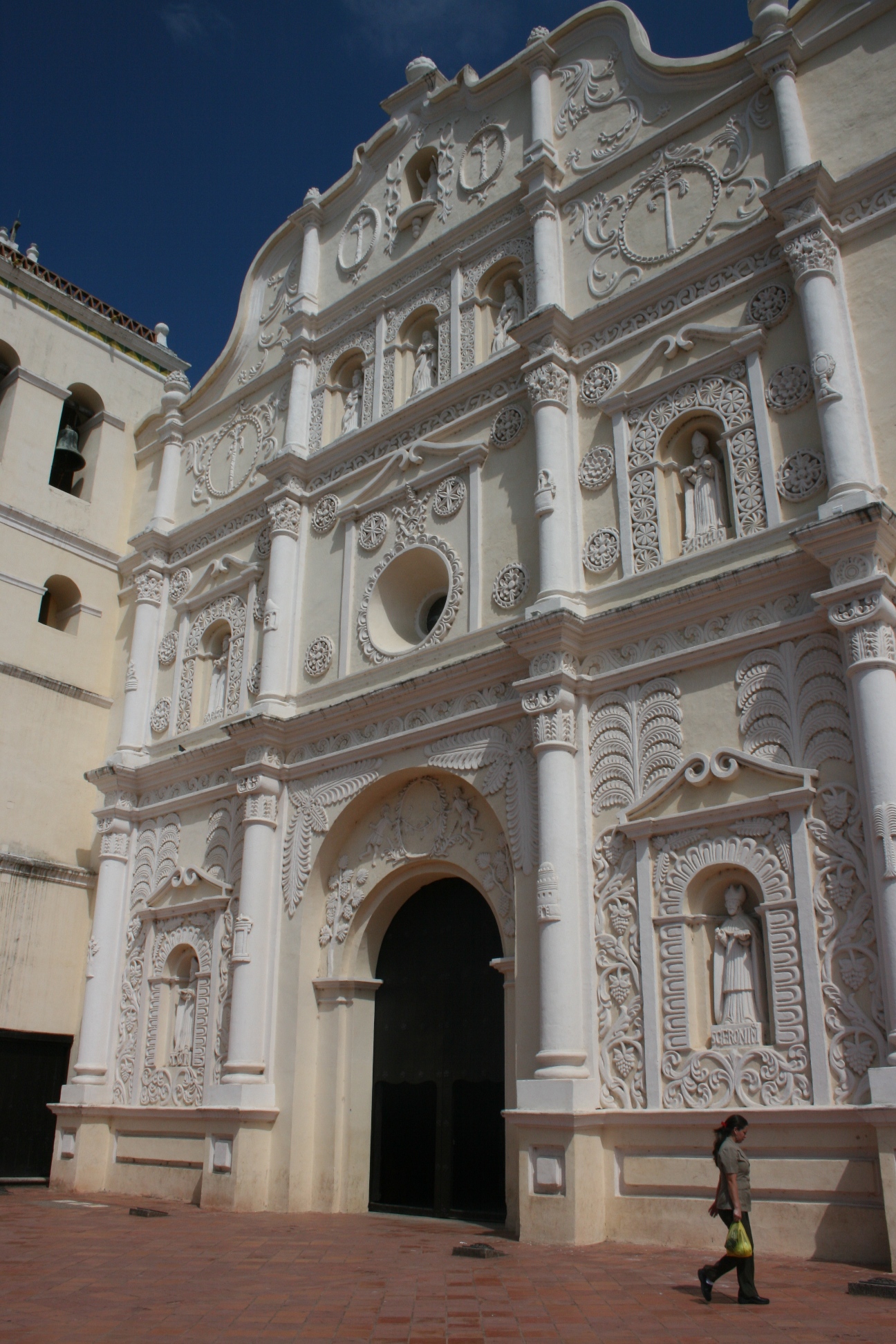
the main church in Comayagua's central park

Once I remember what town I’m in, spelling or pronouncing it is almost always an issue, especially in El Salvador when there was one day we went to Ataco, Apaneca, Ahuachapán and Juajúa all in one day with 5 different buses, and the only words I could think about to help me remember was ‘jube jubes’ and ‘a taco.’ Trying to say ‘jubejubes’ or ‘taco’ to the different bus drivers taking us around didn’t seem to help much, except put a big, confused smile on their face.

Tegucigalpa took some practice, but I still can’t say Quetzaltenango or Quetzaltepeque. Sometimes the same town existed twice or the names were so similar I almost ended up on the wrong bus headed in the totally opposite direction. Frankly, I can’t believe that hasn’t happened yet.

Every Latin American country seems to have an endless supply of town names beginning in San or Santa’s, like San Ignacio, Santa Maria, and every country so far has had a town called Agua Caliente. Towns beginning in ‘Ch’ were tricky in Guatemala because of cities like Chichicastenango, Chimaltenango (not Chalatenango in Honduras), and Chiquimula, not to be confused with neighbouring Chiquimulilla. Other tongue twisters included Huehuetenango, Cuauhtemoc and a bunch of towns beginning in the letter ‘X’ which I’m still not sure how to pronounce.

A floating house in San Pedro, one of the many San- towns, but not the same as San Pedro Sula

Each country has also had its own special Spanish accent or slang words to make things more difficult, and towns where Maya inhabitants still thrive often had one Spanish name and one Mayan name, like Xela which is actually the same place as Quetzaltenango but not the same place as Xel-ha, Mexico. I guess as long as I can remember my own name I’m doing just fine 😛

Terrestrial Travel in Central America

Traveling from Panama to Mexico is actually pretty easy, so long as you don’t mind taking a lot of time to get from A to B. Transportation deserves its own blog entry because I’ve probably spent half my trip just traveling. So far I’ve kept track of 41 buses, 25 collectivos and taxis, 5 private cars, 6 boats, 2 horse carriages, 1 horse and 1 scooter that have got me to where I am now in Belize. The roads have been horrendous, and I’m not talking back streets, but main highways and the only roads connecting towns to one another. Sometimes they’re just plain old undriveable due to flooding, rockfall, mudslides, missing bridges or collapsed banks, yet so many huge, coach buses and semi’s traverse them regularly. And I’ve never seen so many semi’s full of rusted metal cargo, anyone know what that’s about? In addition to all that, impossible mountains, curvaceous roads and reckless driving always kind of made me wish I was walking instead. Although, with the exception of rowing into Panama, I always got to walk to my next country since buses drop you off at only the first of 2 border crossings needed every time, one to exit the country you’re in and the other to enter the country you’re going to. Sometimes the two crossings are more than a kilometre apart, and I can’t understand how they really control the area between since locals seemingly wander freely between both. Sometimes I have a hard time even finding where I need to go for my stamps and accidentally end up in the next town without realising I’ve ‘entered’ the country, just strolling along.

maxell Digital Camera

one of the cliff-hanger, deadly switch-back roads leading down the mountain into Lago Atitlan, Guatemala

Buses are actually like driving markets since street vendors sell everything on board; no need to go to the market. While on the bus, street vendors take the opportunity to hop on, both while we’re parked and also just come along for a few kilometres before hopping off, and sell all sorts of random things. People carry their entire inventory somehow attached to them in an organised, presentable way. One guy pitched toothbrushes, backscratchers and a foldable fan all in one breath. Some come on dressed as clowns and act out a short comedy sketch for tips. Others come on claiming medical knowledge to sell you creams and herbs that all look like tiger balm to me, and some just want to show you their own health ailments like dumbness, missing limbs or freaky tumors growing out of their stomachs. Those who only sell one thing specialise in yelling it over and over in rapid succession, most popular being ‘PAPASFRITASPAPASFRITASPAPASFRITAS’, and ‘CHICLETSCHICLETSCHICLETSCHICLETS!’ Some don’t bother coming on board and at a stop light just come up to the window, ‘FRESASFRESASFRESAS’ or ‘AGUAAGUAAGUAAGUA’ while sticking said item into your window on the end of a big stick.

SONY DSC

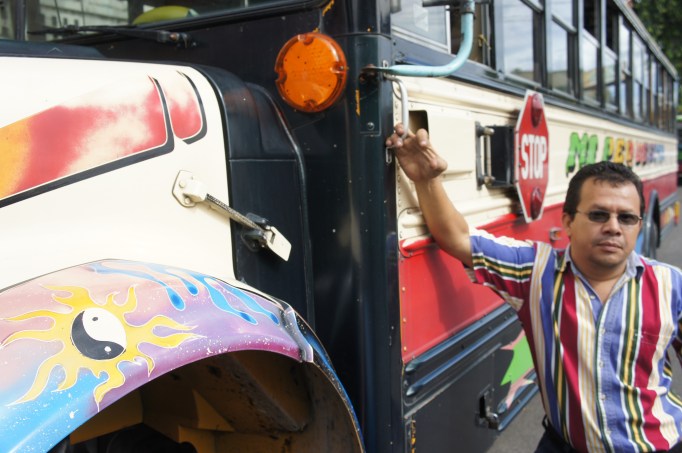
our friendliest bus driver, who smiled all the time except when a camera was pointed at him, and insisted we have a photoshoot outside his bus

The buses in central America are beautiful works of carbon-spitting art, to put it simply. Drivers put a lot of pride in the decals, stickers, disco lights, neon and colour patterns both on the inside and outside of their buses, and the most popular long-haul local bus is an early 90’s Blue Bird school buses that probably got shipped here from the US when they couldn’t pass smog check anymore. They have the capacity of about 55 children, but maybe 60 adults squish the popular routes. They’re affectionately called chicken buses, and some upper class locals even refuse to take them, but in my experience they’re a lot more entertaining, but a lot cheaper for a much longer (just in time, not distance) journey, and I always appreciate more bang for my buck. Just be prepared that the journey will take at least an hour longer than the driver tells you, and will include numerous stop and go pickups of people on the side of the highway that don’t count as “stops,” so all buses are “direct.” Not quite true, but I’m not in a rush so I’ll just keep enjoying the scenic route.

Travel Revolutionized

The more I travel, the more I am blown away by the increasing globalisation and interconnectedness of absolutely everything. No matter where you are while in transit, there is always a payphone, internet accessible computer, or wireless internet, connecting you immediately to the outside world. No matter how far from home you are, you can literally be connected to home within seconds with just one call or email, and programs like Twitter, Skype and Facebook allow people to always keep tabs on you, where you are, how you are, what you’re doing…

The increasing ease of internet access is the most noticeable, at least for me. Almost everyone that I see on a bus, in a train, or sitting at the airport that is using their phone is no longer sitting on it texting, but browsing the internet, tweeting, or writing an email from their multi-purpose cell phone that acts more like a mobile computer than a calling device. Even my iPod has wifi capability, and I can usually check my email by connecting onto some sort of free, unsecured network. Just walking down the street in a big city will give you access to maybe 10 different private networks at any given spot, and cafes and restaurants lure you in for business by offering free wifi. Airports are offering more and more free wifi networks, and now even airplanes flying 35,000 feet in the air somehow offer wireless internet.

Internet has certainly revolutionised travel, allowing us to search and book flights with any airline (or search engine, like  www.dohop.com), to virtually anywhere in the world, and nowadays you don’t even need a boarding pass since airlines are offering a paperless flying option – simply show the barcode from your emailed check-in confirmation on your internet-adapted phone/ipod.

Other technological advances have made travel a powerful, easily accessible tool in other ways. Planes are getting bigger, faster and less pollutant, boats are getting bigger and bigger (have you heard of the Norwegian Epic 4,000+passenger cruise ship built this year?), and tourism infrastructure is popping up in the most remote corners of the world with travel & tourism becoming the largest, fastest growing industry in the world. And, with more flights, more hotels, and more travel options, competition drives airline prices down, internet offers heavily discounted last minute bookings, and almost anyone can afford to travel in a do-it-my-way fashion.

I’d say all this technology is a blessing just as much as it is a curse, because even though the internet makes our lives much easier, it also makes things faster, perhaps even makes us a little lazy, and keeps us constantly connected to the outside world. This is of course a wonderful thing, gives us a sense of safety and security, but sometimes when you’re traveling, the best thing to do is just to get totally disconnected from where you’ve left, not having any communication with anyone that might temporarily remove you mentally from the new place you are physically.

I sometimes wonder what it’d be like 200 years ago when traveling was a serious profession only undertaken by the bravest explorers and funded heavily by big shots like the state, the church or precious royalty. Its nice to know that there still are a few places in the world left to be explored, to be seen as the first foreigner… but with all this fast-forward travel and travel becoming accessible to everyone, that won’t last for too much longer.

Life in Transit

Being a visitor to your actual tourist destination is always satisfying, but the actual act of traveling from point A to point B is kind of a solitude activity. If you are going far or have layovers, it becomes this lonely, slow motion journey where you are stuck a lot in ticket check in, security checkpoints, airport shopping, bus terminals, or taxi stands. Jet lag is super annoying, especially when you can’t sleep in airports or airplanes, but luckily I can pass out pretty much anywhere, it just usually results in a stiff neck or my legs falling asleep and painfully tingling back to sensation, very slowly. Time differences make jet lag and sleeping soundly even harder, like when you travel and lose half a day or a whole night simply because you went east. But then it’s great when you fly west and time just seems to stand still. Crossing the international date line in either direction is also fun, you either lose a whole day or start the day all over again. It’s hard enough to remember what date it is, or day of the week, but sometimes I’m totally lost even what month it is since seasons are also totally different all over the world. I’ve even been known to forget what year it is… but that might be due to other reasons like slight stupidity.

Currencies and exchange rates complicate travel transition as well, but with rising popularity of credit cards, atm’s available almost anywhere, half of Europe using the euro and more and more countries using the US dollar, things seem to be getting simpler. Language is probably the hardest thing to adjust to – landing in a foreign place with weird monopoly money and different weather, plus everything is happening in a tongue you don’t understand. Luckily for me globalization is pushing English as the lingua franca, but it’s a shame when English speakers get away never learning a word of the local language since we often ignorantly expect everyone else to learn English to cater to us.

I am now in Toronto, halfway from where I was to where I’m going. With a 12 hr layover, I was considering to just bum it out in the airport since I actually enjoy airports and people watching the thousands of people shuffle between destinations. I arrived at Pearson at 7pm and it was 33 degrees Celsius outside, much warmer than the -5` I had last in Toronto, so I got outside for some not-so-fresh air, but the smoggy humid still felt great – you never get that sticky pollution in Iceland. Then I got dragged into a free shuttle service by Comfort Hotels to their hotel where they had a pool open til 11pm and free wireless, and next thing you know im sleeping in a king size bed with a view of Woodbine racetrack after a very dramatic, blood-red sunset. I guess its nice to treat yourself once in a while to a cozy hotel room to get out of the airport and break up the lonely act of traveling.

Have You Ever been to Africa?

Anyone that knows me might agree I’m slightly neurotic about travel, and even though I end up spending my last pennies on a trip I shouldn’t be able to afford, I still decided going to Antarctica at the start of this year was a great idea. I justified the trip to be able to say I’d visited all the continents, but then this question ‘Have you ever been to Africa?’ somehow made me feel as though I was cheating. Before this summer, I had only ever been to Egypt, and although it’s on the African Continent, culturally and historically it ties much closer to the Mediterranean and Middle Eastern cultures nearby, so technically I had never really experienced African tourism… until now.

No matter how cultured or well-travelled you are, it seems like Africa should be somewhat predictable from all the stereotypes and generalizations one draws from movies, media, documentaries, and especially development fund campaigns (we’ve all seen World Vision Advertisements). Yes there was poverty, underdevelopment and a lot of little black faces, but there was also blatant affluence, globalization and a lot of white faces. People still wear brand names, buy their internationally imported foods at big supermarkets, goods are all labeled ‘Made in China’, and Alicia Keys & Jay Z’s New York song could be heard almost anywhere. But, as soon as you got out of town into the wilderness, the Disney movie Lion King came alive with Timone, Pumba, Simba, and Wazoo all visible in a day’s game drive.

While this holds true for a lot of southern Africa, South Africa is in its own country genre, since it often resembles Australia or Europe more than the rest of Africa. It is extremely developed in certain aspects – highways and traffic infrastructure, education systems, debatably health care, – and a vibrant cultural arts scene. However, this type of modernity doesn’t exist in all parts of South Africa, and even though English and Afrikaans are widely used, 11 official languages in one nation gives you some idea of how diverse and complicated different areas of the country are.

I never actually realized that Afrikaans was basically a derivative of Deutsch; I always thought it was some conglomerate contact language the colonials and locals developed to communicate, but really it is no different than any other colonial country in the sense that their language was introduced into the area, into the education system, and slowly evolved to become one of the most widely used and official languages. It sounded really strange to me because I just heard a bunch of tourists speaking some German-like European language, and the locals speaking some sort of Creole or local tongue, but I finally figured out they’re all South Africans just speaking Afrikaans with different accents.

The diversity of faces, languages and general multiculturalism was still more than I expected; Cape Town struck me as a very culturally rich, ethnically diverse place, and the super colourful flag of South Africa is a perfect representation of this socially complex place. I’m not sure if this is too much of a leap, but besides personal safety concerns that I still thought were over-rated, I also thought Cape Town to be one of the most livable cities I’ve ever visited, with good weather and amazing biodiversity edging it ahead of other obvious candidates like Vancouver, Canada.