My Thoughts on Cuba

the view of what looks like havan ruins, but is actually the neighborhood directly beside the old centerCuba is a crumbling colonial city – literally. The few buildings that comprise the center of Havana and also the small town of Trinidad are immaculately kept buildings, preserved in their same state since colonial rule, but the rest of Havana and all the more rural towns are filled with buildings that are literally falling apart. The stereotypical colour array of brightly painted houses  only applies to the lucky buildings, and the ones that are in the middle of being restored look quite different as colourless facades completely gutted and surrounded by scaffolding old enough that vines have overtaken them. The deteriorating state of homes may have something to do with the fact that they are all owned by the state; individuals are allocated housing and have no ownership to the property, and of course when something isn´t yours, its harder to motivate someone to take better care of it!

The women are as colourful as the houses, wearing a lot of bright, bold colours like red, yellow and white, that stick out beautifully against their dark tans. Some of the people are actually quite fair; green and blue eyed beauties represent the many that are actually of European decent. The antique cars that literally fill the city are also as colourful, immaculately restored to look like they’ve been newly made in the 60’s just yesterday. The rest of the 50 year old cars, mostly Russian Lada’s, are barely running, heavily pollutant, and definitely wouldn’t be street legal in any other country.

People in cuba really do smoke a lot of cigars, but not the Cohibas or Montecristos that are exported for foreigners; they smoke 1MD (moneda nacional peso – the equivalent of 5 cents) cigars that I think are just as tasty, so long as you don’t get one that is totally dried out. You can also buy ridiculously cheap churros and ice cream, but only if you are far away from tourist central, since they will charge foreigners the peso equivalent in CUC (aka pesos convertibles) which are actually worth 25 times more than one MD peso. This is an extremely confusing pricing system, since both are referred to as ´pesos´but one is pinned to the US dollar and actually converted at a rate slightly stronger than it, and the other is their ´old´peso currency, but both still circulate as legal tender. The most ludicrous business in Havana is getting on the internet; since it was just recently legalised to have computers and internet connection, expect to pay around 4 or 5 euro per hour!

I visited the tranquil Cementerio de Colón, which was extremely beautiful, but some aspect of reverence was lost when a man in flip flops walked up to the cemetery wall (from who knows where since there was just a highway beside it) and threw a dead chicken over it. Weird.

Traveling as a woman in Cuba isn’t easy if its your time of the month since they do not sell tampons, anywhere. Couchsurfing is also, for the most part, non existent since it is illegal for Cubans to host foreigners. And buses and trains operate with extreme infrequencies, with posted schedules a rarity, and even if they were accessible, tourists get different bus services and ticket prices – about 25 times more the cost for long distance buses that only run once or twice a day.

All in all it was a wonderful trip, but one of the more difficult latin american countries to backpack through since little tourism infrastructure exists outside of Havana or the resort hotels. People outside of tourism hot spots are not used to seeing tourists, and definitely not aware of how the industry works, and frankly, not interested in finding out since the laws on interacting, hosting or charging tourists are extremely strict; instead of looking like walking wallets, most tourists probably just look like a reason to get in trouble. The quietude I experienced from almost noone hassling me for my money was something that has never happened to me while traveling, and at times I enjoyed it, but other times, it made travel a little more difficult since people almost totally ignore you and are much less inclined to help you or spend their time talking to you if you have questions! Kind of bizarre, but I don´t blame them, and when I did get to interact with the locals, they were an extremely happy, friendly bunch.

Life as part of the Working Class

It has been strange being in one place for almost a month now, just living and working like a settled local. I have managed to get two full-time jobs since returning to Vancouver, but still feel a little distanced from truly ‘localizing’ myself; the latest and longest memories of Vancouver have always been of my life at UBC, being on Campus all school year and enjoying the city as a starving student. Now, when I go to Campus, I feel strangely foreign, and even though noone else knows I am no longer a UBC student, there is this pang of ‘outsiderness’ that I feel walking around campus without a class to go to or a study group to attend. Even more bizarre is not living on or near campus, so when Im there, I feel like I have nowhere to belong, since my home refuge is gone, as well as a full time class schedule. I have also been coping with the reality that this is the first semester in 18 years that I am not going to school this spring; I have no classes to register, text books to buy, or homework to do. Very, very strange, but comforting. My master’s thesis is almost done too, so I’ve really got very little to do in terms of academic life as of now.

Being downtown is a bit more familiar, same scene, same people, same activities. I would still say I fit the starving student profile since Im tecnically still in grad school until I defend my thesis and officially graduate, but now I’ve joined the ranks of the working class to having that secure, 9 – 5, Monday to Friday Job, in addition to serving at a bar 4 or 5 nights a week. Working two full time jobs is exhausting, and all I have time to do is work and sleep. It’s great since I have no time to spend the money I am finally making, but paying off my upcoming trip and the debt I’ve incurred from both studying in the states and my obsessive cumpolsive traveling habit is a slow process. I have yet to see if I’m actually back to square 1, which would just be an account balance of $0, since my hourly paychecks lag a few days and are paid bi-weekly, but now I’m about to go off on a 3 week trip where Im sure I’ll quickly jump into the negative account balance again. However, not to worry, for after I return back to BC the Olympics are coming to Vancouver, and so are alot of people, all their money, and alot of work – all reasons why I (and my travel habit) may personally benefit from the games.

Why travel to the Southern Hemisphere?

worldI’ve been realizing just how much a difference exists between the ‘north’ and ‘south.’ These are often terms to distinguish between the ‘developed’ and ‘underdeveloped’ nations, synonymous with terms that divide the first-world/third-world and western/non-western countries, since a poverty divide is strangely apparent geographically.

Even crazier to understand is that most of the earth’s landmass is in the northern hemishpere, and 90% of the human population inhabits this land north of the equator. Two-thirds of Africa, almost all of asia, the entire continent of Europe and North America, and even a part of South America sit north of the equator, hosting 5.7 billion people, while the other HALF of the world only houses about  650 million people. This also leads the Southern hemishpere to be significantly less polluted than the north, with less industry, development or infrastructure.

Less people means less crowding, less tourists, and less traffic, and also means more natural habitat, more ocean, and milder seasons. And, when we are in the middle of blistering winter, somewhere north of the 49th parallel, we could fly to the same latitude south of the equator and be in the middle of summer again with long, bright days! So interesting and complex, the way of the earth – rotations and axis and all that jazz. I would have considered myself a genius if I had been the first to figure this out – one could literally have summer all year long if they traveled in sync with season changes and the angle of the earth on its axis. Or, I guess you could just live in the tropics all year round.

It is just after the winter equinox in the Northern Hemisphere, so thankfully the days are slowly getting longer. However, it is still pitch black at around 5 pm, and I couldn’t imagine a better time to travel South. Tomorrow I fly through Houston (which, crazily enough, is not having normal sub-tropic weather and they could benefit from heading further south) enroute to Buenos Aires, where the temperature will be around 30 degree highs and 14 hours of daylight. After I’ll go further south, to Patagonia and the Antarctic Peninsula, where days will be nearly 24 hrs long, but, unfortunately the temperatures will drop a little in exchange.

Tips on Traveling Light

Photo by malias

Photo by malias

By “light,” I mean two things; first, you should try and reduce your ecological footpring from travel, and second, pack lightly. Trying to get away from mass tourism, over-consumptive all-inclusive, package deal vacations is something every responsible tourist should aim for. Long-haul flights to some resort in Mexico or Spain or cruising through the carribbean from tiny island to island on a floating city are some people’s ideas of travel, but this is quickly becoming an outdated, carbon-heavy form of travel appealing to people who think of a vacation as a time to party, buy lots of things (souvenirs, food, drinks), get escorted around on an air-conditioned coach bus, and be surrounded by common, western luxuries and english speakers. This has gotten us and traditional tourist destinations used to seeing sun-burnt, sometimes over-weight white tourists (retired elderly or young party folk), speaking english to absolutely everyone no matter where they are.

I would urge us all to be more responsible, immersed tourists; do not contribute to these types of waste-ful, energy-heavy, carbon emitting forms of travel. Get off the beaten track, travel slowly, see more places than just your hotel room and the beach, and, interact with the local community by learning more about their culture, traditions, and even their language if you’re brave. wander around, never stay at the same hostel or campground, take one way trips, and remember that the travel experiences is not always in the destination, but in the journey.

Being mobile is alot easier to do if you dont bring too much stuff. Its hard to bus, ferry, or drive from place to place with a huge, rolley suitcase, so stay true to the nature of “backpacking” and only bring a backpack. And, unless you are camping or hiking and need alot of equipment, simply bring an average, regular type of back pack (not a $200, 80L heavy duty bag that screams “im a tourist!”) with the bare essentials. You do not need more than a couple changes of clothes, basic hygene supplies, a camera, a good book to read or write in, and maybe a cell phone. I always find I get frustrated with having too much “Stuff,” a load of stuff I end up carrying around with me for the sake of having it, a disconcerning realization of the material dependency alot of us have developed. Remember to leave a bit of room for souvenirs, but dont buy exotic things that you suspect may harm the local environment (turtle shell jewelery, teak wood carvings, etc) and remember the best thing to take with you from your travels are simply memories.

Succingtly put, leave nothing but your footprints, take nothing but photos.

Fly Fly Away!

how do those thousand ton machines actually float in mid air anyway?

How do those thousand ton machines actually float in mid air anyway?

Language is basically a facet of communication, a way to express our thoughts, but it’s often been said that language is a limitation to thought. Language is constantly in flux, with new words being created or borrowed within the thousands of existing languages. Words are often closely related, either because of meaning or etymological history.

Think about the words we use for flying: fly, flights, etc. Its a verb, an adverb or adjective, a noun… but then we have a different name for things that fly, like airplane or helicopter. Similarily, in French, ‘voler’ is to fly, ‘vol’ a flight, (vuelo in spanish) and ‘avion’ an airplane in both French and Spanish. In other languages, flight and planes are much closer related words, where the title of an object that flies is clearly built on the word ‘to fly’. In Icelandic, fljuga is the verb to fly (flug is the noun), and a plane is simply a ‘flugvel’, loosely translated as ‘flight-engine’. In German, an airplane is a ‘flugzeug’, and a flight is ‘flucht’. Further eastern european countries lose the resembling ‘flyvning,’ ‘flygning’ or ‘vlucht’ of Indo-European languages, and in Latvian, airplane is lidmaš?nu, and flight is lidojumu, with Finnish meeting somewhere in the middle between the nordic and slavic languages with airplane said as ‘lentokoneeseen,’ and flight as ‘lennon.’

Etymologically speaking, the word ‘flight’ is said to have originated from low German ‘fleugan’ (circa 1300’s), and was first used to describe skittish horses and then defined as “an instance of flight,” as in ballooning. Before the Wright brothers came around with airplanes, flight really was a supernatural event, which only winged animals and insects could partake, but who could have know that today, millions of people and planes fly in the air every day, defying the laws of gravity and even reaching the frontiers of space!

3 Ways to Get Lost in a Major City

San Fransisco Trolley with the Bay Bridge in the background

San Fransisco Trolley with the Bay Bridge in the background

Whenever I visit great cities, like London or New York, it’s overwhelming how much there is to do and see in one place in too little time. Arriving in east bay California means I’m only 20 minutes away from San Fransisco, a fairly small city (in square km’s), but still offering a lot to explore. I’ve come up with a few little things I like to do (instead of reading guide books and calendars of events) to fill my time.

First, don’t carry any sort of map. Just use your well-travelled self to have a good enough sense of direction to find your way back to where you started. Just make sure you never look too lost, to avoid every nice person coming up to you and asking “are you lost? Can I help you find something?” since, you should have no idea what you’re looking for.

Then, walk in the direction that your senses pull you, and when you get to an intersection, turn in the direction you feel like. Whatever looks prettier, smells yummier, or sounds more interesting, go there. Get off the shopping streets and walk through some neighbourhoods, wander through an industrial area, or even end up in a poorer section of town to see the not-so-touristy picture perfect images of a city.

Finally, try and take a random bus/metro/trolley a few stops in an unkown direction, without asking any questions…try to blend in and act like a local, and get in a little bit of people watching. Just get off when you feel like it, or when most of the other people get off. Just make sure you know how much bus fare is and have exact change, or else everyone will still know you’re that lost tourist 🙂

Basically, try and get totally lost, and along the way, you will discover all sorts of treasures and surprises a lonely planet would have never predicted.

What to do when you're Homesick

me and my sisters in Vestmannaeyjar in 2005... they're two people I miss alot when I travel!

me and my sisters in Vestmannaeyjar in 2005... they're two people I miss alot when I travel!

I’ve come up with a check list to identify homesickness, and what I do about it. I hope it helps you fellow travellers…

1. You start missing friends and family from back home unbearably: Try calling, emailing, or Skype-ing someone back home to chat and get caught up on small talk and find out how everyone is doing and hear a familiar voice. If you dont have technology to facilitate that, keep a diary you can share later or write an old fashioned letter and use snail mail.

2. You stop trying to submerse yourself in the place you’re traveling: If you stop learning bits and pieces of the local language, or stop being adventurous about trying the local food or experiencing local customs, then you are probably missing the familiarity of home. The only way to get over that is to realize that you aren’t home and you should decide to make the best out of where you are instead; don’t miss out on any unique opportunities or the possibility of meeting an amazing local!

3. You are sick of living out of a backpack: Backpacking usually makes travelers realize they don’t have enough stuff, or that they have too much stuff and get sick of carrying it. Either way, remember that the only thing you need for an amazing travel experience is yourself, the clothes on your back, your passport and some money! So be glad to have what you have, or downsize if you can since “stuff” is superfluous.

4. You’re getting bored: Go somewhere else! Change the perspective you have of a place by seeing it from a different point of view, or just go somewhere new and exciting.

5. You’re lonely: Talk to anyone and everyone you meet, share stories, make new friends, get out of your comfort zone and try communicating without words if you experience a language barrier since body language and simple gestures are an amazing cross-cultural communication tool.

6. You are sick of being treated like a walking wallet wearing a “tourist” label: Try to blend in as much as you can, by dressing differently or acting differently, so that people can’t tell if you are local or not (if possible).

7. You just want to go home: Then, really, your homesickness has taken over completeley and the only way to cure it is…to go home! Thats the beauty of travel, you can always travel again after a short visit home, and plan your next trip for shorter or longer depending on what kind of traveler you are.

There’s No Place Like Home

You know how they say you can never truly appreciate something until you lose it? Well, its kind of like that with home when your away from home. Its probably just a psychological thing, but the further away I am from home, in geographical distance, the more homesick I feel just because of the physical separation. Then, depending on where I am, sometimes I get more or less homesick depending on how close to home the place resembles. For example, in Copenhagen, you don´t really miss Iceland that much since things are still familiar, or when you’re in any North American city, it still runs and functions the same way as most other major North American cities. But, if you’re in the middle of Burma, out of touch with phone lines, internet, and the regular commodities like clean running water or flushing toilets, home seems soooo much further away! The more difference a culture has to what you’re used to makes homesickness worse, and makes you appreciate home that much more when you return.

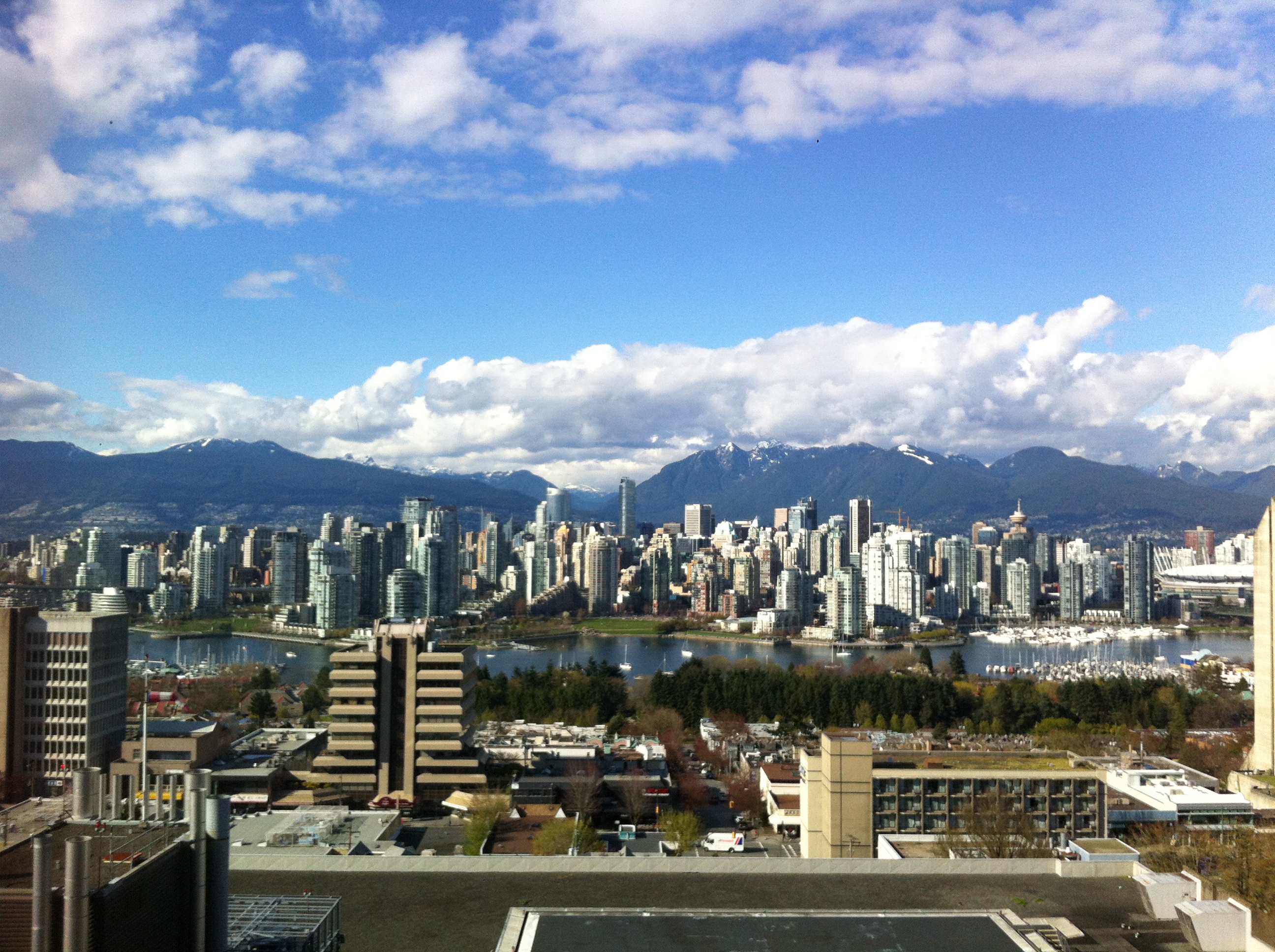
downtown Vancouver, the ocean and the mountains; where else can you have all that in one place?

It´s been so nice to come home to Vancouver after living out of a bag for 3 months with no sense of home or locality anywhere! Stuck in transit between Montreal, New York, Mexico and roadtrips in between has made the comforts of home priceless to me. The familiarity of people and places instantly gives me a sense of belonging, and knowing where to eat, where to go out, and how to navigate the streets and public transport just makes the city feel like the back of my hand again. Meeting up with good friends seems like absolutely no time has passed apart, and these are the same friends I’ve been dying to see for so long, and now they’re only a phone call away! What luxury 🙂 As for my family, home cooked food is another amazing luxury, and I can not seem to get my fill of mom and grandma’s cooking. Its nice not to carry my life on my back, not worry about getting lost or missing a flight, and especially nice to sleep in my own bed.

But now I have this strange identity dilemma where I don´t know if Im rightfully homesick for British Columbia or Iceland, (or both) but now Ive found that as soon as I satisfy a homesick feeling for Vancouver, I start to miss Iceland!  I want Icelandic hot dogs, nightlife that lasts all night, long days and stinky, hot showers. It’s certainly confusing and annoying… but I guess having two places to go home to isn´t all that bad 😛

Budget traveling a blast even in big cities

I’ve always thought of budget traveling being something that only happens in places like Southeast Asia or South America, because things are cheap there and their currency is usually valued less, but traveling Canada for 6 weeks on a Southeast Asia budget seems to be working out for me. I love the $0.99 pizza kiosks, dollar stores that sell virtually anything for a dollar, couchsurfing and rideshare networks.

Most people know what couchsurfing is, and rideshare is basically another way for roadtrip travelers to save money: If you have room in your car and want to split gas cost, you offer backpackers or other commuters a spot in your car, or if you are looking for a ride somewhere, you can go on web sites like craigslist and say you need a lift and then people taking that route can offer you a spot for a lot less than even major bus companies like Greyhound.

I took such a rideshare to Quebec City for St. Jean Babtiste day, otherwise known and celebrated as the Quebec national holiday, and also to Ottawa to celebrate Canada day in the country’s capital. Tomorrow I embark on a 1000km trek to Halifax, and of course rideshare pulled through and a ride has been arranged for 60% cheaper than a bus, and a lot less expensive than flying. And besides, the trip is about the journey and not the destination, so driving there seems like more fun. Slow travel is also better for the environment, no use emitting all that carbon on a plane when you can take the scenic route.

Anyway, back to budget travel surprises… I have never had so much free and consistent entertainment anywhere else before Montreal. I’ve seen so many free concerts, including Sarah Maclachlan and Stevie Wonder to name a few, and I’m just missing  Ben Harper by a few days. Canadians are also really nice people, they stand by their reputation of being friendly with all the free bbq’s and parties I’ve happily attended. I walked past a restaurant one day last week called Globe, and the manager wanted to commend me for my quebecoise patriotism ( I was wearing a Quebec flag in my hair) by inviting me in for some sangria that turned into a few more drinks and another similar visit the next day. All in all, I’ve been pleasantly surprised by the $10 a day I’ve managed to get away with spending, excpet for on special occassions when I feel like splurging and spend a full 10$ on an amazing meal of mussles!

But, to put things in perspective, its difficult to be traveling with the issue of currency exchange, especially if your base currency is Icelandic kroner (now, not accepted anywhere for exchange), and everytime I swipe my Icelandic credit card, I think “imagine if the currency was still worth double that of the dollar?” Things would be a lot cheaper, or I would just live like a queen off double my budget.

Photo from www.bloomberg.com

You know you’re travelling when…

Where am I? You know that question you ask yourself when you wake up totally lost and in a moment of total and utter confusion you try to remember whose house and what country you are currently in? That question has frantically entered my mind one too many times ever since school got out mid May.

Its not the same kind of “where am I” that you ask yourself after a night of too much drinking or too little sleep, but the kind of lost feeling when you’ve been moving to too many different places without enough time to readjust to any of them. I’m not complaining by any means, since I’ve been dreaming of the summer and all the travel to be had since last September, and actually, I’m certainly getting used to waking up in Montréal after 10 consecutive nights in the same place.

Before I got here, there was Boston, and before that, any and every city with more than 30 inhabitants in Iceland since me and my best friend took 2 weeks to drive 3700kms around Iceland, including the west fjords and any part of the highland we managed to drag his Toyota corolla into, neglecting the many “impassable” signs we later learned were always posted for a reason.

bathing in the wild – 38°c hottub in the westfjords

Sleeping in an assortment of tents, hostels, couches, floors and even a hammock over the past 3 and a half weeks has taught me to appreciate the single bed I now have in downtown Montréal. Even more gratifying is the fact that my dorm residence is totally free, thanks to an amazing Canadian scholarship that covers your living expenses, tuition, AND food costs for an entire 5 weeks to learn french in Quebec! At least those tax dollars are being put to good use…

I have to admit the “travelling” feeling is slowly phasing out, since 10 days in the same place starts to make things feel like home. Although, the efficiency of student housing at the University of Quebec at Montréal somehow justifies having 8 people living in one apartment, and lucky me – sharing the kitchen and bathrooms with only guys, so getting totally comfortable in my temporary house won’t be possible. My best friend lives in Montréal, so she’s my go-to person when the testosterone gets too much too handle, and the perfect tour guide of the city and all its local charms as I try my best to fit in as a “local.”

Even so, the travel bug still reigns, since summertime is the epitome of perfect travel climate. I got my first tan back in Iceland after lazing in the many natural, outdoor hot pots spotting the countryside, and reconfirmed another brown layer lazing on a friends yacht off the coast of Boston 2 weekends ago. There is a park for beach volleyball players in the centre of Montréal city, so that excuse to wear a bikini in-town has also done great things for my summer bod.

You also know you’re travelling when you get the first pangs of home sickness. Iceland is great, and its even nicer in the summer, but of course I lasted the 8 darkest, coldest months, cursing the ice I walked on daily, and left just when things started to get green, warm, and bright. I got a tease of the Icelandic summer before leaving, as the trees bloomed and around-the-clock daylight was almost in full force mid May.

The sun is different here in Canada, cool in the mornings and evenings, cooking you at midday, and setting a lot earlier. The city scene here really dwarfs Reykjavik, but the Icelandic nature is what I miss most. I love bathing in geothermal pools, drinking water straight from a free-flowing river, and having enough free, open space to drive for hours in any direction without seeing a soul… except for maybe a few sheep. Homesickness aside, it’s been an amazing start to the summer, and it’s true what they say, you don´t truly appreciate something until it’s taken away from you, so Iceland, I’m sorry for cursing your winters, I miss you and I’ll love you unconditionally when I return.