Terrestrial Travel in Central America

Traveling from Panama to Mexico is actually pretty easy, so long as you don’t mind taking a lot of time to get from A to B. Transportation deserves its own blog entry because I’ve probably spent half my trip just traveling. So far I’ve kept track of 41 buses, 25 collectivos and taxis, 5 private cars, 6 boats, 2 horse carriages, 1 horse and 1 scooter that have got me to where I am now in Belize. The roads have been horrendous, and I’m not talking back streets, but main highways and the only roads connecting towns to one another. Sometimes they’re just plain old undriveable due to flooding, rockfall, mudslides, missing bridges or collapsed banks, yet so many huge, coach buses and semi’s traverse them regularly. And I’ve never seen so many semi’s full of rusted metal cargo, anyone know what that’s about? In addition to all that, impossible mountains, curvaceous roads and reckless driving always kind of made me wish I was walking instead. Although, with the exception of rowing into Panama, I always got to walk to my next country since buses drop you off at only the first of 2 border crossings needed every time, one to exit the country you’re in and the other to enter the country you’re going to. Sometimes the two crossings are more than a kilometre apart, and I can’t understand how they really control the area between since locals seemingly wander freely between both. Sometimes I have a hard time even finding where I need to go for my stamps and accidentally end up in the next town without realising I’ve ‘entered’ the country, just strolling along.

maxell Digital Camera

one of the cliff-hanger, deadly switch-back roads leading down the mountain into Lago Atitlan, Guatemala

Buses are actually like driving markets since street vendors sell everything on board; no need to go to the market. While on the bus, street vendors take the opportunity to hop on, both while we’re parked and also just come along for a few kilometres before hopping off, and sell all sorts of random things. People carry their entire inventory somehow attached to them in an organised, presentable way. One guy pitched toothbrushes, backscratchers and a foldable fan all in one breath. Some come on dressed as clowns and act out a short comedy sketch for tips. Others come on claiming medical knowledge to sell you creams and herbs that all look like tiger balm to me, and some just want to show you their own health ailments like dumbness, missing limbs or freaky tumors growing out of their stomachs. Those who only sell one thing specialise in yelling it over and over in rapid succession, most popular being ‘PAPASFRITASPAPASFRITASPAPASFRITAS’, and ‘CHICLETSCHICLETSCHICLETSCHICLETS!’ Some don’t bother coming on board and at a stop light just come up to the window, ‘FRESASFRESASFRESAS’ or ‘AGUAAGUAAGUAAGUA’ while sticking said item into your window on the end of a big stick.
SONY DSC

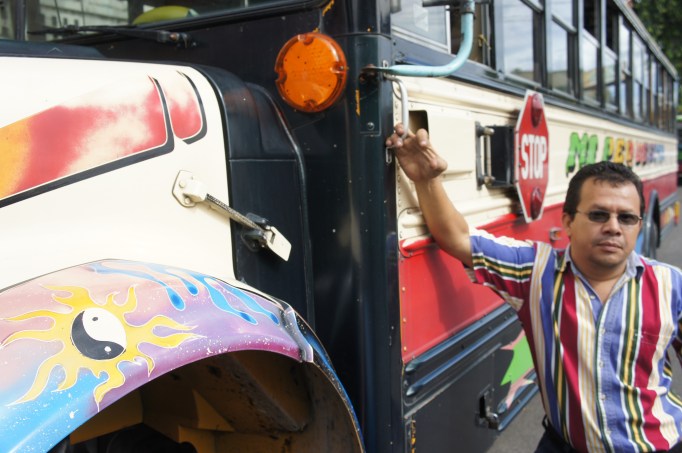
our friendliest bus driver, who smiled all the time except when a camera was pointed at him, and insisted we have a photoshoot outside his bus

The buses in central America are beautiful works of carbon-spitting art, to put it simply. Drivers put a lot of pride in the decals, stickers, disco lights, neon and colour patterns both on the inside and outside of their buses, and the most popular long-haul local bus is an early 90’s Blue Bird school buses that probably got shipped here from the US when they couldn’t pass smog check anymore. They have the capacity of about 55 children, but maybe 60 adults squish the popular routes. They’re affectionately called chicken buses, and some upper class locals even refuse to take them, but in my experience they’re a lot more entertaining, but a lot cheaper for a much longer (just in time, not distance) journey, and I always appreciate more bang for my buck. Just be prepared that the journey will take at least an hour longer than the driver tells you, and will include numerous stop and go pickups of people on the side of the highway that don’t count as “stops,” so all buses are “direct.” Not quite true, but I’m not in a rush so I’ll just keep enjoying the scenic route.

Why traveling with a Guy helps

My first day solo in Panama City I ran into this guy named Guy at the canal. Well, actually he ran into my taxi from the locks back into town and we discovered we were on the same journey north through Central America. We only spent a day being tourists together in Panama and lost each other for Costa Rica, but reunited again in Granada, Nicaragua a few days later. The fact that his name is Guy provided endless pun jokes, but he himself provided splendid entertainment. One morning we were walking on a totally empty sidewalk and he had is head down in my lonely planet book when he walked straight into an electricity pole as wide as him. I was half a step ahead and only heard a loud thump, then him mutter ‘well that was stupid.’ When I turned back to see him just flip the page and keep reading on, I had to put two and two together to figure out what had just happened and then almost peed my pants laughing. The next time he made the same comment to himself I had to ask what happened since he was in the bathroom, and he casually explained he had just put soap in his eyes.

girl and Guy on our nicaraguan road trip

The most ridiculous thing he ever did was stroll right into a dog napping on the road, this time without any book or distraction but just total oblivion of where he was stepping. His reaction this time was a simple ‘Oh, hello’ as the dog wimpered off totally in shock, not sure what had just happened in his deep, peaceful sleep. Then there was the time he almost walked off the top of a Mayan temple in Copan, but realized just in time the edge of the path we were walking on didn’t have any steps down. In Honduras, me and Claudia convinced him to try painting his toe nails red with us, but that really didn’t help the fact that locals always hear is name pronounced as ‘gay,’ not Guy.

SONY DSC

very steep steps to fall off

Aside from being my complimentary entertainer, he provided great travel company with some great philosophical debates, discussions on faith, and shared incredible stories from his time as a professional cyclist on Lance Armstrong’s team. He had a heart of gold, listening to everyone’s life story and trying to be friends with any locals he interacted with. He was always trying to give away all the most valuable stuff he had, and for some reason that kind of generosity was never abused. When we took a horse-drawn cart 9 hrs for only $20, he offered to pay the drivers with his ipod instead, worth probably $150, but they preferred the cash in hand. While we were traveling, we cracked a few beer and he only took one sip of his before passing it off to a guy peddling his bike alongside us, going just slightly slower than our horse and looking a bit more fatigued. When we met up with my friend Claudia in Honduras, she told us about how she had gotten mugged just a couple weeks before, and when she told Guy her blackberry was the last thing taken, he offered over and over to give her his blackberry, even though I’d say that was the only thing he was dependent on, communicating with family and friends hourly. The most ironic give away he actually succeeded in was in El Salvador; we were looking for a restaurant that was serving lunch and when the first place we asked was out of food (?), he gave the owner a bag of raw potatoes covered in salt and hotsauce he had bought in the market a few steps before, probably thinking it was some delicious fruit.

Claudia, Guy and I at the border of Honduras via horseback

One valuable thing I learned traveling with this guy named Guy was about safety. There is something always unnerving about traveling alone as a girl, and his company was extremely comforting in the dozens of sketchy buses and dark streets we had to frequent along the way. He explained something pretty profound to me too: one time he walked right past a guy trying to say hello, ignoring him probably as a precaution, but the guy responded to his brush off by yelling ‘well there’s one great way to get robbed.’ He said he never feels afraid at 2 am in the most dangerous neighbourhoods because he’s already made friends with the street folk, and thus, he’s probably safer there than anywhere or anyone else. Being friendly to people is so important, and the trick Guy taught me was to always make people believe you trust them. I’ve been trying it and it does really work; once you make a personal connection, even if its just sharing a hello or a smile, the chance that they’ll hurt you is probably zero.

How to Enjoy Seattle in a Day

Seattle is a big, beautiful, port city with a great arts scene, lots of live sports, and of course, excellent coffee. I’ve often driven through Seattle, on my way to Seatac or just driving down the I5, but rarely stop to enjoy the city sights. I had one sunny day in town after my cruise from Alaska disembarked one early Saturday morning and these are my recommendations for seeing the best of Seattle in a day.

pulling out from Pier 66 on an Alaskan bound cruiseship

1. Walk around town by foot. Its not a big city center, and there are tons of shops and cafes along the way to stop and enjoy. Just get a map from any tourist information center or hotel, and wander around the downtown area and Fremont neighbourhood, or if you dont want to think about it, book a walking tour with seattlebyfoot.com who offers their signature coffee crawl tour.

2. Stop by Pike Place Market near the waterfront and watch big cruise ships come into Pier 66 if its summer, or to get out of the streets that are probably getting rained on if its winter. The market is full of delicious treasures, a lot of fresh seafood, and claims to be the oldest, continually running farmers market in the USA.

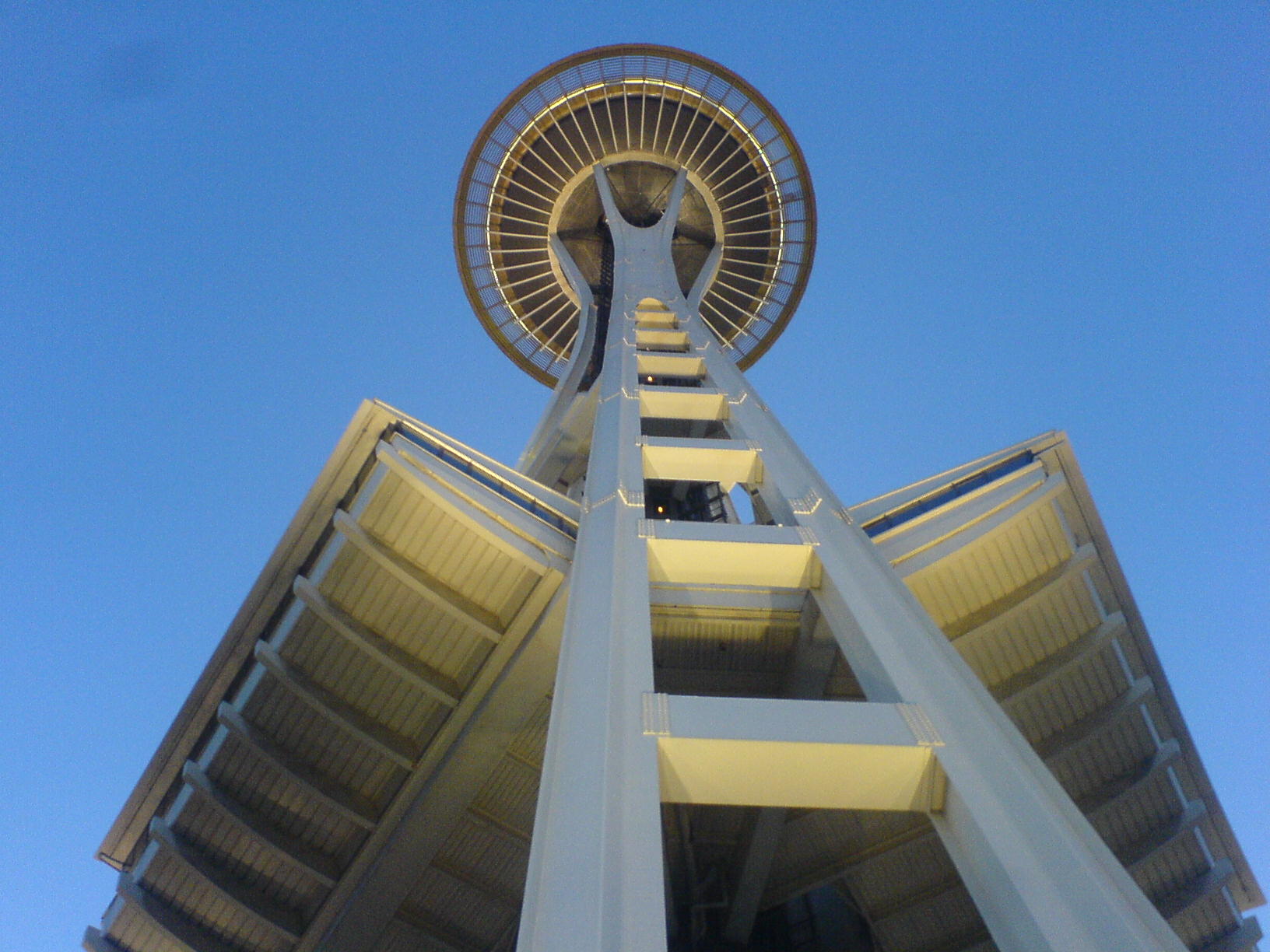
3. Go up the Seattle Space Needle for an amazing view of the city, or to enjoy a glass of wine with a dramatic sunset over the Pacific Ocean. Its almost $20 to go up but its cheaper if you include an entrance to the Pacific Science Center located below. Use your judgement when checking out the shows/ exhibits going on at the Science Center to decide if its worth it. Bodies was a great one.

the Space Needle

I know thats not much, but I’m just suggesting a days worth of activities that would probably satisfy for the Seattle Experience. If you have more time, by all means take a day just to each of the above!

Links: www.seattlebyfoot.com

www.spaceneedle.com

Cape Town Touristic Highlights

My younger sister Ruth went on a trip to southern Africa a few years ago with her classmates on a charitable/missionary-work trip, and when I mentioned South Africa to her once, she insisted there was no such country and it only referred to a region of Africa. But, after a small argument ensued, we established she was wrong, and I can now assure her of its existence as I started my own trip to Africa in (The Republic of) South Africa.

My first week in South Africa was amazing, full of all the sights and activities a good tourist should do in Cape Town. I flew directly from London to Cape Town on a very luxurious, entertainment-filled, all-you-can-drink, 12 hr, overnight flight with British Airways. I arrived at 8 am to an airport that was surprisingly small for an international airport to what I would consider one of the major African airport hubs, but it was a delightful surprise to clear baggage and customs within 15 minutes.

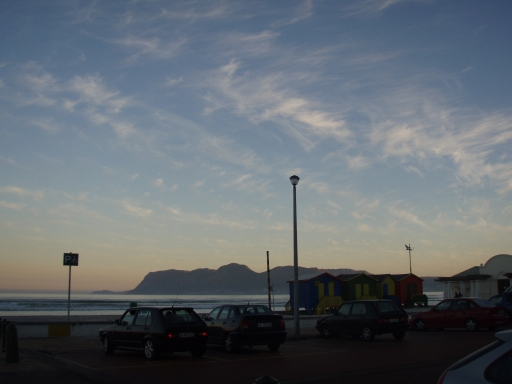
Muizenberg, the sleepy beach town I called home

Muizenberg, the sleepy beach town I called home

There’s only a 1 hr time difference between Reykjavik and Cape Town so jet-lag dismissed we made the most of our glorious, sunny Sunday by doing all the most stereotypical tourist things one should do in a day in Cape Town. Steve, who I met a few months ago at UC Berkeley and was staying 3 weeks in Cape Town for an Applied Mathematics/Public Health workshop – he can explain to you very well how they’re related but I won’t try – picked me up in our $17/day Suzuki rental. In South Africa you drive on the left side of the road in the right side of the car and it took some adjusting, but now I’m not sure I even register the difference since its quite easy just to follow the car in front of you and not even think about which side you’re supposed to be on… although parking lots are tricky.

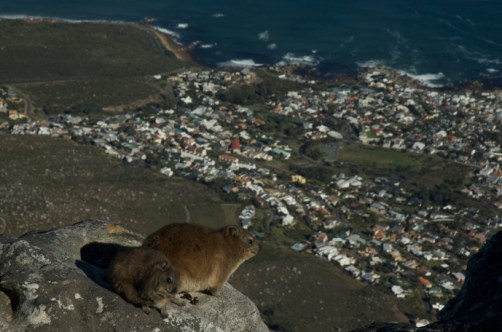
Hyrax enjoying the view of Camps Bay from table Mountain

Hyrax – considered the closest living relative to the elephant – enjoying the view of Camps Bay from table Mountain

First we visited Table Mountain; we took the cable car up and walked around the plateau with a free guided tour led by a presumably retired old lady who could barely talk faster than she walked. After losing patience with her, we wandered around with the most beautiful view of Cape Town on one side and Camps Bay to the north, and were super amused by all the little hyrax’s sitting on cliff ledges, also enjoying the view. On the way down, we saw a (slightly suicidal) rock climber ascending the sheer cliff face without any safety ropes and decided we were glad we didn’t walk down.

The cliff-top entrance for Table Mountain Cable Cars, and the death defying rock face you can see a ropeless rockclimber ascending

The cliff-top entrance for Table Mountain Cable Cars, and on the death defying rock face you can see a ropeless rockclimber ascending

We took lunch on Long Street, the main drag in town, at a delicious café called Pickwicks, and carried on to drive Chapmans Peak to Cape Point Vineyards for a little wine tasting. That ocean view drive is definitely one of the most beautiful roads you can imagine – and an amazing representation of road engineering genius.  We ended the day at Simon’s Town and went to visit the penguin colony there. What a sight to see hundreds of little grumbling penguins swimming in on the waves, avoiding all the boulders on the appropriately named Boulders Beach, and then scurrying up into the bushes and low lying forest all around  where they’ve hidden their nests and young ones. They were extremely habituated to human presence, barely even noticing your foot inches away from them and thus, allowing for some great, up-close encounters.

Friendly Penguins

Friendly Penguins

The weather all week was glorious, rare for mid-winter days, and the sun kept the temperature above 20`C almost every day. I made it to Robben Island and the Waterfront with a fellow traveler from Antarctica, also considered must-do Cape Town tourist stops, and was very impressed by the Pier 39/Fishermans Wharf inspired boardwalk offering an endless selection of shopping and dining. On the way home we also drove through the University of Cape Town main campus, the nearby Rhodes Memorial (he endowed all the land to the state where the university is currently located), and the Botanical Gardens.

Robben Island prison cell, similar to Nelson Mandela's

Robben Island prison cell, similar to Nelson Mandela’s

I stayed south of Cape Town in a suburb called Muizenberg, right on the beach with a corner store a block away that sold the most delicious, cheap eats. I was already impressed enough that you could find good meat pie and ginger beer, a luxury I haven’t indulged in since living in Brisbane years ago, but even more excited about their banana bacon burger (don’t knock it til you try it) and calamari bun – a burger filled with huge, deep-fried squid. The town is famous for some of the best surf in the world which apparently holds the Guinness World record for most surfers on one wave (circa 100+). Even though the water was almost too cold, I wanted to be cool and tried surfing in a full wet-suit, and not until I was in the water trying to catch my first few waves did Steve tell me these were some of the most shark infested waters around. To make matters worse, the day after, a small, badly bruised pigmy sperm whale washed up on shore, and after hours of failed attempts by some 20-odd surfers to push it back out repeatedly (it kept getting drawn back in with the waves since it could barely swim), shark spotters set of a siren to alarm everyone sharks were on their way in, probably from the scent of its blood.

struggling to help the beached pigmy whale before sharks got to it

struggling to help the beached pigmy whale before sharks got to it

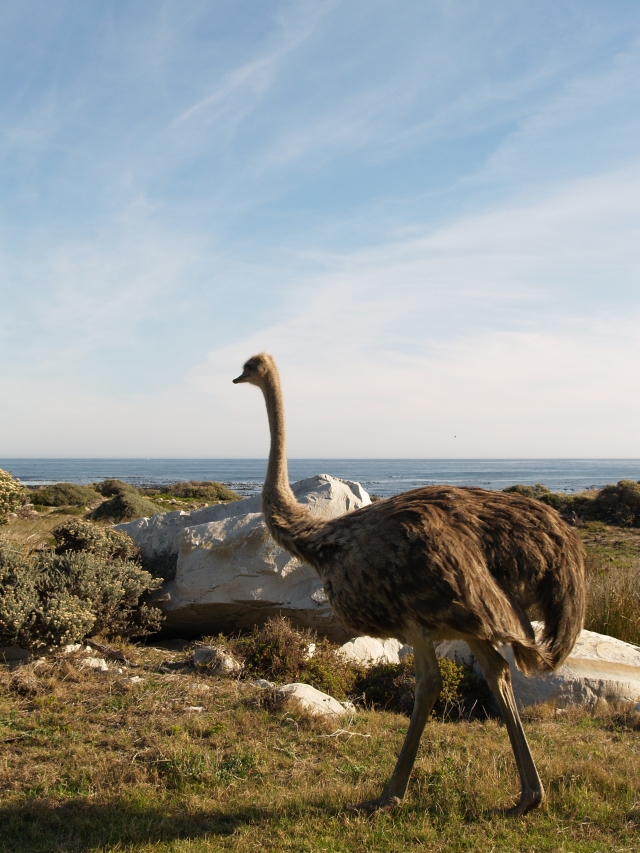
I also spent some time visiting my good friend Yashar, a fellow UBC alumni who is on a rotary scholarship to complete his masters in international relations at the University of Cape Town.  With proper Persian hospitality, we enjoyed hookah and drinks on his balcony with an amazing view of Table Mountain, and also made it to Cape Point National Park later in the week to have some intimate encounters with baboons and ostriches. Ironically enough, after I left Yashar, I attended a Rotary Club meeting, and two friends of mine, retired South African men who sailed to Antarctica on the same cruise as me, were Rotary Members of that same club and they made the connection that only 2 degrees of separation existed between them – it really is a small world.

an ostrich strolling along in Cape Point National Park

an ostrich strolling along in Cape Point National Park

Links: For more information on Yashar’s Charity, the beneficiary of his hard work and Rotary Club’s generous scholarship – Peace and Love: http://www.PeaceandLoveInternational.com

Why travel to the Southern Hemisphere?

worldI’ve been realizing just how much a difference exists between the ‘north’ and ‘south.’ These are often terms to distinguish between the ‘developed’ and ‘underdeveloped’ nations, synonymous with terms that divide the first-world/third-world and western/non-western countries, since a poverty divide is strangely apparent geographically.

Even crazier to understand is that most of the earth’s landmass is in the northern hemishpere, and 90% of the human population inhabits this land north of the equator. Two-thirds of Africa, almost all of asia, the entire continent of Europe and North America, and even a part of South America sit north of the equator, hosting 5.7 billion people, while the other HALF of the world only houses about  650 million people. This also leads the Southern hemishpere to be significantly less polluted than the north, with less industry, development or infrastructure.

Less people means less crowding, less tourists, and less traffic, and also means more natural habitat, more ocean, and milder seasons. And, when we are in the middle of blistering winter, somewhere north of the 49th parallel, we could fly to the same latitude south of the equator and be in the middle of summer again with long, bright days! So interesting and complex, the way of the earth – rotations and axis and all that jazz. I would have considered myself a genius if I had been the first to figure this out – one could literally have summer all year long if they traveled in sync with season changes and the angle of the earth on its axis. Or, I guess you could just live in the tropics all year round.

It is just after the winter equinox in the Northern Hemisphere, so thankfully the days are slowly getting longer. However, it is still pitch black at around 5 pm, and I couldn’t imagine a better time to travel South. Tomorrow I fly through Houston (which, crazily enough, is not having normal sub-tropic weather and they could benefit from heading further south) enroute to Buenos Aires, where the temperature will be around 30 degree highs and 14 hours of daylight. After I’ll go further south, to Patagonia and the Antarctic Peninsula, where days will be nearly 24 hrs long, but, unfortunately the temperatures will drop a little in exchange.

Traveling during Christmas Time

winter hindrances at the airport

winter hindrances at the airport

The nature of the holiday season always gives me an obsessive cumpolsive urge to travel, since its the time of year when everyone has time off and either goes home or to some sunny destination for Christmas time. I, of course, was resisting the other voice in my head, which said “no, dont travel now, there is so much air traffic, airports are so busy, and bad weather is all over the northern hemisphere that traveling right now would be stupid.” However, the choice was much simpler than that for me, since I am completely broke and have no way of getting anywhere right now, so I stayed put in Vancouver. This has worked out great, since all my friends who have left have vacated their place to me, asking me to house-sit, feed plants or walk dogs and having access to 3 or 4 different refuges has been kind of special. However, I am so overcome by jealousy of everyone elses travels that I’ve spent alot of time traveling through other people’s pictures, reading blogs, and planning my own future travels.

I have been hearing so many horror stories about people’s traveling times over the last few days. Average delay times in JFK New York and Newark airports were reported at above 3 hours, storms all over the east coast have grounded Chicago and Boston bound planes, and worst of all, an attempted Christmas day terrorist attack from a Delta flight east-coast bound from Amsterdam could have ended fatally for hundreds, but miraculously, passengers extinguished the chemical bomb before it detonated.

Traveling any other time of the year somehow seems more efficient and safe, not only for the above reasons but also because of airfares; I could not make it back to Iceland for the holidays since flights were out of my affordability reach, over 110.000kr, about 600 Euros, when Ive paid only 56.000kr for the same flight other times of the year. A friend of mine paid $2,700 US to go from San Francisco to Cape town (its usually around $1500), and others have had to take 3 flight connections just to get from coast to coast when one, 5 hr flight usually suffices.

Going from Iceland to Canada or vice versa always makes me lose a day in transit, and the 8 hr jet lag takes a couple more to recover, so I’m generally too confused to know what day is actually christmas.It has also been nice to not have to do anything in preparation for Christmas; no packing, shopping, wrapping gifts; I have really just been able to enjoy the free time and stay put for once. Despite all these negative reprecussions of travelling, avoiding peak season is a good enough recipe for efficient travel and successfully enjoying the holidays. I can day dream about so many places I want to go and journeys I want to take, but it has been extremeley satisfying to not travel this christmas season. But, don’t get me wrong, I still look very much forward to my next travel experience, beginning Jan 11th, just after this Christmas hustle and bustle finally slows down.

Tips on Traveling Light

Photo by malias

Photo by malias

By “light,” I mean two things; first, you should try and reduce your ecological footpring from travel, and second, pack lightly. Trying to get away from mass tourism, over-consumptive all-inclusive, package deal vacations is something every responsible tourist should aim for. Long-haul flights to some resort in Mexico or Spain or cruising through the carribbean from tiny island to island on a floating city are some people’s ideas of travel, but this is quickly becoming an outdated, carbon-heavy form of travel appealing to people who think of a vacation as a time to party, buy lots of things (souvenirs, food, drinks), get escorted around on an air-conditioned coach bus, and be surrounded by common, western luxuries and english speakers. This has gotten us and traditional tourist destinations used to seeing sun-burnt, sometimes over-weight white tourists (retired elderly or young party folk), speaking english to absolutely everyone no matter where they are.

I would urge us all to be more responsible, immersed tourists; do not contribute to these types of waste-ful, energy-heavy, carbon emitting forms of travel. Get off the beaten track, travel slowly, see more places than just your hotel room and the beach, and, interact with the local community by learning more about their culture, traditions, and even their language if you’re brave. wander around, never stay at the same hostel or campground, take one way trips, and remember that the travel experiences is not always in the destination, but in the journey.

Being mobile is alot easier to do if you dont bring too much stuff. Its hard to bus, ferry, or drive from place to place with a huge, rolley suitcase, so stay true to the nature of “backpacking” and only bring a backpack. And, unless you are camping or hiking and need alot of equipment, simply bring an average, regular type of back pack (not a $200, 80L heavy duty bag that screams “im a tourist!”) with the bare essentials. You do not need more than a couple changes of clothes, basic hygene supplies, a camera, a good book to read or write in, and maybe a cell phone. I always find I get frustrated with having too much “Stuff,” a load of stuff I end up carrying around with me for the sake of having it, a disconcerning realization of the material dependency alot of us have developed. Remember to leave a bit of room for souvenirs, but dont buy exotic things that you suspect may harm the local environment (turtle shell jewelery, teak wood carvings, etc) and remember the best thing to take with you from your travels are simply memories.

Succingtly put, leave nothing but your footprints, take nothing but photos.

Crossing the Peace Arch Border

2 friendly and tame racoons beg for food from passerby's at Stanley Park

2 friendly and tame raccoons beg for food from passerby's at Stanley Park

I was in Vancouver for the weekend, compromising between American & Canadian Thanksgiving, my grandmothers’ 80th birthday, and Rememberance Day as reasons to take one trip for all of the reasons above. I dragged along my roommate Maya, and Misha, my brother from another (russian) mother. It was a short 3 day visit, but the time there felt like forever and far away, but now that I’m home, it literally passed in the blink of an eye – as does all travel it seems. I also happened to be sick for all (and only) the 3 days I was there, which was unfortunate for me and everyone around me (people are way to paranoid about H1N1). I was in the airport and a hospital at one point, and everyone that hears you sniffle or cough looks very suspicously over their shoulder at you, and finds the nearest antibacterial pump machine to lather their hands (has anyone else noticed they are absolutely everywhere now?). My response? I point at my nose and say, “dont worry, its just allergies,” since I’ve definitely heard the horror storries of being caught up at a border or airport in quarantine when someone accuses you of having swine flu symptoms.

Fortunately – and suprisingly – it didn’t rain the entire time we were up north, but grey skies and cold rain sent us on our way back to Seattle-Tacoma airport. We flew in and out of SeaTac, which is only 150 miles south of Vancouver, because flights are about one third the cost than flying from the Bay to BC, and I have to admit how much I love taking that I-5 drive and stopping into any of the Washington State rest areas that are fully equipped with free hot drinks and tasty treats for anyone interested. However, to my dismay, I got held up at the border for an hour when they threated to revoke my American Study Visa because I showed them my Canadian passport (which allows free travel between the American/Canadian border) instead of my Icelandic one (which holds the actual student visa). After they asked if I had an Islamic passport (ummm, hello, Islam is not a country, a religion cannot issue passports… are you really qualified to be a border patrol officer?!?), I (laughed) and said, no, I had an Icelandic one. Without asking to see it, they brought me inside, where a pms-ing woman on an authority trip (more of a power struggle, since I did nothing wrong) tried unconvincgly to make me feel guilty or apologetic of ‘misleading’ border officials of my identity and purpose in the states. After threatening to confiscate my visa and doing nothing at her desk but comparing my stamps of entry in each passport for an hour, she told me they never wanted to see my Icelandic passport after my student permit was up, and that I cannot use whichever passport I feel like or is more advantegous anymore.

Too bad I got in trouble for not showing the Icelandic passport in the first place, and, having two valid passports is completely legal so I will continue to exploit my rights as a dual citizen. Argh.

3 Ways to Get Lost in a Major City

San Fransisco Trolley with the Bay Bridge in the background

San Fransisco Trolley with the Bay Bridge in the background

Whenever I visit great cities, like London or New York, it’s overwhelming how much there is to do and see in one place in too little time. Arriving in east bay California means I’m only 20 minutes away from San Fransisco, a fairly small city (in square km’s), but still offering a lot to explore. I’ve come up with a few little things I like to do (instead of reading guide books and calendars of events) to fill my time.

First, don’t carry any sort of map. Just use your well-travelled self to have a good enough sense of direction to find your way back to where you started. Just make sure you never look too lost, to avoid every nice person coming up to you and asking “are you lost? Can I help you find something?” since, you should have no idea what you’re looking for.

Then, walk in the direction that your senses pull you, and when you get to an intersection, turn in the direction you feel like. Whatever looks prettier, smells yummier, or sounds more interesting, go there. Get off the shopping streets and walk through some neighbourhoods, wander through an industrial area, or even end up in a poorer section of town to see the not-so-touristy picture perfect images of a city.

Finally, try and take a random bus/metro/trolley a few stops in an unkown direction, without asking any questions…try to blend in and act like a local, and get in a little bit of people watching. Just get off when you feel like it, or when most of the other people get off. Just make sure you know how much bus fare is and have exact change, or else everyone will still know you’re that lost tourist 🙂

Basically, try and get totally lost, and along the way, you will discover all sorts of treasures and surprises a lonely planet would have never predicted.

What to do when you're Homesick

me and my sisters in Vestmannaeyjar in 2005... they're two people I miss alot when I travel!

me and my sisters in Vestmannaeyjar in 2005... they're two people I miss alot when I travel!

I’ve come up with a check list to identify homesickness, and what I do about it. I hope it helps you fellow travellers…

1. You start missing friends and family from back home unbearably: Try calling, emailing, or Skype-ing someone back home to chat and get caught up on small talk and find out how everyone is doing and hear a familiar voice. If you dont have technology to facilitate that, keep a diary you can share later or write an old fashioned letter and use snail mail.

2. You stop trying to submerse yourself in the place you’re traveling: If you stop learning bits and pieces of the local language, or stop being adventurous about trying the local food or experiencing local customs, then you are probably missing the familiarity of home. The only way to get over that is to realize that you aren’t home and you should decide to make the best out of where you are instead; don’t miss out on any unique opportunities or the possibility of meeting an amazing local!

3. You are sick of living out of a backpack: Backpacking usually makes travelers realize they don’t have enough stuff, or that they have too much stuff and get sick of carrying it. Either way, remember that the only thing you need for an amazing travel experience is yourself, the clothes on your back, your passport and some money! So be glad to have what you have, or downsize if you can since “stuff” is superfluous.

4. You’re getting bored: Go somewhere else! Change the perspective you have of a place by seeing it from a different point of view, or just go somewhere new and exciting.

5. You’re lonely: Talk to anyone and everyone you meet, share stories, make new friends, get out of your comfort zone and try communicating without words if you experience a language barrier since body language and simple gestures are an amazing cross-cultural communication tool.

6. You are sick of being treated like a walking wallet wearing a “tourist” label: Try to blend in as much as you can, by dressing differently or acting differently, so that people can’t tell if you are local or not (if possible).

7. You just want to go home: Then, really, your homesickness has taken over completeley and the only way to cure it is…to go home! Thats the beauty of travel, you can always travel again after a short visit home, and plan your next trip for shorter or longer depending on what kind of traveler you are.