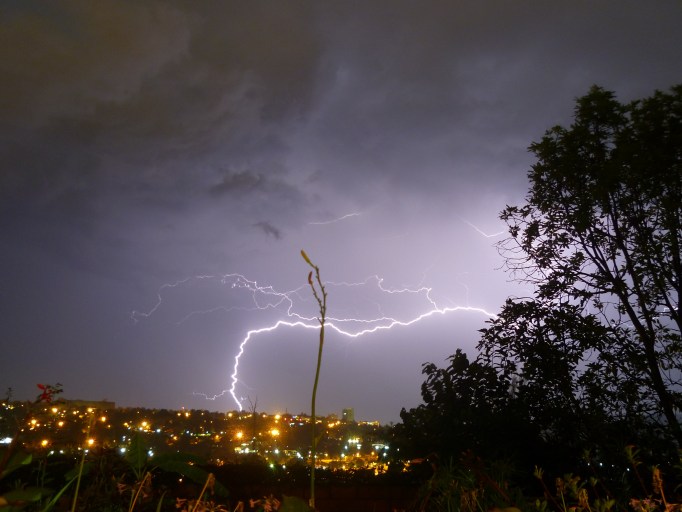
- a lightning bolt hits one of the thousand hills in Rwanda
This photo was too beautiful not to share, taken form my couchsurfers place in Kigali by Reuben’s small canon handheld on a 3o second exposure.

This photo was too beautiful not to share, taken form my couchsurfers place in Kigali by Reuben’s small canon handheld on a 3o second exposure.
East Africa is worlds apart from South Africa, but strangely similar to parts of Central America, the Caribbean, or India. At times it seems I’ve been transported to Nicaragua; one-storey concrete homes are painted by Coca Cola and competing cell phone networks; rice and unidentifiable fried meat are staple; servitude is acceptable by hierarchical class distinctions reminiscent of the castes in India; and the chaos of road traffic and markets are just functioning in a different language by darker faces. Reggae music creates the atmosphere of a Caribbean night as it blares from every street corner from the moment the town stirs awake at 7 am until the party stops in the wee hours of the following morning.
The biggest difference is the people: everyone here is unbelievably friendly and smiley! People always greet you and ask how you are, shake hands for a little too long and hug with extra rigor. Ive given up any notion of a personal bubble, since private space is invaded by almost anyone who talks to me; some latch onto my arm, stand within a few milimetres of me, and talk directly into my ear so close to my face that I cant actually turn to face them while they talk to me without knocking foreheads. Its only unfortunate when they have bad breath or you really do want to turn to face them to remember what they look like and you just cant.
People are genuinely interested in helping you, and will do so without expecting any sort of payment. Im not sure if its pity or curiousity, but the sight of a muzungu girl makes them think theres no way I’ll make it without their help, so everyone wants to know where Im going, do I know any Swahili, do I have a friend waiting for me, or what am I looking for. Upon giving an answer, it becomes their sole goal to help me find what, where or who I need and translate any language, directions, or pricing confusion.
Women wear beautifully colourful clothing, with elaborate pattern stamps in bright colours that shine in contrast to their dark skin. They’re quite modest, covering most of their body and head in wraps of cloth, and Ive learned that showing arms is ok, but leg-baring shorts causes me quite a bit of grief. That’s especially unfortunate since its so hot and Im constantly sweating through my jeans, and a little embarrassing since Ive seen few people break a sweat even in the most intense mid-day heat.
Its hot and dry here, with luscious green vegetation and red-mud huts covering all the rural areas. The dirt roads are bright red, contrasted dramatically by the green palms and crop fields. All the soil and spit up dust are also blood red, and it seems to keep most peoples clothes a little earthy coloured no matter how clean they are. Parts of Uganda and all of Rwanda are rolling, forever continuing hills, and almost every square foot of arable land is still exploited through terraced agriculture practice. When dirivng along the winding roads, its hard not to get car sick or frightened by the cliff-dropping heights, but the beautiful symmetry of the perfectly groomed hillsides makes for a very geometric scenery to enjoy.
I’ve decided to bus my way around East Africa, mostly to save money, but also to avoid the high end tourism market catered to with chartered flights. Terrestrial travel lets you see so much more, take in a scenic drive for hours instead of staring at the tops of clouds for 45 minutes. Traveling by bus is also better for the mind and body – it gives you time to adjust the changes in altitude, temperature, humidity, and the brain has more time to process its surroundings and sensual bombardment.
On most buses its impossible to sleep, and if you do, people immediately worry “are you feeling sick?” Preoccupying your conscious mind for 3 or 6 hours can either lead you to some new friends or some crazy ideas. Bus travel is supposed to be fairly safe, but I often get snapped out of my daydreams by an abrupt road block, since police checks are regular and they’ve always got important questions to ask. I can never understand what goes on, but their dialogue interchange is usually stern, slow, and results in an exasperated bus driver raising his voice and gesturing his hands in way that means to me “whatever, sorry, Ive got nothing!” Maybe their asking for registration papers, maybe a bribe, maybe illegal drugs… I’m not sure.
The buses have been less than luxurious, mostly due to overcrowding, but also an unshakeable uneasiness from excessive speeding and bold overtaking driving habits. Im still the only non-east African on every bust Ive taken, and this could be a warning Im refusing to take notice of but I’ll keep believing I truly enjoy the excitement and entertainment of each ride. I’ve had half-dead chickens in a box beside me, a 10L jug of water splashing at my feet, and a 5 kg bag of flour explode ontop of me. Most buses have assigned seating, but the taxi cars and mini-buses usually have two people per seat and a few more standing in between or shoved in the trunk. I’ve had children refuse to sit beside me, even though women plop them on my lap when they’ve got too many to fit on their own. Im not sure if they’re afraid or too shy, but other children can’t get enough of me as they grip at my skin to make sure Im real.
Most people know about the ludicrous gorilla wildlife tourism market in Uganda and Rwanda, but some may not realize those same gorilla groups wander passportless to the DRC and thus, also gorilla track in the Congo. The benefit is its cheaper and not sold out months in advance, but the pitfall include bad organization, unreliability and arguably more dangerous. I talked with a tour agent in Kampala, Uganda, who thought it may be hard to get a gorilla permit in any of the Ugandan parks, so connected me with a tour operator in Bunugana, the border town between Uganda and Congo.
His name was Jackson, aged about 30, portly and soft-spoken. He met me in Kisoro a few kilometers out of Bunagana. It took me 6 hrs on a bus the night before to get to Kabale, then 3 hours in a car taxi to get to Kisoro. You’d think the bus ride was worse, but atleast it was during the evening, since the car ride was intolerably hot, and involved the driver squishing 8 adults into a 5 seater sedan. I shared the front seat with another woman whose dress smelled like menstruation, and the driver shared his seat with a man whose legs cradled the stick shift. In the back, the four squeezed sardines looked slightly more comfortable.
If that doesn’t sound bad enough, imagine the entire dirt road under construction, with stop and go one-way traffic, semi-trucks spewing constant dust clouds on the air-conditionless car, and keeping our windows shut to avoid being coloured red by it and instead cooking in the 8 person sauna at high noon. It was fun.

Jackson making dinner while the laptop entertains us
When I finally met Jackson, he put both of us on one moto-taxi, and 3 people on an 8km ride with speed bumps the whole way to the Congo border was certainly an upgrade, but not necessarily luxurious. We sped to the border which he explained we needed to clear my Ugandan exit since it was almost 5 pm, and in the morning we wouldn’t have time to do anything but clear the Congo entry visa. The borders are only open during sunup, so we would have to wait from 6:30 am outside the congo border to get my $50 8-day visa available only at that border for that province of Congo (other entry points are more like $150-$250) and only because I had a letter of invitation by the gorilla park rangers.
We then walked over to Congo anyway, and with a head nod at the right guard, were free to refuge illegally in the Congo til the border reopened. There was a few metres of no mans land, where French, English, luganda and a Congolese dialect all mixed together, and then I enjoyed a coca cola on the patio of his Congolese family. We were to stay in their extra apartment, which was just one big room, no electricity, no running water, and a dingy mattress on the floor that he usually shared with his 3 sons.
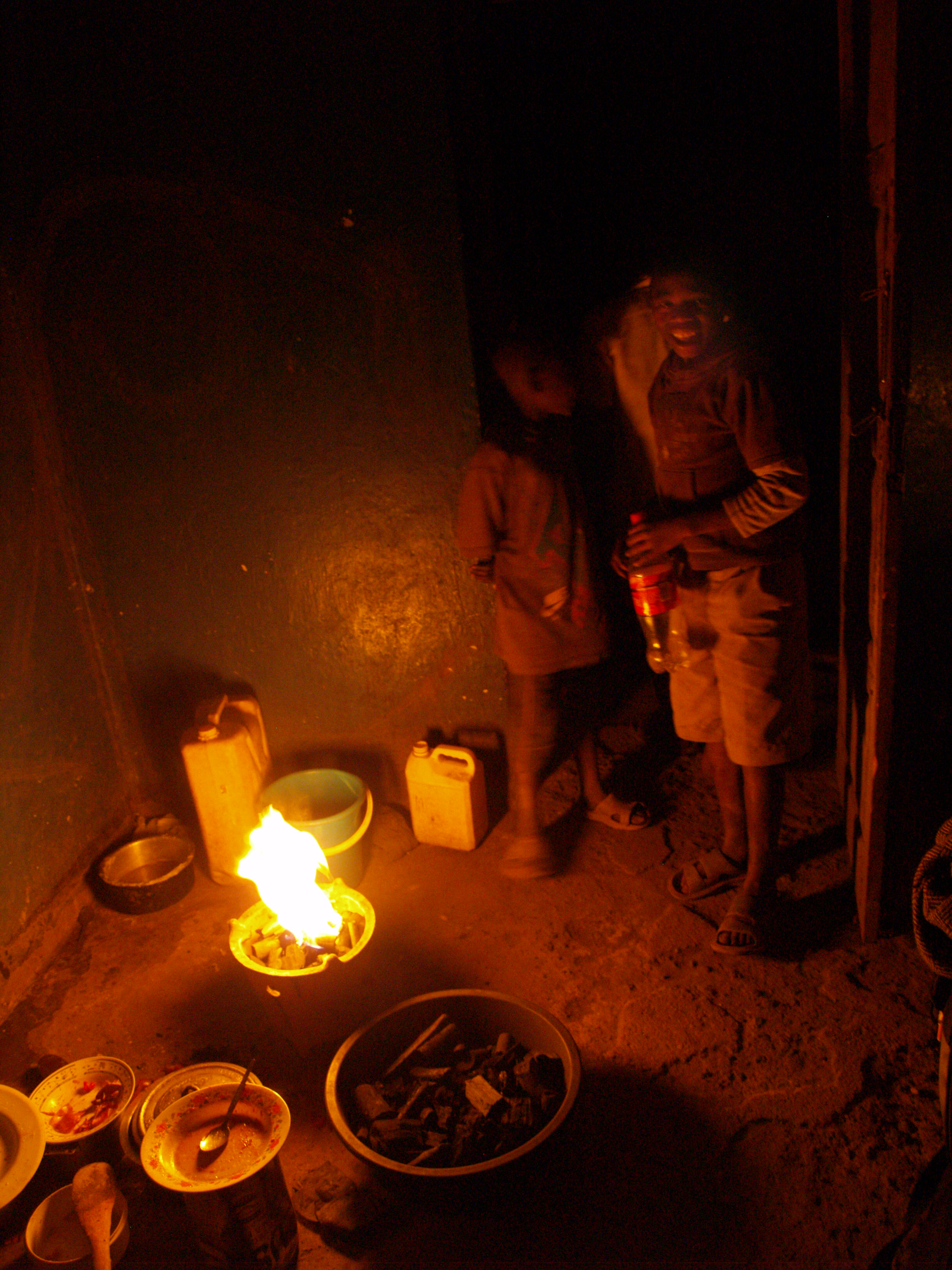
prepping the coal stove
At this point I was kind of reconsidering my idea, but then the other Katrin whispered “you can totally do this, this is how everyone here lives.” So I stuck it out, and the apartment slowly got cosier and cosier. The boys lit some coals and a few candles to provide light and heat, Jackson brought out his laptop and played Ugandan reggaeton music videos, and he cooked chapatti over the coals in a pan much too dirty to eat out of. Then he paired it with warm beer, and all of this I pretended to take graciously since I couldn’t even leave if I wanted to – I was already exited out of Uganda and illegally in the Congo.
Sure enough, the night was sleepless, and Jackson wanted to confide in me his whole life story and feelings of loneliness. It was awkward, inappropriate, and perhaps my fault, but by 6 am the borders had opened and I tried to start the day anew with a goal to try and choose my tour guides more carefully. It turned out I wouldn’t get the Congolese visa the next morning, since the park rangers were not at the border in person to confirm I was tracking gorillas, so Jackson suggested I stay two nights and be patient.
I literally ran away back to Uganda at the crack of dawn. The problem was I was now illegally reentering Uganda, and I actually had to escape both the Congo and Uganda to hire a moto-taxi to take me the 14 km to the Rwandan border. Thank god no one noticed that I had been stamped out twice since I would have had to reenter and pay another $50 Ugandan visa. Even more thanks to God when I finally arrived on Rwandan soil and got issued a visa even though I wasn’t eligible for one since I dind’t have local papers and didn’t preapply for one online – perhaps another piece of useful information one could take from this blog.
I find it fun to get off the beaten track, or atleast avoid the tourist trail by taking local transport. So far Ive been the only non-east African on every bust Ive taken. Im also always the only person with a backpack, even on the 5 hour rides accross the country where the most people are carrying is a days worth of crops. When they do have something to carry and no bus to shuffle them to and fro, people hoist their possessions ontop of their heads, and I see people walking along the side of the roads in some of the most remote areas, at all times of day and even night.
In the mid heat of the day, its not unusual to see a 5 year old carrying something that’s probably bigger, heavier or longer than them, strolling along the side of a highway. Women carry huge reeds and stick piles on their heads, as well as buckets full of water that must weigh a ton. They carry suitcases, mattresses, upturned tables, watermelons and raw fish, some for sale and others to take home. Sometimes two share the load and carry 5 meter tree trunks on a shoulder each, to who knows where or even from where.
It seems most people walk everywhere, no matter how far, since horses, donkeys, camels, or even the wheel aren’t common labour aids. And sadly, they use the roads built for those rich enough to afford cars, buses or bikes, which proves to be quite dangerous since they usually have no sidewalks; car accidents hitting pedestrians are one of the leading causes of fatal accidents on the road.
The trees are probably being cut down for burning, since one environmental issue in Uganda is deforestation from dependency on coal. Coal is sold in bags on the side of the road, fairly cheaply, and as soon as nightfall hits, the smell of burning coals hits your nose from every direction. Families are using it to cook delicious food, boil water to drink and bathe, as a source of light and sometimes for heat.
There is amazing tilapia fish from Lake Victoria that you can buy fried as street food. Ethiopian food is also popular in Uganda and its so delicious and affordable. Local food almost always consists of matoke (mashed plantains, which they always call bananas), cassava, posho (a food staple made of maize flour) and rolex – a breakfast wrap made of eggs with a kind of chapatti bread feel. They have mini-bananas here, that are much sweeter than regular bananas, and eating them is more fun – although for one bite some get impatient to peel them, like my bus driver who just put them back, peel and all, in one big bite.
Being a former British colony, they also sell ginger beer, and the local beers are Nile Special, Bell and Club – all available for about $1USD per 500ml bottle. They apparently have Ugandan wine, which I haven’t tried in suspicion that its terrible, and a millet-based alcohol called Waragi that smells like gin.
One of the official languages here is English but not everyone is as comfortable in it as Luganda, the most widely spoken Ugandan language. But there are so many other dialects, sometimes totally unrelated, and its normal for people to speak 5 or 6 languages according to what languages nearby tribes speak.
Theres quite a Sudanese presence in Uganda, since the border they share is slowly getting safer after South Sudan declared independence from Sudan. They speak and dress quite differently, and are not to be confused with all the Indian decent locals who came to Uganda during British rule as labourers. There’s still some racist tension between the two groups, even though both are born and raised Ugandans.
Its been interesting to travel around here as a solo muzungu, and I certainly get a lot of strange stares. Sometimes people seem to think absolutely nothing at all, but just stop to stare to take in the strange sight. Other times, they’re inquisitively checking me out, from head to toe, wondering what the heck Im doing all alone, where Im from, and maybe what Im thinking. Meanwhile, Im noticing their gaze, and glancing back at the stares, wondering what they’re thinking, and I realize its just circular curiosity – we’re both just wondering what the other is thinking, equally baffled by what we’re seeing.
To get from South Africa to Uganda, I had to change planes in Rwanda. At Kigali International airport, I waited on the tarmac for my next plane, and was issued a boarding pass for “Kategre Ndege.” Im still not sure if that was someone else or a rough Kinyarwanda translation of my name…
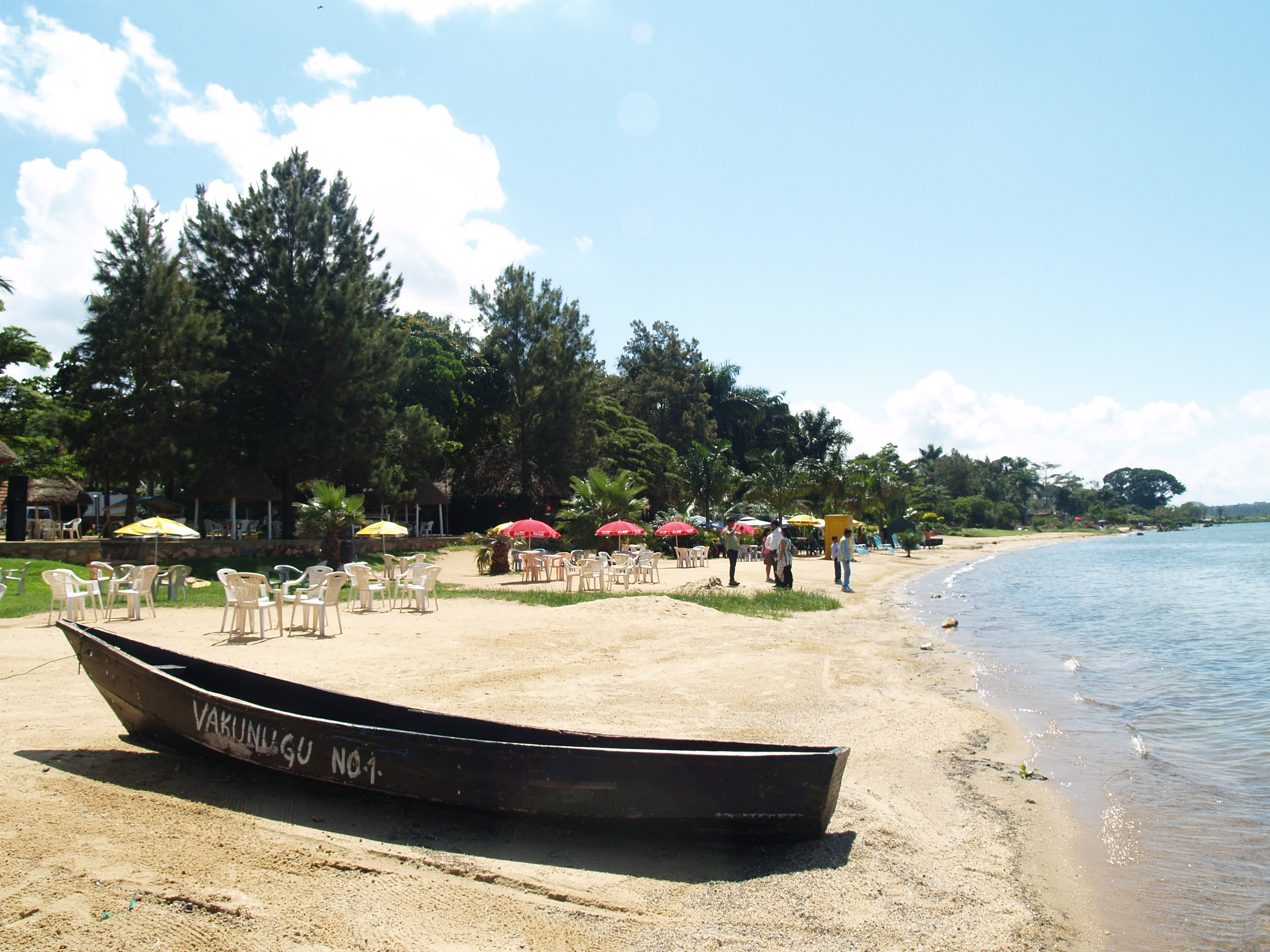
the shore of Lake Victoria in Entebbe
My east Africa trip started in Entebbe, the international airport town on Lake Victoria which has a huge UN presence. Couchsurfing with a couple of them made me feel like I wasn’t too far from home or that exotic but as soon as I traveled west, the word Mzungu greeted me everywhere I went. Mzungu means “foreigner” or “white person” and thank God we’re no longer seen as colonial devils since children run up excitedly to wave and yell mzungu. In earlier times, from the start of the slave trade and into about the 60’s, children would run away from any white people they saw since it was a common saying for mothers to warn their children, “behave or a muzungu will eat you!”
Its been a whirlwind since I arrived in this beautiful place. It borders magnificent Lake Victoria, boasts the start of the longest river in the world, has snowcapped mountains at the equator, has the highest concentration of primates in the world, and amazing bird watching. Some say Uganda is the pearl of Africa, squeezing in all the African attractions you’d ever want in one, very-safe country. Funnily enough, this hasn’t caught on with backpackers yet, as the infrastructure for traveling around the country alone is pretty minimal (and insanely cheap). There is usually a hostel with a couple other mzungus in the main cities and most touristy places, but most of the tourism is high-end tourism related to gorilla wildlife tracking.

the big boss walking past my gorilla-tracking friend Jon who took this great snap
Gorillas are the biggest driver of wildlife tourism in Uganda, Rwanda, and Congo has recently reopened their parks and begun hosting more gorilla tracking tours. They all cooperate on price (circa $500 for an hour with a group) and work together for conserving their natural habitat since it sits most of the gorilla groups live within the tri-national park. Since the gorillas are free to move between all three borders, its possible that the gorillas all slowly migrate to one or two countries, but so far, their numbers have only been increasing and many groups are totally habituated to human presence, so it looks like the gorilla tracking industry will just keep growing in all three countries. Im hoping it won’t only bring more international visitors to see these primates, but also allow travelers to discover the other hidden jewels in these sometimes misunderstood and underrepresented countries.
Last week I attended an international conference on Sustainable Tourism in Kampala, Uganda. It was hosted by Makerere University, which is one of Africa’s oldest and most prestigious universities. Although it was established by the British and probably maintains excellent tuition, the campus itself seems weary from lack of funding, and parts of it look more like a deserted army base with crumpled buildings surrounded in rusty barbed wire fence. Around the skies above the hill the university is perched on circle dozens of Malibu storks, with massive wing spans and vulture looking stances. They sit on the tops of trees and create an eerie atmosphere, though they’re truly beautiful. Locals consider them the pigeon of Kampala, annoying garbage scavengers with stinky poop.

a malibu stork at dusk on campus
There were mostly Ugandans and Americans at the conference, in total about 100 people, and some interesting characters made the 3 days of constant presentations barable. There was a Masai from Kenya jingling around in his colourful garb, one very enthusiastic Chinese professor who was extremely difficult to understand, and an American professor who had a squinty, perma-“huh?” face twisted up so weirdly that you always wanted to ask him “are you alright?”

the welcoming committee at the ATLAS Africa Tourism conference
The conference was a first for me, and I was happy to present my research on ecotourism but it seemed like no one was really there to hear you talk, but to see if you were useful to them. People capitalized on the coffee and lunch breaks to network with all the most strategic people and once in a while, swap business cards with those people they found interesting. When presentations sparked a discussion, there was barely time to facilitate a dialogue since there were 6 consecutive sessions running at any given moment, for only 30 minutes each.

my Masai friend James
In the end, I kind of noticed that everyone had something smart to say about sustainable tourism in theory, but only bad things to say about actual cases of attempted sustainable tourism. Local Ugandans complained about it as a form of neo-colonialism and almost everyone recognized tourism as an activity exclusive to the rich. In the end, even the things we had to say about theory just ended up having a lot of academics and practitioners talking in circles, so not much came out of the conference except new friends and potential industry connections. For me, I lucked out with some great connections in the places Im headed next, and some well-knowledged people who actually know a thing or two about tourism in East Africa since the backpacker trail seems hard to track.

its a debatable, so-called "Start" of the nile, but its certainly one big arm of it flowing out of Lake Victoria. However, not up for debate is the magnetic attraction kayakers have to this place, seeking out the white-water rapids - some even class 6 level.
Until now, Ive only ever been to southern Africa and Egypt, and while people miscorrectly refer to Africa or African as an entity, each corner of it is worlds apart from the next. Southern and northern Africa are completely different from western, central and Eastern, and even those broad generalisations of regions of Africa refer to 5 or 10 totally different countries. Then within each country, you’ve often got 10 to 50 local languages, a complicated history of colonisation and independence, and dramatically different landscapes and climates.
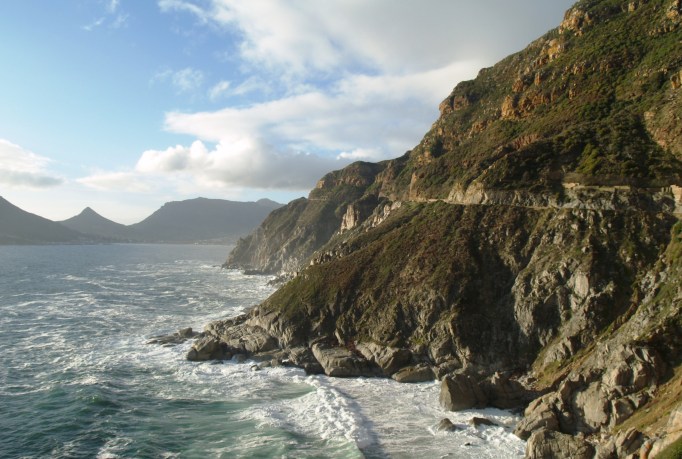
Chapmans Peak Drive around Cape Point
When someone asks me “what’s Africa like?” I have a feeling of what they’re picturing: something between poverty, danger, disease, black faces, hot climates, dense jungle, and poor infrastructure, and its certainly not a question I can answer having only been to a few places in Africa. So far, Ive learned there is civil unrest, political instability, impenetrable wilderness, poor and sick people and a very hot sun, but only in a fraction of the continent. There’s also a lot of the opposite, and places the size of Iceland with not a singe person living or traveling through them.

Cape Point, in all its glory
There’s unbelievable wealth in South Africa, especially in Cape Town, and neighbourhoods that make me believe Im in Brisbane or Sydney, Australia. Cape Town is also cold; its only been hovering around 11 degrees celsius since I got here, with periods of torrential rainfall worse than Vancouver and windstorms that compete with the fierceness of Iceland’s climate.
Today was the first day of sun since I arrived, and I felt like a blossoming flower gravitating towards its rays for warmth, and very catlike as I curled up in the sunlight on the only edge of my bed being lit.. It also felt like a rarity since the days are only 10 hours here, from 7:30am til 5:30 pm, a big change from the 22 hr sunlight in Reykjavik I left. All the bad weather was great for my writing, since I wrote my first complete childrens story and also started brainstorming for my first book.
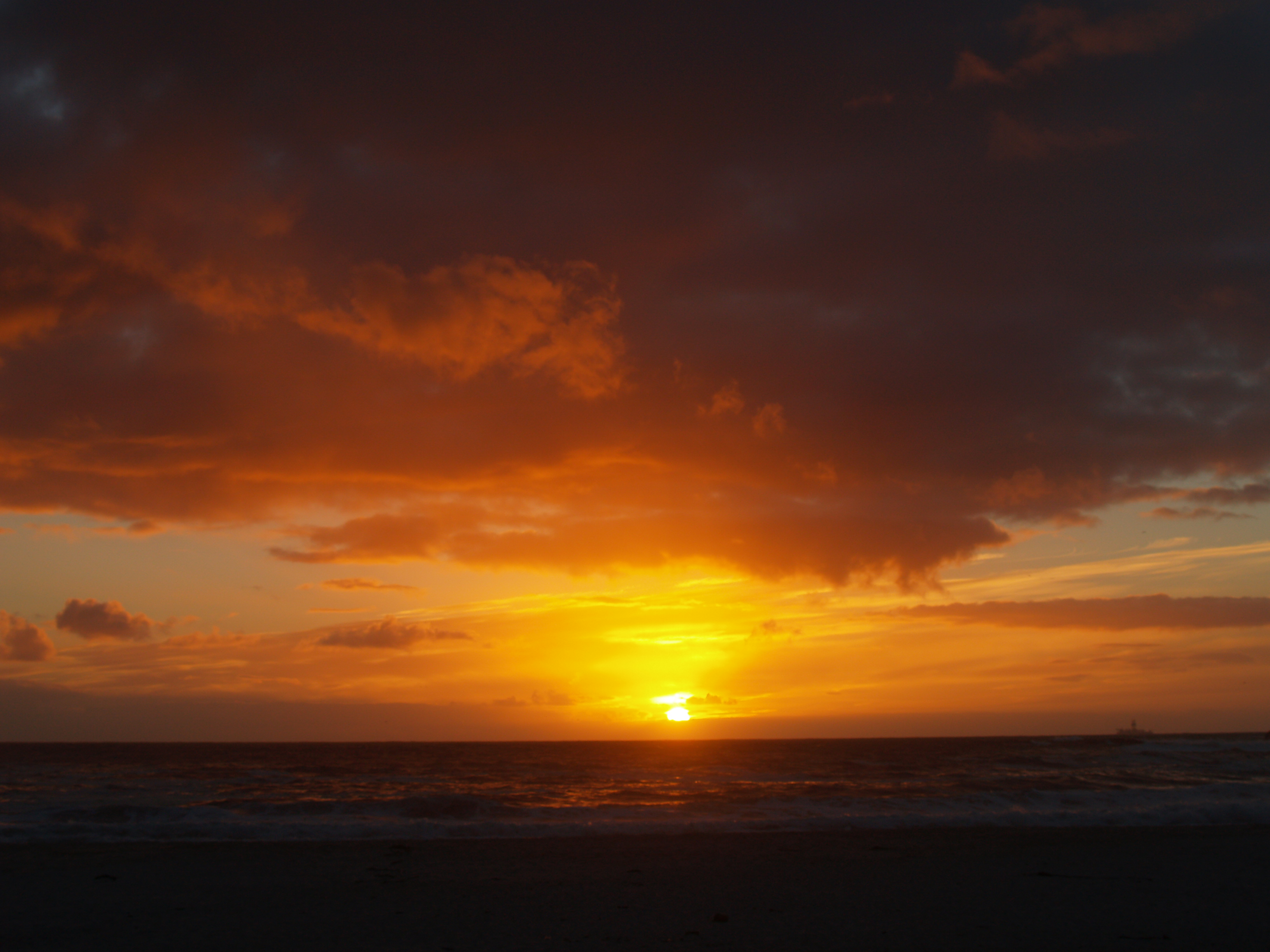
a 5:30 sunset from Camps Bay
I managed to have quite a few bubble baths, since Capetonians are not used to the cold and built their houses with zero insulation. You may as well wake up outside, when you crawl out of bed to a 10 degree apartment, so a hot bath is one way of warming me up, and another way to reconcile my longing for an Icelandic hotpot.
I love that Cape Town is on the sea, and on 2 seas at that – both the Atlantic and Indian Oceans battle violently at the bottom of Cape Point, and suicidal kite surfers take advantage of the huge winds to ride waves like the adventure-seeking extremists that they are. Surfers tempt fate as they enjoy the consequential great waves, in some of the most infested Great White Shark waters in the world.
I took a tour to Seal Island, a colony of thousands of seals that hopefully keep those sharks satisfied enough not to take my leg when I surf. The thick 5mm wetsuit I wear while surfing kind of makes me feel like a flailing seal, so thats worrying. But so far, so good.
Enjoying the waves from the sandy beach shore is much more assuring, and I did that in the most amazing way possible. I went with a local guy on two, HUGE, retired racehorses to Noordhoek beach, and we virtually had the entire thing alone for us to race fullspeed and frolick in the wake of the shallow waves. My legs are certainly suffering now, but it was well worth it.

kite surfers at Scarborough Beach
The thing I love about travel is Im always experiencing new places, new faces, and making new memories, and trying to absorb, digest, and make sense of them all is exhausting. So it doesnt help when you get trashed around by morning waves on a surfboard and your ass kicked by a monstrous horse, since mind and body recuperation simultaneously seems to happen slower. Although, as confused as I may get, I cant even remember the names of the 11 official languages in South Africa, let alone speak any of them except english, so Im constantly refreshed by the people I meet here to keep pushing for more unfamiliarity, more novelty, and just take things in stride.
There is a tiny town nestled on the Atlantic side of Cape Point, right beside Table Mountain National Park, and its home to one of the most beautiful, dramatic beach scapes I’ve ever seen.
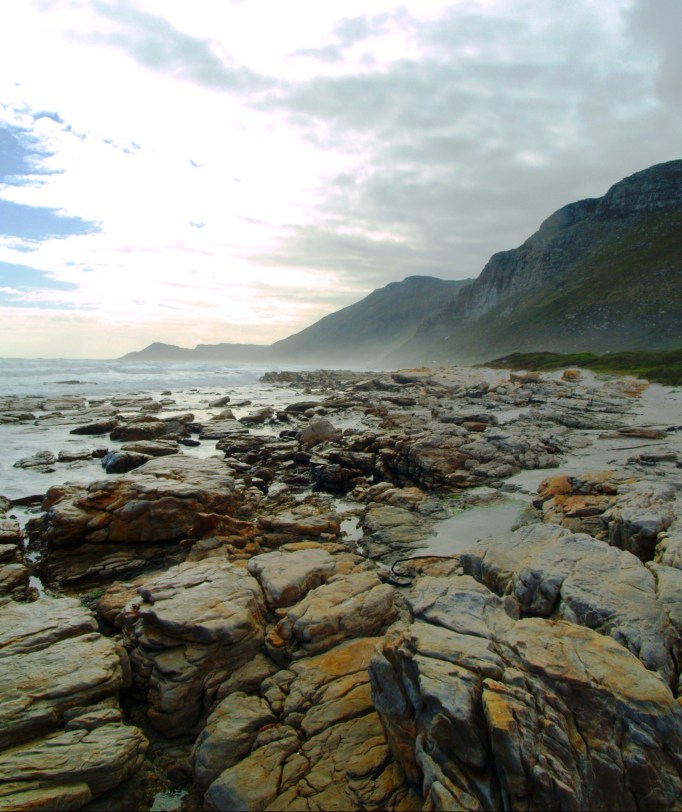
Scarborough Beach on the Cape Peninsula

a pair of sleepy African Penguins, totally accustomed to camera-happy tourists only inches away
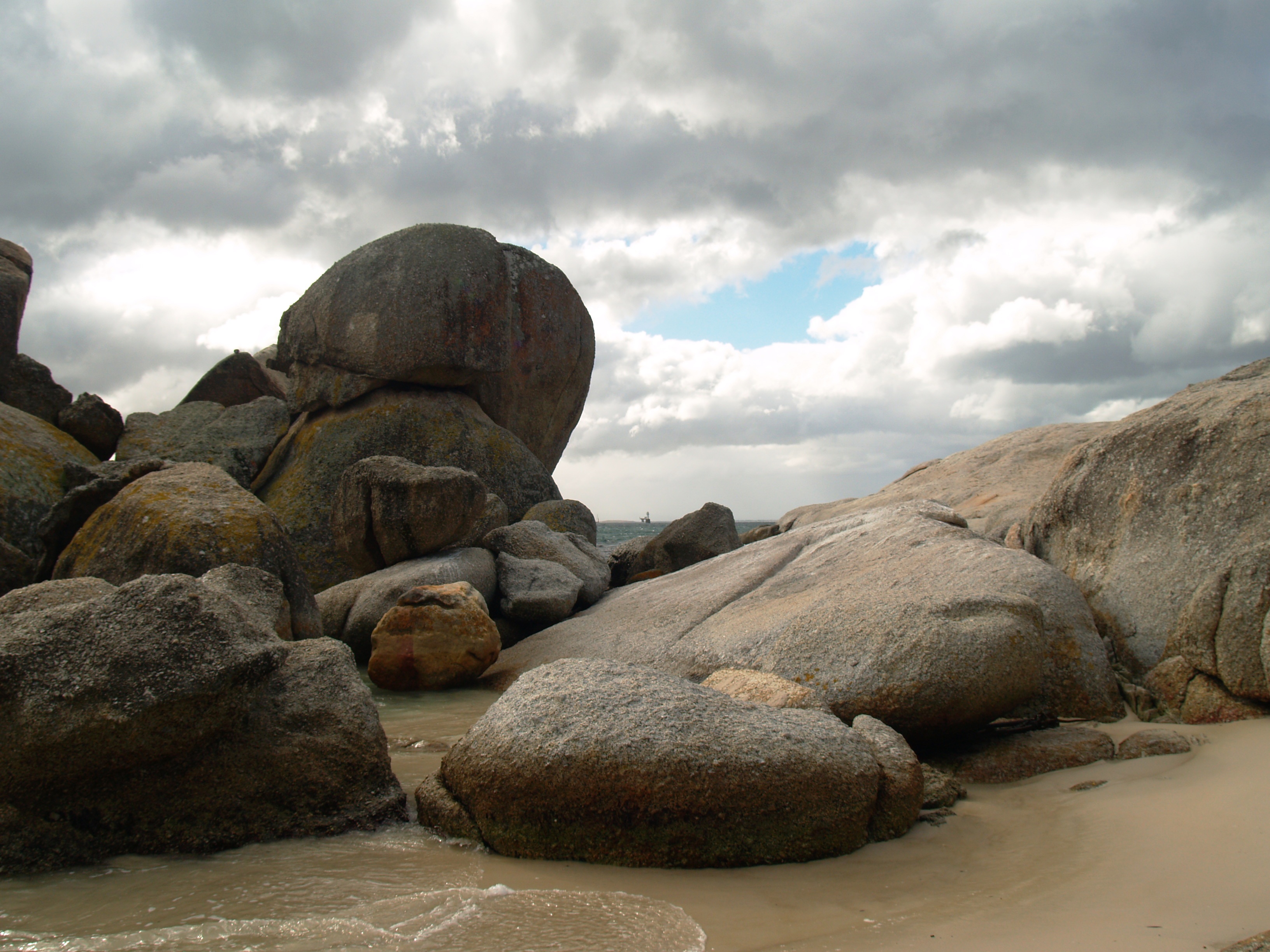
Appropriately named Boulder's Beach in Simon's Town, which is full of black-footed aka African Penguins
 nomadic cosmopolitan