Memorable Impressions of Central America

I found it weird that Christmas was in full swing the minute after Halloween ended, and also weird that Halloween was any occasion in the first place. I didn’t see any trick or treaters, but I did crash a family Halloween party in Panama city with a lot of orange and black decorations and a dalmation dog wearing pumpkin lights. Christmas songs have been playing on the radio and Christmas lights have been on sale in the markets for all of November, and I guess that might have something to do with the fact that they don’t celebrate Thanksgiving or Rememberance day between the two holidays.  

I had to get used to the fact that a lot of men just carry around machetes strapped to their belts, both in town and in the lonely countrysides, occasionally convincing myself that they’re probably not used as weapons, just crop tools. Although it made me wish I carried around some functionable item that doubled as a weapon. My friend Jeff in San Jose, Costa Rica, lent me his umbrella one day that did just that, but they’re just to big and clumsy to travel with. Maybe they make sweet smelling pepper spray that can double as deodorant? Someone should patent that.

for the best market finds, pay only in cash, with small bills (or coins). Across from this market in El Salvador Guy paid $0.02 to use the internet for 5 mins, so dont say pennies are useless

Having to function in a new currency and exchange rate every week was fun, trying to figure out all the coins and bills and actual values of them. In Honduras, their lowest paper bill was 1lempira, which is the equivalent of 5.3 American cents, and they had bills in denominations of 2, 5, 10, as well as 5, 10,and 25 cent coins!

One reoccurring problem I always had was that people hate accepting big bills or making change. It may have something to do with the fact that things cost next to nothing, but even if you were paying with a bill with the equivalent value of 2 euros, people would scratch at it and hold it up to a light to make sure it wasn’t fake before grumbling about having to give you change.
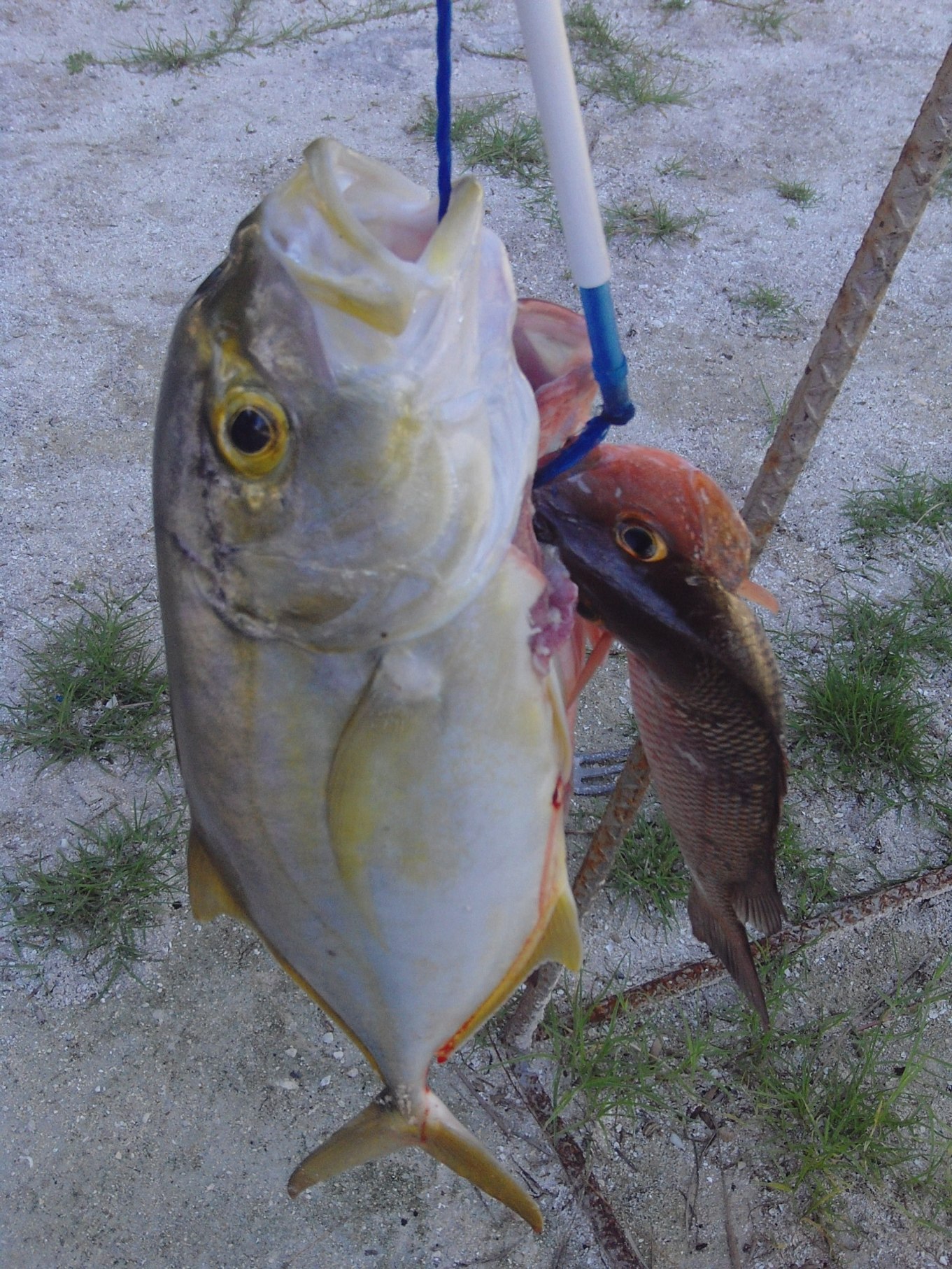
the one time you dont need cash for dinner is when you fish it yourself - these catches in Caye Caulker thus tasted even better

Cash seems to be the only way to go as well, with atm’s and banks nonexistent at borders, replaced by a bunch of businessy looking men strapped with the biggest wad of cash their hands can hold. I guess there’s no point in using VISA for $0.25 purchases, but then when you want to buy something expensive, the only way to get it at a reasonable price is to pay in cash or else they charge weird visa surcharges. To make sure I always get the haggling discount, I had to visit in ATM every week or so to minimize the amount of cash I had to carry around, and of course they only dispense big bills for big withdrawls. Shockingly though, one ATM in El Salvador dispensed $10, $5 and $1 US bills – $1 US bills out of an ATM!

Terrestrial Travel in Central America

Traveling from Panama to Mexico is actually pretty easy, so long as you don’t mind taking a lot of time to get from A to B. Transportation deserves its own blog entry because I’ve probably spent half my trip just traveling. So far I’ve kept track of 41 buses, 25 collectivos and taxis, 5 private cars, 6 boats, 2 horse carriages, 1 horse and 1 scooter that have got me to where I am now in Belize. The roads have been horrendous, and I’m not talking back streets, but main highways and the only roads connecting towns to one another. Sometimes they’re just plain old undriveable due to flooding, rockfall, mudslides, missing bridges or collapsed banks, yet so many huge, coach buses and semi’s traverse them regularly. And I’ve never seen so many semi’s full of rusted metal cargo, anyone know what that’s about? In addition to all that, impossible mountains, curvaceous roads and reckless driving always kind of made me wish I was walking instead. Although, with the exception of rowing into Panama, I always got to walk to my next country since buses drop you off at only the first of 2 border crossings needed every time, one to exit the country you’re in and the other to enter the country you’re going to. Sometimes the two crossings are more than a kilometre apart, and I can’t understand how they really control the area between since locals seemingly wander freely between both. Sometimes I have a hard time even finding where I need to go for my stamps and accidentally end up in the next town without realising I’ve ‘entered’ the country, just strolling along.

maxell Digital Camera

one of the cliff-hanger, deadly switch-back roads leading down the mountain into Lago Atitlan, Guatemala

Buses are actually like driving markets since street vendors sell everything on board; no need to go to the market. While on the bus, street vendors take the opportunity to hop on, both while we’re parked and also just come along for a few kilometres before hopping off, and sell all sorts of random things. People carry their entire inventory somehow attached to them in an organised, presentable way. One guy pitched toothbrushes, backscratchers and a foldable fan all in one breath. Some come on dressed as clowns and act out a short comedy sketch for tips. Others come on claiming medical knowledge to sell you creams and herbs that all look like tiger balm to me, and some just want to show you their own health ailments like dumbness, missing limbs or freaky tumors growing out of their stomachs. Those who only sell one thing specialise in yelling it over and over in rapid succession, most popular being ‘PAPASFRITASPAPASFRITASPAPASFRITAS’, and ‘CHICLETSCHICLETSCHICLETSCHICLETS!’ Some don’t bother coming on board and at a stop light just come up to the window, ‘FRESASFRESASFRESAS’ or ‘AGUAAGUAAGUAAGUA’ while sticking said item into your window on the end of a big stick.

SONY DSC

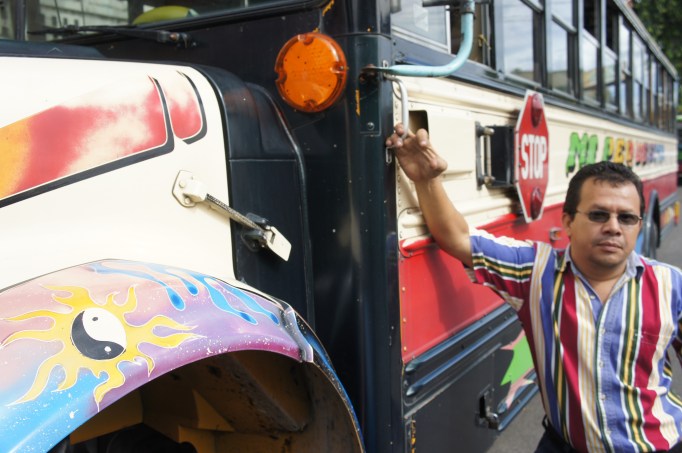
our friendliest bus driver, who smiled all the time except when a camera was pointed at him, and insisted we have a photoshoot outside his bus

The buses in central America are beautiful works of carbon-spitting art, to put it simply. Drivers put a lot of pride in the decals, stickers, disco lights, neon and colour patterns both on the inside and outside of their buses, and the most popular long-haul local bus is an early 90’s Blue Bird school buses that probably got shipped here from the US when they couldn’t pass smog check anymore. They have the capacity of about 55 children, but maybe 60 adults squish the popular routes. They’re affectionately called chicken buses, and some upper class locals even refuse to take them, but in my experience they’re a lot more entertaining, but a lot cheaper for a much longer (just in time, not distance) journey, and I always appreciate more bang for my buck. Just be prepared that the journey will take at least an hour longer than the driver tells you, and will include numerous stop and go pickups of people on the side of the highway that don’t count as “stops,” so all buses are “direct.” Not quite true, but I’m not in a rush so I’ll just keep enjoying the scenic route.