Highlights of Dominica


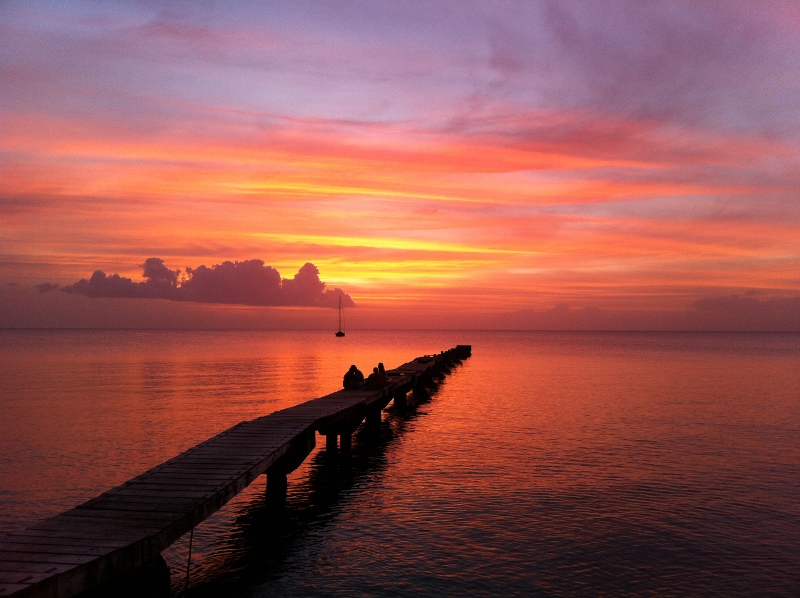
west coast sunset

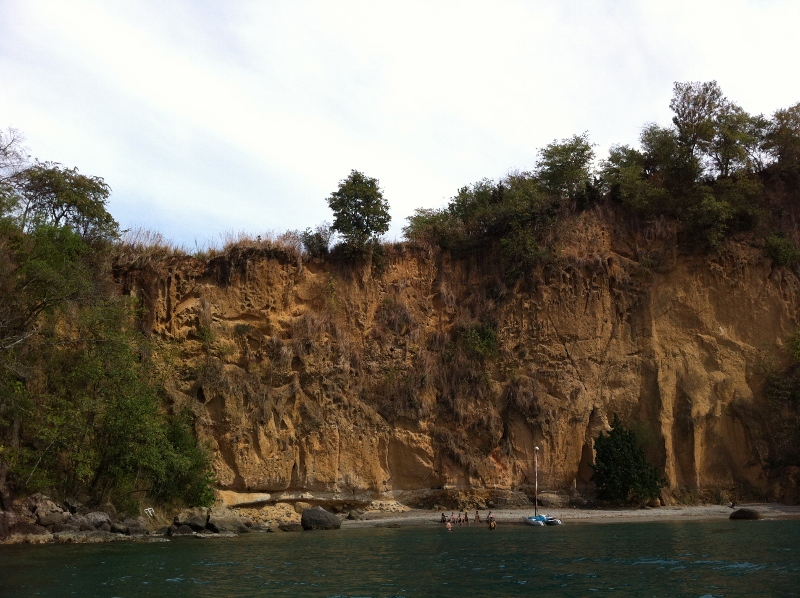
Secret Beach

I spent a couple days traveling around with a German couple from Dresden, who met me at the Portsmouth Ferry terminal. We asked Shorty to take us to Secret Beach on his motor boat, a small, secluded, hidden beach isolated between a massive cliff and the Caribbean sea. There was a cave you could wade through, through a narrow passage with only space big enough for your head to stay above water that opens up in a big bat cave.
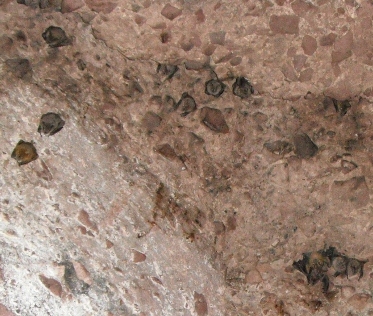
bats in the cave

We took a cruise up Indian River, a protected area where motorless boats get paddled up by slow talking rastahs. At the furthest point up the river, there was a small bar serving peanut punch, guava wine, and rivergrape wine, aka ‘fat-pork-stain wine’ (all disgusting, unfortunately). Our guide was Gregory, not Jeffrey, because “Jefferey is J and Gregory is
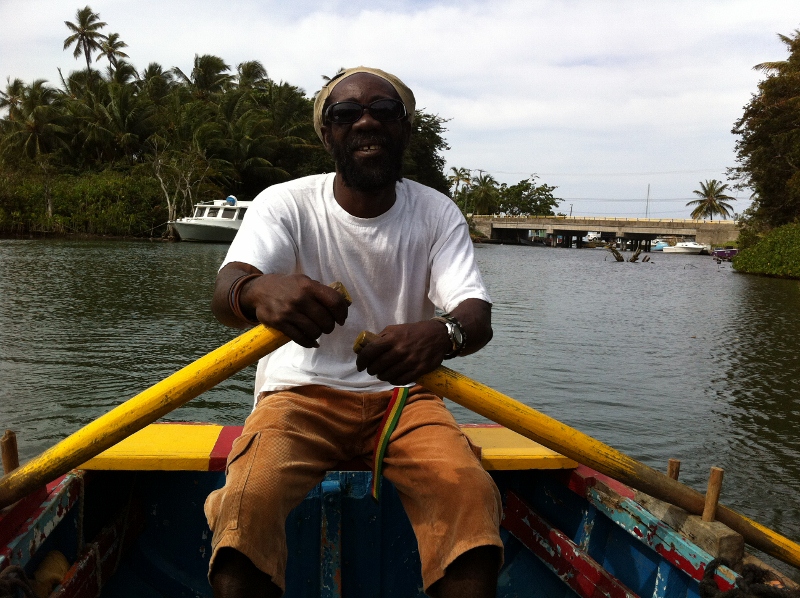
Gregory

G and they really not so much matching.” He apologized if his English would ever be “not englishable enough,” but could speak German, French, English, “I can speak anybody.” He explained the bamboo is not “originated,” the seamoss is “nice deliciously,” the mangroves were very “livable,” and the river “swimmable,” with no “dangerosity. He pointed out some fish that eat crab’s legs, and saw one crab still alive with only 2 legs left that was “well f*cked up.” We saw a hummingbird which “beat his wings 250 time before one second flow.” He took us to a “postcardic view with all the

Indian River

good vibes” where its “nice scenery, nice breeze, nice reflection, nice everything… its just nice to be nice.” We thanked him for a great tour and his entertaining narration, and he asked us to come back because “that’s how I do business, more for less, the more I work, the less it cost, sometimes I work for nothing, that’s how cheap I get.”

Me and Ordovich feasted on lobster with a couple other medical students, the sunset painting an

lobster feast

unbelieveable background. When we went horse back riding, we rode up the hill deep into a luscious forest, passing lime trees, mango trees, avocado trees, cassava trees, banana palms, pineapples, coffee bushes, cinnamon bark, breadfruit, yams, carambola, red lavender flowers, coconut palms, and lemongrass – all seen growing from a trail less than 1 km long.

We went to Macoucherie Distillery, a local rum factory that looked

Macoucherie Rum

as though it had been abandoned 50 years ago. But a handful of staff kept it running, one guy in the office who was the default tour guide since the other 3 staff were busy crushing sugar cane. They make the rum from start to finish, and only age some rum 1 year while the others aren’t even bottled, since you bring your own empty bottle to fill it straight from the cask for just a few dollars.

cassava bread in carib territory

They left me at Trafalgar Falls near Rouseau, a beautiful place of freshwater and hot geothermal water meeting between rocks at the base of a waterfall. Me and Will, another couchsurfer from Portsmouth, went hiking in Cabrits National park in the north of the island, exploring Fort Shirley and some old canons. We took a bus past Calibishie to the Atlantic side, where Carib territory begins and fair-skinned, skinny-nosed natives harvest cassava. They pull the roots from the tree, peel them, and grind them down to flour to make cassava bread.

Trafalgar falls

We spent a few nights out trying the local beer Kubuli and listening to a lot of Reggae. We met a bartender who was expecting his first son with his Chinese girlfriend. We asked him what the baby’s name would be, and he laughed and said “Im gonna throw a pan down on the floor and whatever sound it makes, Ching Ping Pong, and itll be something like that!” When leavin Dominica, I saw a guy with dreadlocks so long they actually touched the backs of his heels on each step… simple, but memorable additions to my Dominican highlights.

Guadeloupe to Dominica, chez Ordovich

I ferried from Pointe-a-Pitre with L’Express des Iles, the most organized public infrastructure for transportation I’ve seen in the Caribbean. The boats are brand new, always on time, and run often enough for it to be practical for both tourists and locals. It connects Guadeloupe, Dominica, Martinique and St. Lucia a few times a week in each direction, and a one way costs little less than a return ticket, and a one way costs the same if you’re going to the next island or the last island. It seems logical that you could scam this into cheaper travel if you plan things right, but paying 70 euros each ride always added up to too expensive – even more than flying with LIAT.

LIAT is another convenient but expensive means of travel. “Leeward Islands Air Transportation” connects all the islands from Anguilla to Barbados, and further down to Trinidad and Guyana, but isn’t exactly the most organized company. The LIAT acronym is also interpreted as “Leave Island Any Time,” or “Lost in Airport Terminal” and “Left in Any Terminal” for their notorious mishandling of luggage. The planes leave 40 minutes or early or 1 hour late, with no accurate updates given by any of the misinformed staff. Sometimes the pilot doesn’t show up, or no one is working to check you in, and I even tried to check in for one flight that a LIAT employee insisted didn’t exist (she eventually found the right flight number to print my boarding pass).

There was a strange secrecy or exclusiveness with ferry travel that I didn’t quite figure out. The two French Islands Guadaloupe and Martinique are separated by Dominica, an independent, poorer Island, just like St. Lucia further south. The French nationals traveling with EU passports were normally searched and questioned about smuggling in cigarettes but little else, while the Dominican and Lucian passengers were barely allowed to buy tickets to France without showing hotel confirmations, contact numbers of the people they were visiting, a reason why they were going, more than 25 euros per day they would be there, and an emergency contact number if anything should happen to them. It was like crossing the Mediterranean from an uncivilized Africa to the pristine palaces of Gibraltar, when in reality the islands are right beside eachother sharing similar culture, history and people.

Yet, you still felt different in Guadaloupe, as though you were in mini-France, with its paved highways and overpasses, traffic lights and round abouts, shiny little Citroen cars and scooters; the people – fair, their clothes – branded, their French – Parisian. In Dominica, the roads are unpainted and undivided, the intersections simply yield to oncoming traffic from the main road, the beat up cars magically keep on running, and the rastahs outnumber the expats, speaking creole and Patois I rarely understand.

Me and Ordovich on our gallant rides

Still, life goes on the same way, hot and slowly, day by day, but I had left the air-conditioned apartment of Francois for the coackroach/ant/mosquito friendly apartment of Ordovich. He lived in Picard, a mini-America south of Portsmouth. Hundreds of medical students attend Ross University there, and do little more than see the small confines of that village. Ordovich was different, not cursed by the solidary life of perpetual study, traveling around Dominica more than most. He took me horse back riding in some wicked cowboy boots, and told me about Secret Beach, a spit of sand reached only by boat. He hadn’t been to the neighbouring islands

(C) Ordovich Klarxonov

yet, but was planning a trip to Ireland. He was often like this, a surprising left-fielder. He liked to blare Rachmaninoff symphonies, and played the Accordion and piano in a mixed style of blues, western, classical and almost klezmer that could perfectly narrate a black and white film. He was an amazing artist, with a similar, cartoony drawing style that blended 18th century romanticism, Moulin Rouge and Pirates of the Caribbean scenes that looked like they were drawn on dirty, antique paper. He drank coffee from wine glasses and only wrote in cursive.

People that I tried to describe him to said he reminded

(C) Ordovich Klarxonov

them of John Lennon in the 1970s’, or an American lad from New Orleans that dreamed to be French in the early 1800’s. He went by the aliases Black River Bandit and White Devil, was superstitious, read cards, and had a dirty mouth that always smiled when he spoke. He wore a hat over his curly hair, held his skinny jeans up with suspenders, smoked a pipe, and went nowhere without his leather, scholarly bag. That was his only academic fashion, being a med student, and the rest of him an explosion of old and fringe societies.