Serengeti – home of the world's densest mammal population

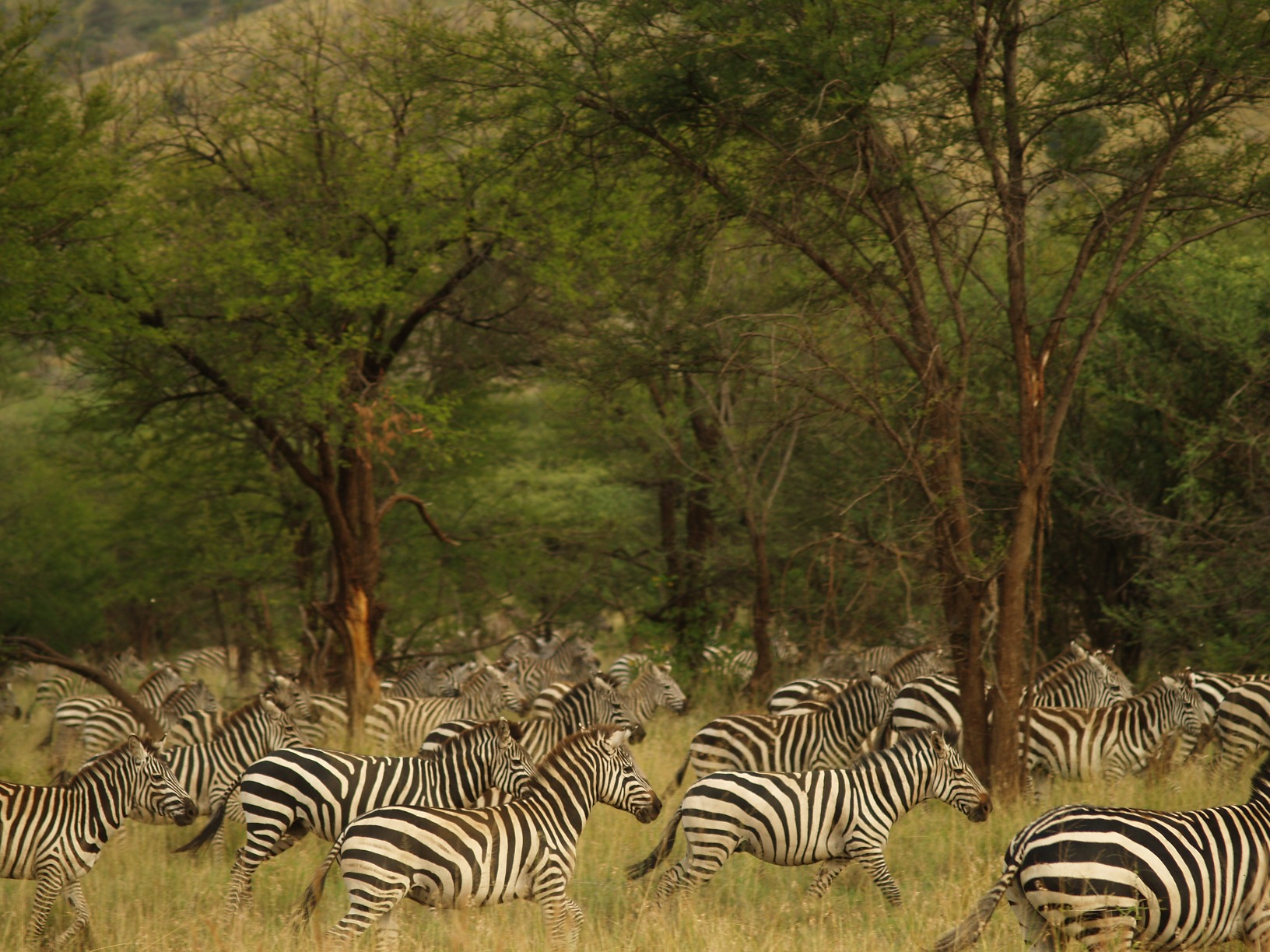
flashes of zebra stripes

It’s supposed to be the dry season, but it rained last night in Serengeti. The weather, like the world all over, has been strange here, confusing the animals and vegetation. However, it’s the perfect time of year to watch the great migration, as hundreds of thousands of wildebeest make their way from Tanzania to Kenya for greener pastures. I was lucky enough to see a herd a few thousand strong, headed slowly from Serengeti to Masai Mara.

wildebeests as far as the eye can see

Getting to the Serengeti was quite a mission, since it tailors poorly to backpackers who rock up and think there’s a cheap alternative to visiting the park. The better prepared tourists have planned their safari tour before they even arrived in Tanzania, and hiring a car for a day from outside the park gates will cost you a cool $450, payable only in US cash.

I was in Mwanza, a sort of gateway town to the Serengeti since its only 2 hours away, and also touristy since it sits on the shores of Lake Victoria. I took a local bus to the west gate, and stopped at a campsite there called Serengeti Stopover. The receptionist there quickly shone light on my ill-preparedness, but tried everything he could to help me. After two hours of discussing, making some important phone calls, and talking to another safari car already at Stopover, we had succeeded in the luckiest plan.

OLYMPUS DIGITAL CAMERA

elephant crossing

I would go with the 7 passenger range rover, claiming the last seat, for free because the other passengers had already paid for the car and the driver couldn’t ask me to pay more. Im not sure why they agreed; maybe they felt sorry for me, maybe they were curious to see what I’d do once inside the park, or perhaps they’d never met anyone from Iceland and wanted to seize the opportunity.

hippos out of the water, a special sight

We took a leisurely 4 hour game-drive into the park, spotting huge herds of zebra, wildebeest, elephants and hippopotamuses. It was 145km to central rest camp, where I would meet Paolo, the park ranger Stopover arranged my park permit and accommodation with. All the camps and guesthouses were full, so I would stay at Seronera, the staff village. I did not even have to camp there, since they had running water and electricity to all the houses, and I stayed in one of the nicest rooms I had seen in East Africa, complete with a hot shower. The next morning I went out into the village to wait for my bus back out of the park, the staff bus which costs $12 per person, payable only in Tanzanian shillings.

frisky little vervet monkeys

A bird managed to poop on my computer screen as I typed under a shady tree waiting. People lazed around the unfenced camp, and others waiting for the bus sat on their suitcases. Chickens waiting to be slaughtered gobbled in the heat, tied up an unable to move. I was sitting watching a bunch of vervet monkeys play a few metres from me, migrating between the ground, the trees and the roof of the restaurant. I saw an adult steal two tomatoes thru the tiniest crack in the door of the kitchen, and he managed to run back up the tree with one hand full back to the roof without anyone but me noticing. Unfortunately, he got a little clumsy as he greedily started eating the first, so the second tomato slowly rolled down the slanted roof to drop on the floor infront of the shopkeeper. This caused the three women of the house to start waving sticks, brooms and chucking rocks at the monkey on the roof as they taunted him with the lost tomato in a fist shaking hand.

It was hard to believe I was still in Serengeti park, as routine life carried on in Seronera exactly as it does in all the other villages I had seen.


Wildlife Capture

UC Berkeley isn’t the only university with research presence here; the University of Queensland also has giraffe DNA studies going on – ironically also a University I’ve attended and fell in love with. Their research offices are located in the Etosha Ecological Institute, a small office building located in Okaukuejo shared with the Ministry of Environment and Tourism government staff and scientists. It’s fun to see the daily in and outs of the few people that work here; you get to rub shoulders with very important people in the Ministry and I’ve also taken to becoming friends with the resident vet and his girlfriend who are super nice, laid back, environmentally-minded folk – Michelle is currently researching and lobbying for real recycling programs to be put in place in Okaukuejo and she gets to go dumpster diving every week to sort recyclables from the trash. Its a smelly research project, that’s for sure.

The vet is probably one of the most important, well-paid positions with the coolest job, since his job basically licenses him to capture, drug, and/or handle wild animals. He gets to dissect animals if they die from an unknown, natural cause, and recently a black rhino with suspected enteritis drowned in a water hole and Ortwin had to drag it out before cutting it wide open for dissection. The thickness and roughness of rhino skin would almost make you believe it had an exoskeleton, but since it had already been gutted, made it very accessible to scavengers. We later went back to that mutated rhino carcass after dark and watched a pride of 11 lions feast on the find.

a very cooperative little jackal, waiting for his poking and prodding to be over

a very cooperative little jackal, waiting for his poking and prodding to be over

The funnest and most exciting thing we have to do is definitely jackal capture. The vet, Ortwin, came with us one day to dart a specific jackal whose collar needed to be removed, and it was a perfect situation since the scent of the opened rhino lured him right up to our car. Once shot with the drugs, it takes a few minutes for the animal to go down, but once it is, you just blindfold them before handling them like a puppy dog.

They’re tiny up close, usually scruffy to touch, and when they get woken up again, turn back into the growling, biting little jackals that they are. But then they have to sit in a cage, still half dazed, until they’re fully awake to release, and even when you think they’re ready to be released, they sort of hesitantly stumble away, still looking all drugged up. Steve also captures without drug administration; he uses a padded leg trap method and tricks the jackal with a scent trail of some bloody meat to get them to step where he wants. Recently we were using some guts that were a few weeks old , and I cant even begin to explain how foul meat smells after sitting in the heat of the day. *shiver* Its gross.

Steve and Jimmy man-handling a powerless jackal

Steve and Jimmy man-handling a powerless jackal

Anyway, then you have to grab them by the neck using a blanket for distraction, while they’re still totally awake and fiercely vicious, ear muff them, Velcro their mouth shut, blindfold them (with a stinky sock), and bind their legs together. By this point they’re totally obedient, and you can take your samples and measurements without too much trouble. One jackal we caught near Namutoni was seriously psychotic though, and after biting Steve on the leg, had to be released before she was fully sampled because she kept struggling and wiggling her blind fold off.

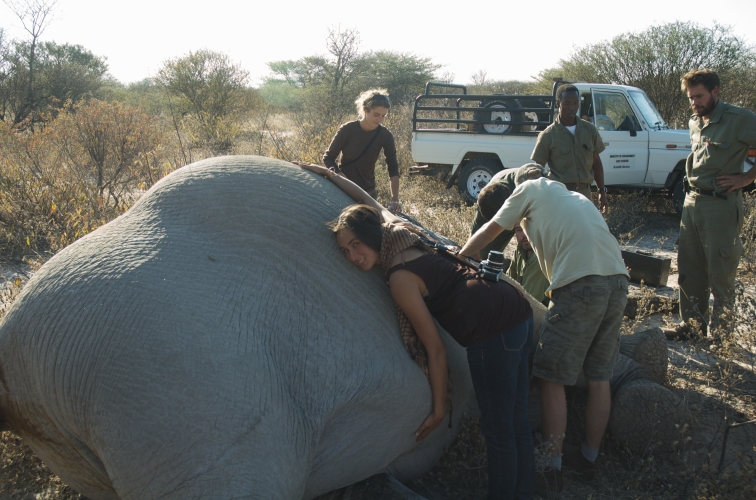
Even more entertaining than handling jackals is elephant capture. A week ago a caravan of 4 cars and one helicopter went up to the north-eastern edge of the park to collar 5 female elephants, and man oh man is that a mission and a half. The helicopter circles around a few hundred metres above the ground to spot an elephant breeding herd, then it swoops down close enough for Ortwin to shoot one with 2ml of drugs, we wait 8 minutes until it crumbles over, and then drive through thick, prickly bush on the back of an open flat bed truck to where its lying. Then we all run to the elephants side, pull it and poke it in all sorts of places for feces samples, ticks, blood, measurements, age, and finally, a collar fastened around its neck. Im not sure if you can imagine, but an elephant neck is very, very thick, and these collars must have weighed 20 kg each.

trying to get my arms around the tummy of a sleepy elephant

trying to get my arms around the tummy of a sleepy elephant

At the end of this flurry of activity, and after getting some great photos of each of us cuddling a sleeping elephant, the vet gives it 1ml of drug reversal, and we all get the heck out of there as quick as possible before it stands up, pissed no hell.

Its definitely an adrenaline pumper, and if it wasn’t the elephant who was going to kill someone, I thought for sure our off-road driving with 8 people squished and exposed on the back of the truck driving through thorny acacias certainly would… but we all escaped with minor scratches and ripped clothes.