Thinking about German in Switzerland

German-speaking Europe is a confusing place. There are so many dialects of German that some German speaking people don’t even understand eachother. Some German words have only one vowel per six consonants, twisting your tongue in werid ways as you try to pronounce it (ie. Dirndls, schloss) The German word for “Austria” looks more like “ostrich” than Austria. English and Icelandic help me understand a lot, but I’ve been wishing I could speak more German– high German, low German, Bavarian Dialect – I don’t care which version.

The slopes in Flims

Switzerland doesn’t use euros, and their Swiss Franc is illogically abbreviated as CHF. Well, the “F” makes sense, but CH stands for “confederazione Hervatica” (which I now know is recognized as the mother of Switzerland). I like the way Swiss German sounds, it’s somehow softer and sweeter to the ear. I stayed with a friend, Ursina, in Flims, a picturesque ski town in the middle of the Alps, and in this region of Switzerland they have another official language called Romanish. It’s the closest language relative to Latin, and it sounds like old Italian poetry being recited.

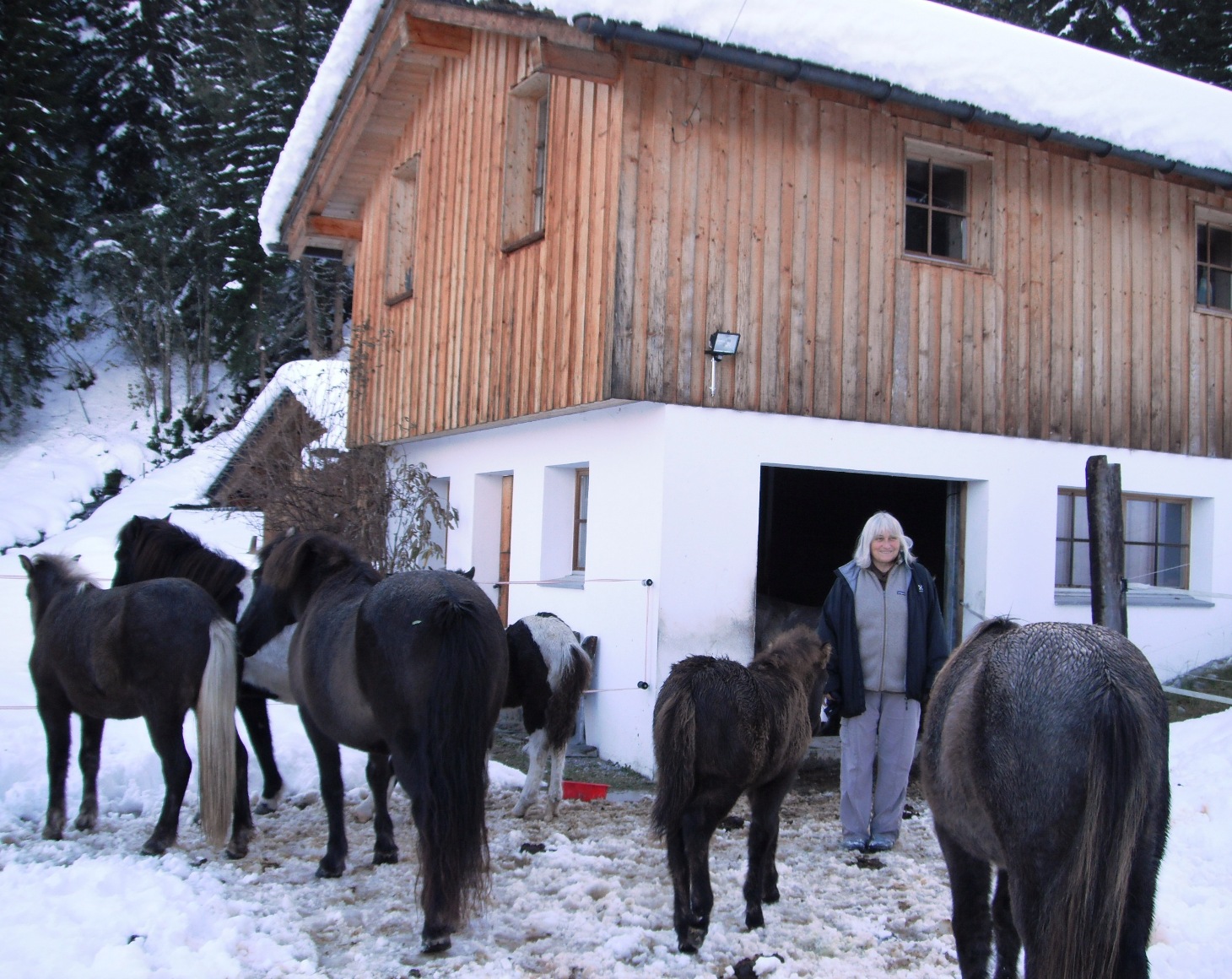
Ursina's mom with their Icelandic horses

Her family, the Isenbugels, is well known in Iceland because of their contribution and involvement with Icelandic horses. I visited her parents in their mountain hut near Laax, which we had to hike half an hour past ski lifts and through 2 feet of snow to get to. They had Icelandic horses there, mostly young yearlings and new foals with their mothers, and an Icelandic dog. Her father, who has eyebrows growing out like bangs, spoke English and some Icelandic. Her mother speaks Romanish, and also German with an accent I found easiest to understand.

I went with Ursina to her sisters Icelandic horse stable near Zurich, where we rode horses into the night. Gallopping through a forest without seeing anything was an adrenaline rush I hadn’t before

Zurich

experienced. I would love do it again, but Iceland lacks forests, and it doesn’t really get dark in June or July when Im riding most.

my horse, almost invisible in the black background

Everything in Switzerland costs more, even though you can drive quickly and easily past the German, Austrian or Italian border to buy the same thing for less. The doner kebab trumps McDonalds and Burger King combined as the king of fast food, and I’ve been using it as a base price economy marker. In Berlin, you can get one for €1.50. In Munich, €3.50. Vienna, around €4, and in Zurich, it costs as much as €8 for the exact same thing.

But I guess prices are all relative, to the people’s standard of living and places’ economy. What really puzzles me is how wine can be cheaper than water, and beer, almost always cheaper than coke. If only Iceland could pick up on that trend.


The Sheep round up in Eastern Iceland

I went directly from Holardalur to Fljotsdalur to chase more sheep. The round up area in the east is probably ten times bigger than the valley in Skagafirdi, and we were looking for a couple thousand sheep over a 3 day mountain ride.

Hallgrimur riding with 3 hand horses

We started in Skridaklaustur, the same farm where all the horse trips start from, and rode up from the valley into the mountains. We were about ten riders, each riding one horse and holding 1 or 2 extra, and I learned very quickly its quite difficult to ride with 3 horses over the swamped ground and crossing ditches and rivers. Some other riders started from deeper in the valley and another from the other side of the mountain in Jokuldalur, and we rode all day alone looking for sheep and chasing them towards the mountain hut where we’d all meet.

After a 14 hour day, we somehow did all make it to the hut, with all our horses and the tired sheep. For dinner we had lamb soup, a welcoming meal after eating dried fish and drinking vodka all day.

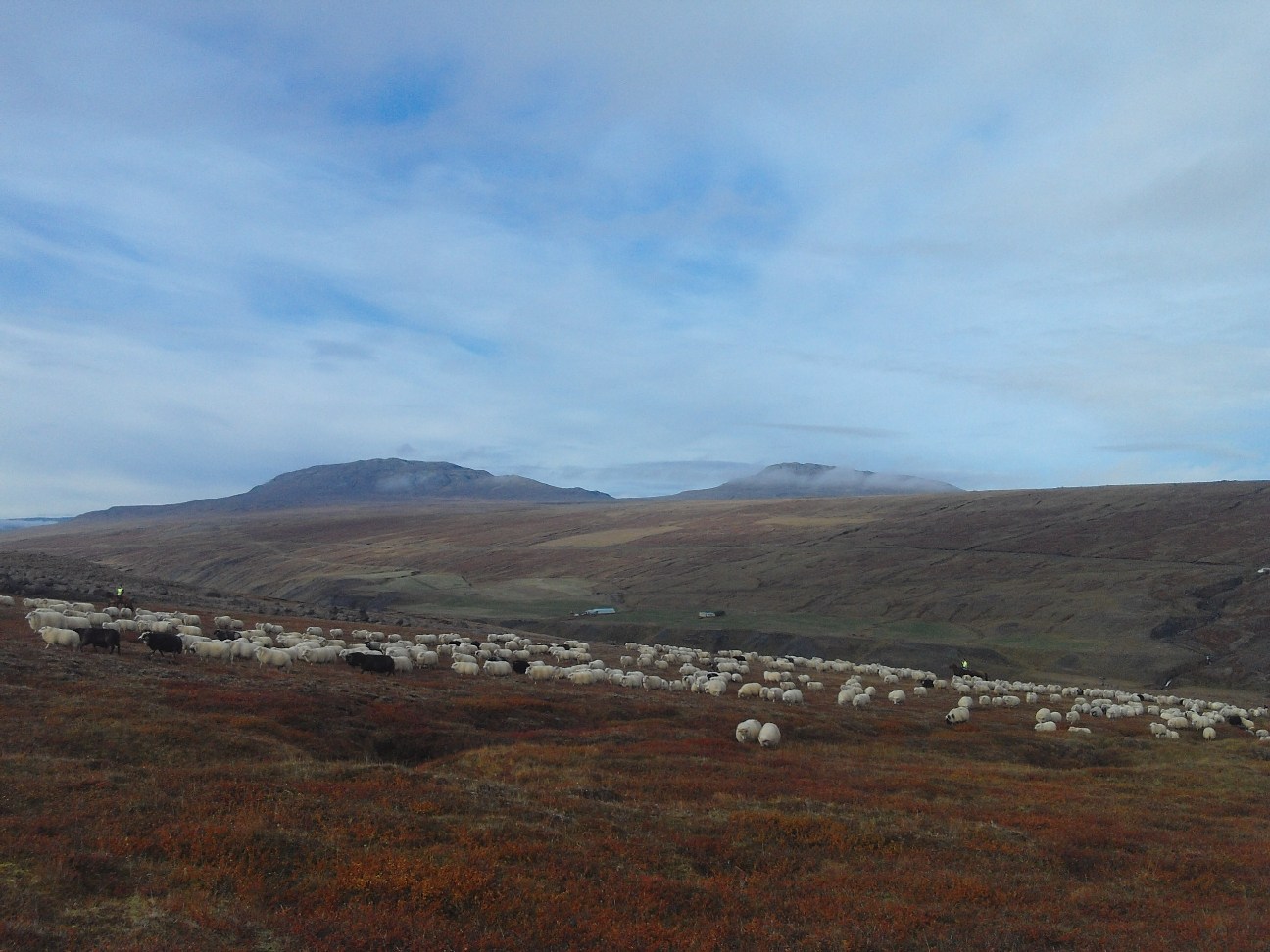
On the second day, most of the sheep had crossed the river that leads us down the other side of the mountain into Jokuldalur. We had the river on the right side and a mountain on the left side of us to help funnel all the sheep together into a massive, crying herd of white fluffy mass. Some sheep that didnt get the memo stayed on the wrong side of the river, and one farmer on a 4×4 had to spend the whole day chasing 5 or 6 sheep down the harder way.

the stupid gill I had to climb

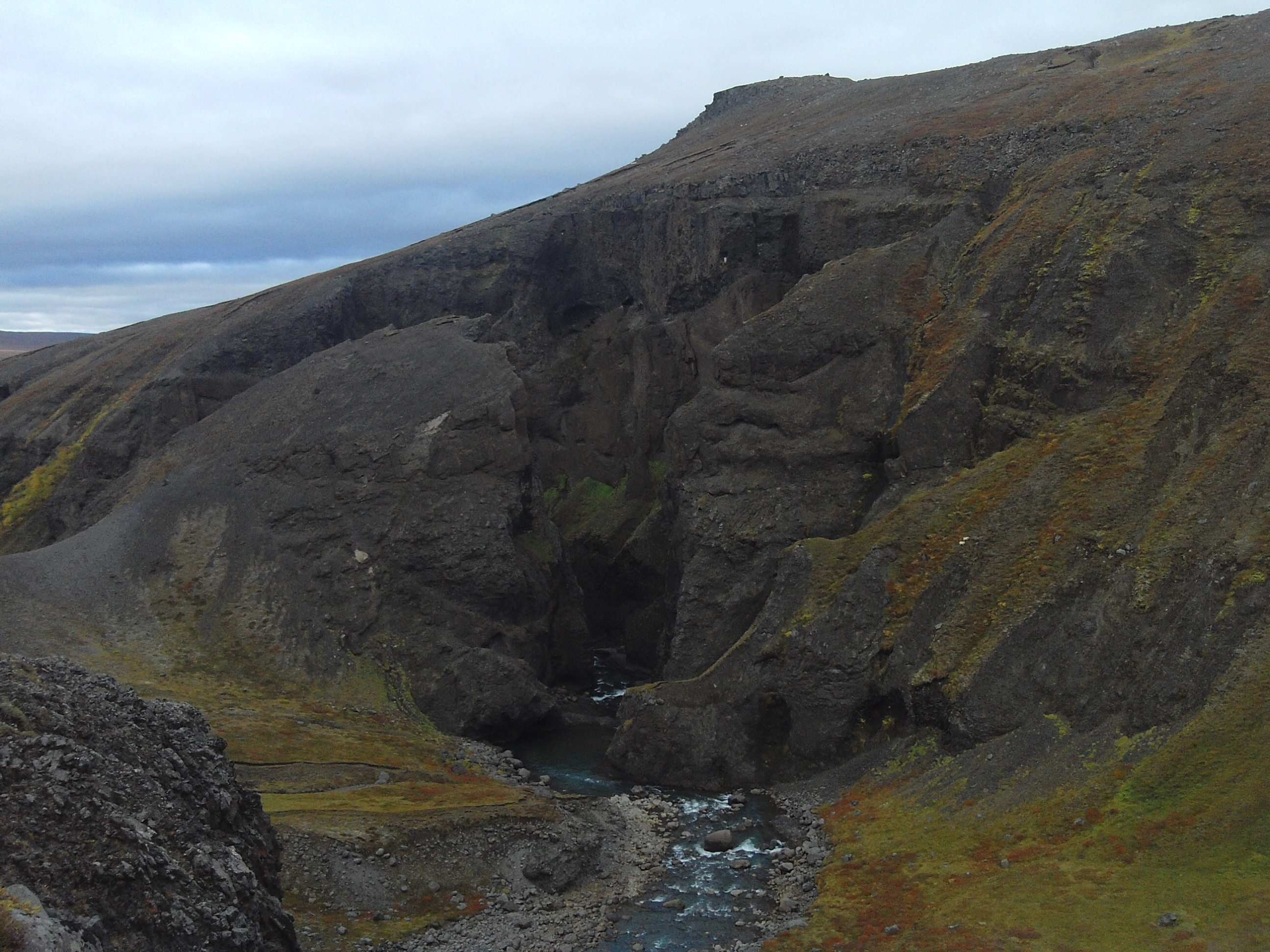
Lucky me spotted 3 sheep standing in the middle of the river gorge on a huge piece of broken-off cliff, so I took a nice long hike straight down to the bottom of the gorge, and literally crawled on my hands and feet up the loose-gravel cliff. I took with me Tyra, a 6 month old border collie puppy who probably did more harm than good. She kept fighting me over foot space on the narrow sheep track we were following down, and would stop dead in her tracks if the leash got tangled between her legs. If I took her off the leash, she would stop, stare and cry at me. I certainly couldnt carry her as I had to keep grabbing at the ground with my hands for balance. When we finally got close enough to the sheep to see them and try to yell at them, they just ran further up the cliff, and it was me who had to go fetch them. It was times like this when I wished my eye sight was a little worse, so that I wouldn’t have spotted them and noone would have known these three stubborn sheep weren’t in the right place.

One day I spotted two sheep as far as my eyes could see and started riding nearly 5 km over the flat marshy ground towards them. When I got closer, half an hour later, I realized it was 2 swans and made a mental note to self: not all white things are sheep.

At the end of the second day, the sheep arrived in Klaustursel, a famous farm in Jokuldalur that has a petting zoo complete with reindeer and foxes. We had a traditional Icelandic christmas meal – smoked lamb leg and creamy potato stew, and drank even more vodka and beer. We sorted out which sheep belonged to that valley that night and the next morning, and the rest of the sheep had to be ridden back over the mountain to Fljotsdalur where we started.

funeling the sheep to Klaustursel

The last day was less lonely, since we rode in a massive herd together – 1000 sheep, 10 riders and 20 horses, but moved quite slowly. We lost one and two sheep here and there, those too sick or old to keep up. It was always a difficult decision to make, when to stop chasing them, pass them by and just say goodbye.

riding the sheep from Jokuldalur to Fljotsdalur

My hand horse on the last day was a young, newly trained horse called Freyr that nearly managed to kill two of us on the trip. The first day he threw one of the riders off, Lilja, and she had three massive, blue/black bruises on her back and ass. After this, he galloped off and went missing for an hour until me and Hallgrimur found him in the middle of nowhere. Then, of course, Hallgrimur (the farmed from Skridaklaustur, who owns most of the horses from the horse trips) decided I should ride him the rest of the trip, since Hallgrimur has a weird way of showing his affection to me by giving me crazy horses. Freyr was always getting tangled up with the second horse I was riding or holding, and he doesnt know how to stand still but he’s very good at rearing up. He tried to rip 3 of my fingers off at one point and managed to tear a chunk of my index finger and sprain my ring finger by tangling my hand up in his reins as he reared away from me, the entire weight of his body pulling on my right hand for a good 2 seconds! Hallgrimur thought it was funny, laughed, and cleaned my bloody hand with some vodka before bandaging it up with electricity tape.

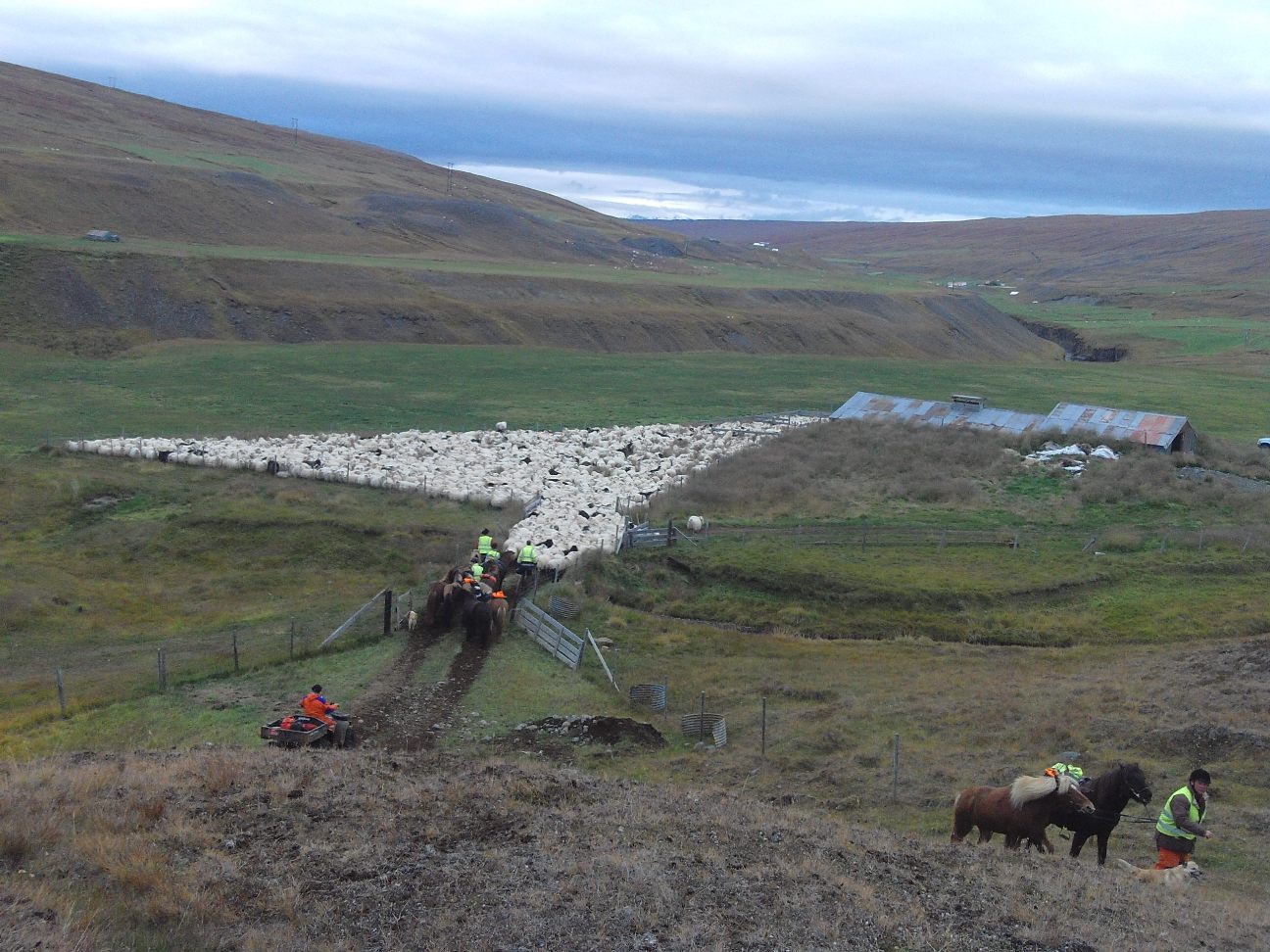
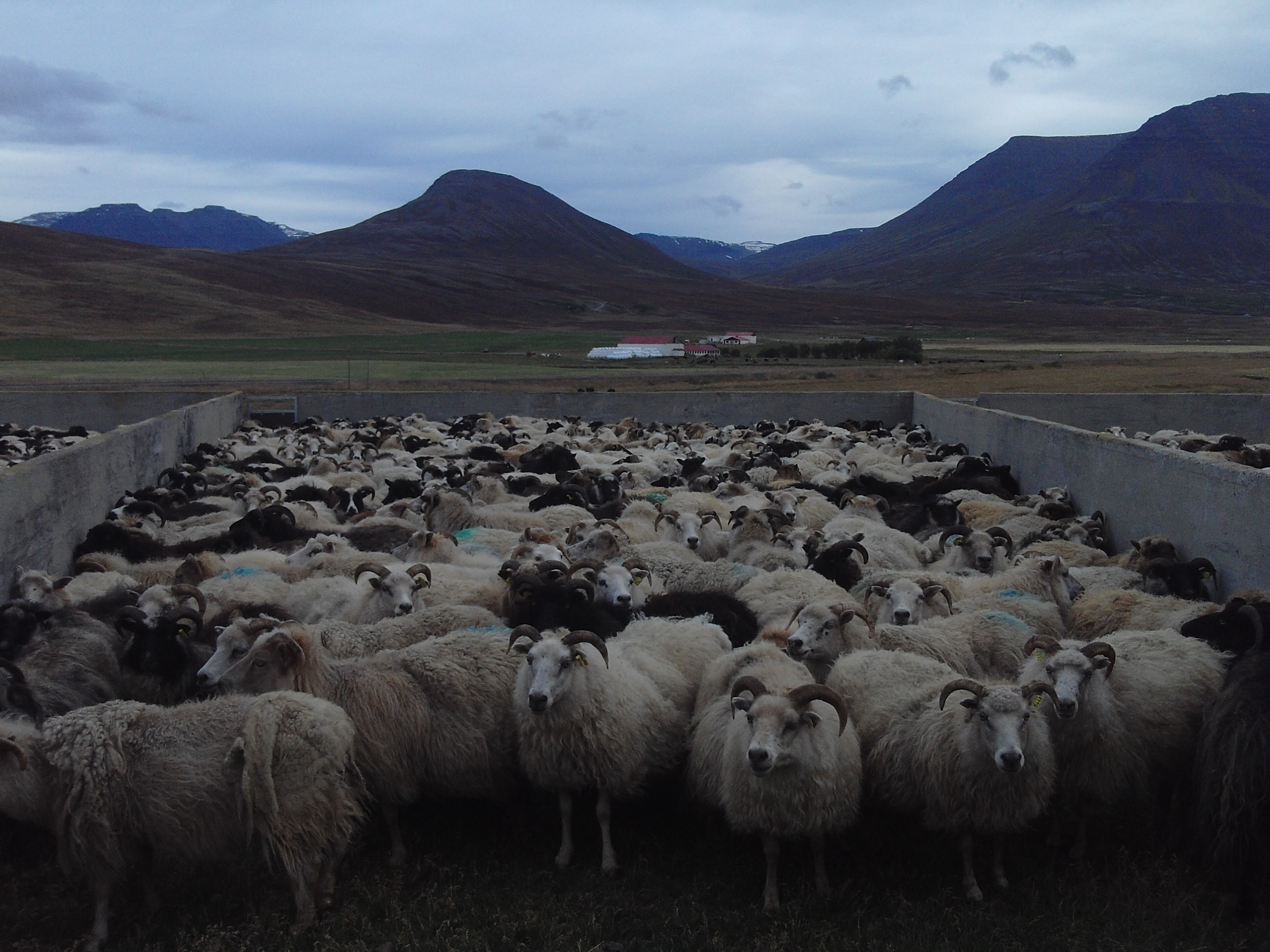
The final sorting happened on Saturday, at Skridaklaustur farm in an old stone-walled round corral. It was the busiest I have ever seen the valley, with cars and people crowded everywhere, and even when it started pouring rain, all the farmers and their kids and very extended families kept on sorting sheep.

sorting sheep in rainclothes at Skridaklaustur

The drowning “baaaah” rang in my ears days after the sorting was finished, and I’ve still got black and blue bruises on my legs from all those gnarly sheep horns. Its hard to believe that now, one week later, the smell of horse and sheep is completely gone, and even the dirt on my fingernails has completely disappeared. Its hard to convince people I really was manhandling sheep in eastern Iceland one week ago, as I sit in the sun in Munich mentally preparing for yet another Oktoberfest night, so Im glad I still have the bruises as proof.

Chasing Sheep in Skagafjörður

After the touristy summer season ends in Iceland, the farmers have start to prepare for the long winter ahead. The biggest task is probably the sheep round-ups, when all the sheep in Iceland have to be brought down from the mountains back to the farms where they belong. They’ve been left to roam freely during the long days and good weather, turning grass into meat, growing bigger and stronger. In the highlands and mountainous fjords there are no fences, so the sheep graze themselves over huge areas, as far as the highest cliff will allow. Each farm, valley or peninsula picks a day or two in mid September to go and round them up, combing these vast areas by foot or horseback.

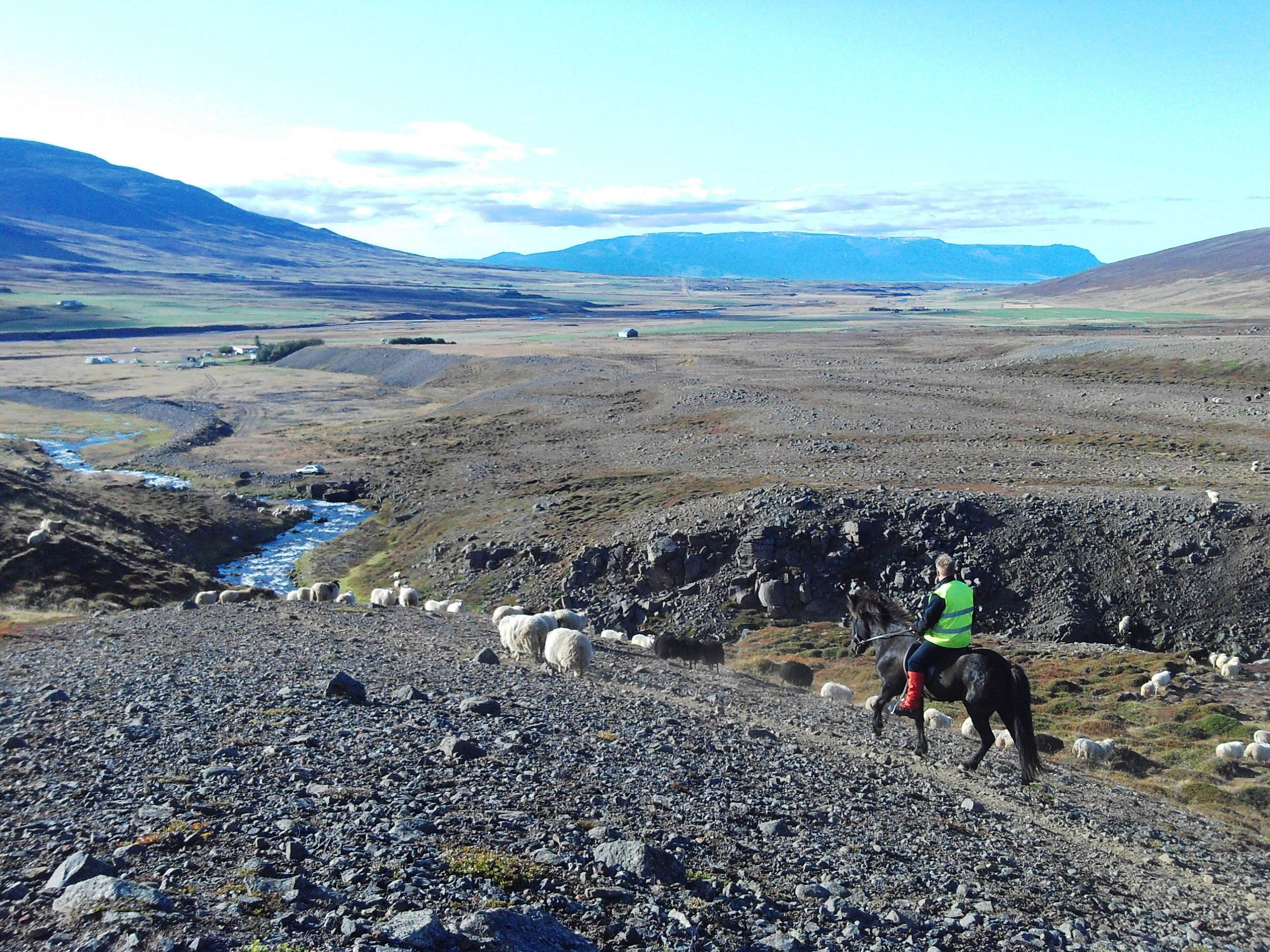
chasing the sheep down Hólardalur

Working with horses all summer has made me some horsey friends, and that plus traveling a lot in the countryside has allowed me to meet farmers from all around Iceland, so I managed to sneak my way into a couple sheep round ups. It’s a tricky thing to get into, and Ishestar even sells a sheep-round up tour for the tourists who want to experience one of Iceland’s most authentic events. The first for me was this weekend in Skagafjörður, a bay in northern Iceland that boasts amazing scenery and most of Iceland´s best horses. I was staying with Gunnar from Víðines, the farm beside Hólar, Iceland´s only horse university. I would ride again with Denni, my horse boss from the east, since his girlfriend Arna works at Hólar and is a good friend of Gunnars.

riding into the sunrise

There were about 15 riders of all ages, all farmers or children of farmers from the area, or students from Hólar, doing this sheep round-up. We started at the crack of dawn on Saturday, getting up before the sun and riding into the sunrise to the end of the valley. The valley has two names, since a river splits if in half, and 6 of us were responsible for the southern half, Hólardalur.  Once we got to the end of it, blockaded by some big snow mountains, we started riding back out in a line formation, yelling at any sheep we passed along the way to head on out. I rode one of Arna´s horses, and held another horse for the poor guy that had to walk to the top of the cliff and clumber along the rocky tops yelling at sheep to go down.

It took about 6 hours clear the whole valley of sheep, and then drive the couple hundred of them over a small river where some managed to get away and run back into the valley. The northern part of the valley brought their sheep down a couple hours later, and then all 5 or 6 hundred sheep were escorted along the main road to the sorting corral, closing the highway to any traffic faster than 5km/h.

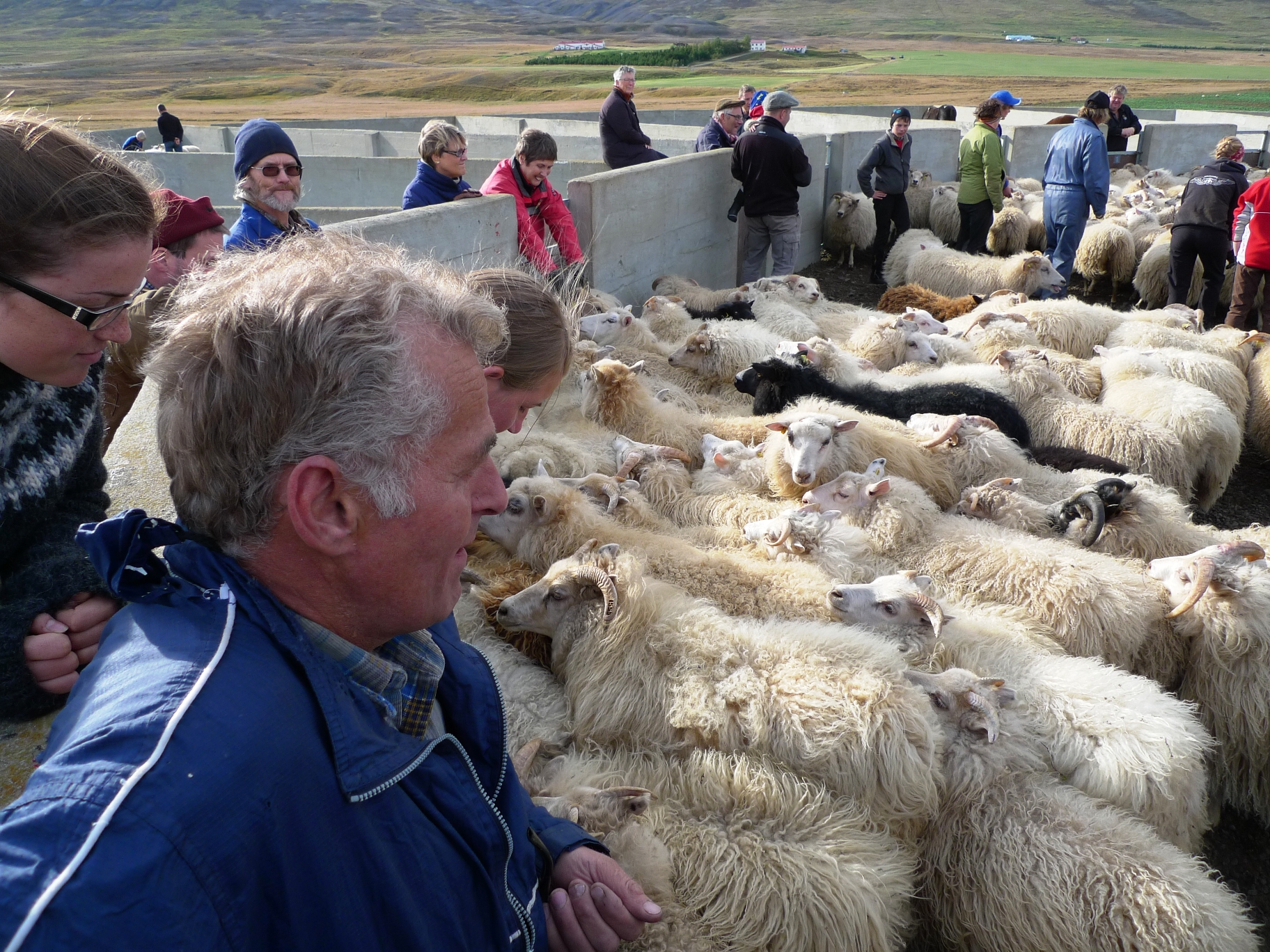
a kid peers into the fluffy white abyss

The next day, all the farmers from the valley and their very extended families came to the corral to sort the sheep. The corral has a circular center with lots of doors, each leading into a pie piece of the outer circle that’s split into many different fences. Sorting them involves a few rounds of sheep being herded into the center corral, and each indiviual sheep being manhandled in order to read their ear-tag number. We were looking for 12S4 and 27S4, and lambs went into one door while adults went into the door beside. After a couple hours of tackling sheep, atleast one ends updragging you in the wrong direction, another manages to throw you over, and many of them leave horrible purple bruises on your thighs from trying to headlock them with your legs. Sheep may be small, but don’t be fooled by their cuddly exterior – they are tough, crazed little buggers in the corral. My entire body aches and the palms of my hands are still throbbing after trying to drag them by the horns to the right door.

Gunnar trying to recognize his sheep

There were children sorting that were smaller than some of the sheep, and they resorted to a full-on rodeo tackle tactic. Some still tried to get the sheep between their legswithout realizing they weren’t quite tall enough, so the sheep bounced away with them as they struggled to hang on to the horns and wait for an adult to rescue them.

maxell Digital Camera

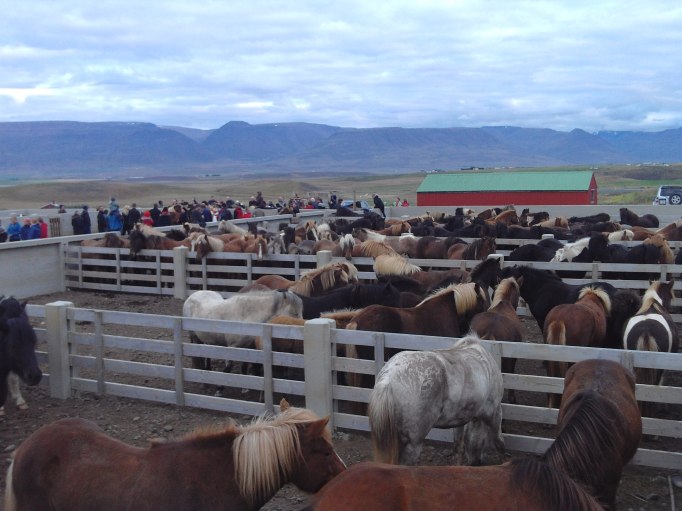
the horse round-up at Staðarétt

That same weekend, another valley was doing a horse round up. Its the same idea as the sheep round up, but instead you’re herding horses on horseback, and sorting the right horses to the right corral fence requires it to be a little bit more of an adult-only event. Its Iceland’s best showing of the bold and beautiful horsey people, the tough, young farming generation, and people seem to be having too much fun as the sobriety levels dwindle and herd after herd gallops off into the distance, in all different directions to their respective farms.

waiting to go home

Once we found all of Gunnar’s sheep, we said a regretful goodbye to all the lambs taken out for the slaughter house, and reuinted the rest with their mothers, silencing the drownding “baaaaaaah” we had been listening to all day. All the other farmers did the same and took their sheep home. At the end of the day, Gunnar´s herd of colourful sheep were also returned to Víðines farm, and peace and quiet was restored once again to the valley.

Horseback and Hunting

Spending the summer riding horses gives you a new perspective of the landscape around you. For one thing, it passes much slower, as you have time to stare and think about the scenery unfolding. Getting into a car and flying at 90km per hour after a week of reaching maximum speeds of 30 (bouncy) kilometres per hour causes me to panic and hold onto the side of the car seat and wonder if Im moving at lightspeed. Requests for the driver to slow down just gets a chuckle from those in the car, but eventually people’s suggestions to relax are possible.

One thing I noticed is that crossing bridges is a lot easier in cars than on horseback. I was once riding a really safe gelding over a bridge while holding a hand horse, and at one point, in the middle of the bridge, they both decided they were too close to the sides of the bridge, and in attempt to stay as far away from the rail as possible, they stopped and had a push of war against eachothers sides. My leg was pinned between the two, and as one edged the other out, their shod feet started sliding out on the concrete, making sparks and stressing them more. The herd pushed from behind, also uncomfortable to be stuck halfway on the bridge, and eventually we made it over without losing anyone overboard.

One lonely old male has made a home out of Fljótsdalur, near this narrow

4x4ing through glacial streams

bridge where you get the most beautiful sight of glacier water mixing with the heavier fresh water and causing the bright blue water to line up against the brown stream. We also saw a herd of 900 reindeer when we were driving up to Vatnajökull for a glacial walk, blasting through river crossings and peering into icecaves.

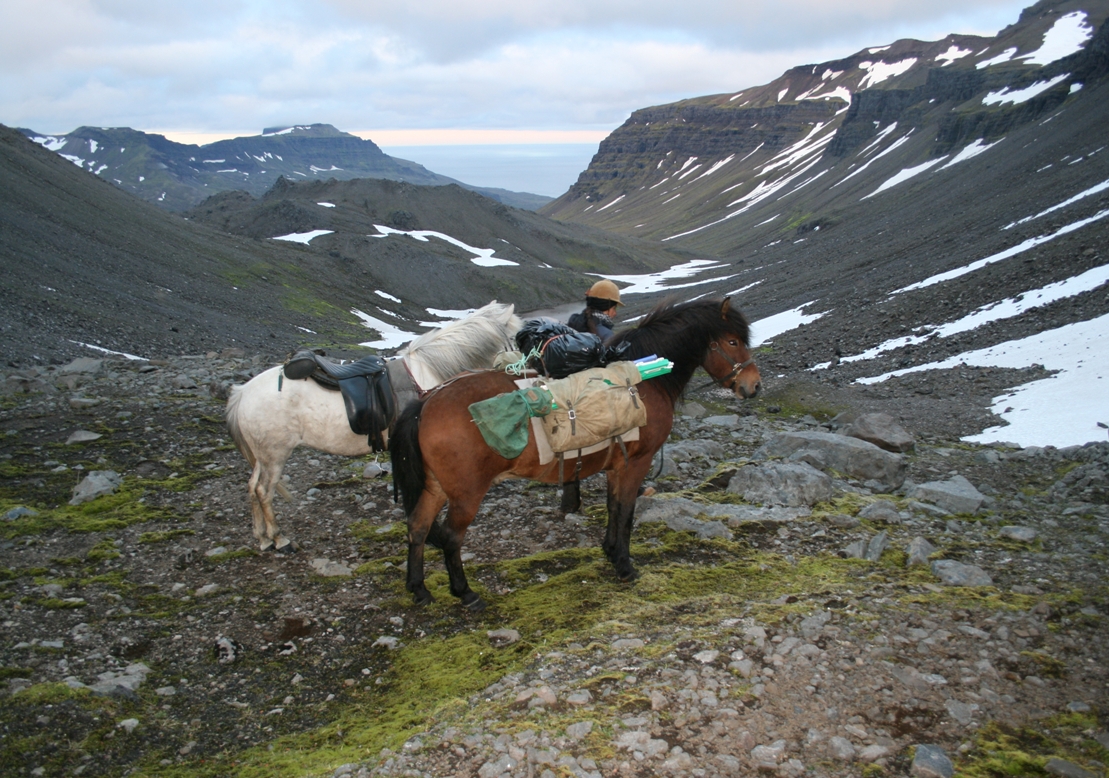
At the end of August, I went reindeer hunting on horseback with 5 hunters and 14 horses. We started 15km north of Egilstaðir town, from a farm at the base of the snow-covered mountains. The beginning was a bit rocky, as 4 riders fell off their horses and we temporarily lost the herd as the 7 loose horses galloped off. I realized the hunters weren’t true horsemen (yet), and that having handhorses might reduce the chances of the herd galloping off with our food, beer, tent and sleeping bags again. We eventually got our act together and made it to Hrundalur where we tented in a rented Marmot tent that came with no ground pegs. We creatively experimented with saddles and extra horse shoes to hold fasten the tent down securely.
_MG_1447

searching for 200 reindeer, not as easy to spot as youd think

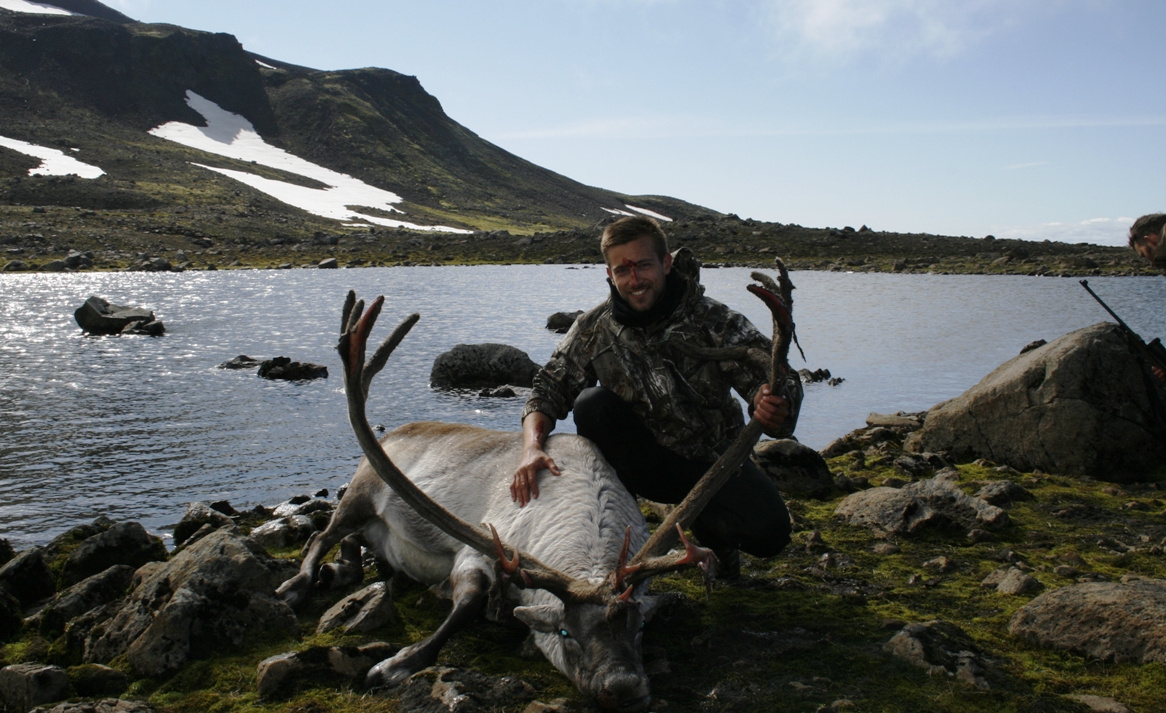
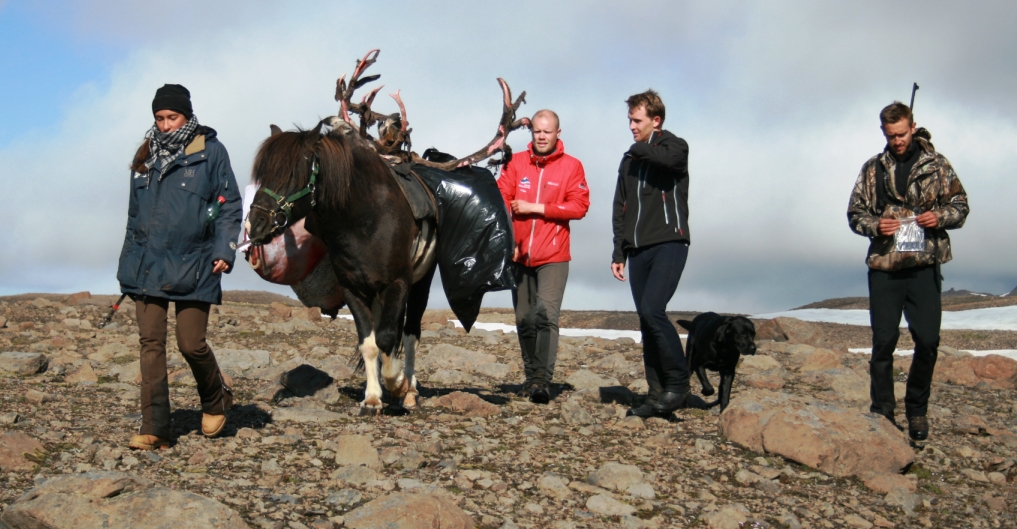
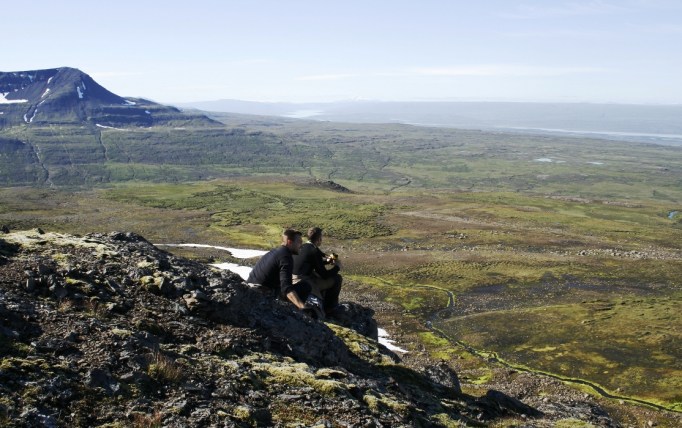
The next day we hiked hours into the mountain tops, and spotted a herd of 200 reindeer. There were 4 hunters on the trip, all doctors and good friends, but only Kalli had the hunting permit. By noon, he had shot a 90kg male, that we had to gut, chop into three pieces, and tie down on the back of one very calm, patient horse called Postskjoni. He carried the deer back down the steep slopes where we left it submerged in an icy river.

Kalli, the hunter, with his reindeer
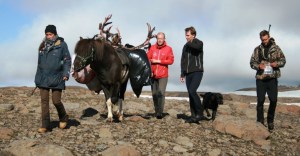
Postskjoni carrying the deer down

There was 1 reindeer hunter guide, and me, the horse guide. I was the new Denni of the trip, in charge of all the horses and also the riders who transformed magnificently into true horsemen after 3 days of riding. Instead of Leo, Denni´s dog with the innate knowledge to herd and nip at heels regardless of getting kicked square in the head, we had Molli, a black labrador that was more interested in our wellbeing than the horses. He paced alongside us, always looking up at us riders for eye contact and assurance that we were doing ok.

IMG_1611

the hunters, our horses and the dog Molli

I remember one of the first horse trips I rode with Denni, he wore converse shoes and a cowboy hat, so I tried to put some style into my outfit and wore Timbalands and an old beige riding hat I found at a second hand store for 450kr. Jón, the former Denni, could ride with a wild goose in one hand and a bottle of schnapps in the other, but there was nothing I could do to top that except drink a little schnapps during riding pauses.

taking a break at the top of a moutain pass

This trip was a little more difficult, with no path or tracks to follow, and the horses unsure of where they were or where to go. At least I knew all the horses by sight, no longer confused by the lookalikes or needing strips of coloured tape to tell them apart. We also didnt have to ride past other herds of horses, since we had one stallion escape twice from a fence and run along with our herd during the summer trips. On the first day of the Ishestar trips, my cell phone fell out of my pocket and a herd of 90 horses trampled it dead, but on this trip we only lost one pocket knife. We may as well have lost our phones, since we rarely had service and my battery was basically dead the entire weekend, relieving me of any contact with the outside world and only focusing on the horses and my new best friends.
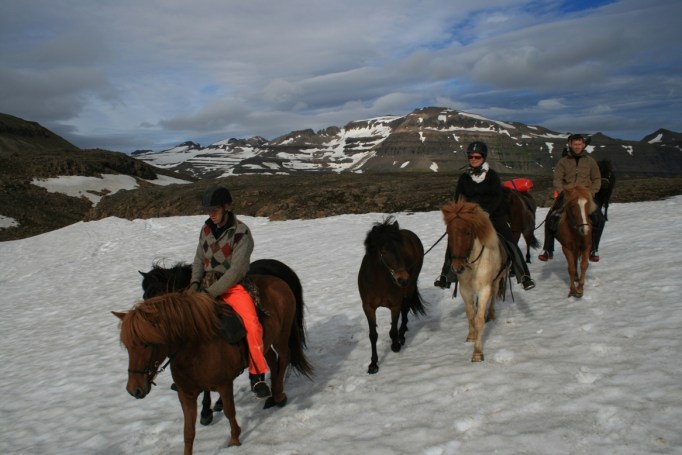
IMG_1658

riding with hand horses

After completing our main hunting mission, we rode over a mountain pass, over rivers and snow, to Klyppstaðir, arriving well into the unexpected dark of night, to tent at the afterparty of a country ball in the valley where the icelandic band KK had just finished playing. We sat under the stars and watched northern lights flicker behind the silhouette of the mountains, and ate sheep heads, salted lamb, dried fish, homemade moonshine and whiskey. All 6 of us crammed into the 6 person tent that probably fits 4 more comfortably just as we started to feel a little dizzy, as the horses grazed just beyond our heads.
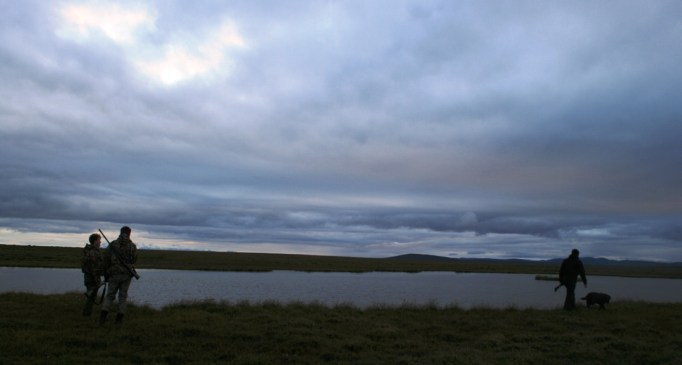
goose hunting on Fljotsdalsheidi

I got to choose the horses I knew and liked best from the Ishestar horse trips, and pair rider to horse like an intricate matchmaker. It was nice not to have to ride the crazies and untamed, like the case so often was one the regular tours. By the last day, the hunters had transformed into horsemen, as we all found our groove and rode triumphantly back into the valley we started, over another icy mountain pass. The next day, they skinned the reindeer, and after becoming a tight riding, tenting, hunting family unit, the boys invited me goose hunting. We drove Frikki´s Land Rover up into Fljótsdalsheiði and sat beside the pond with the most abundant, shiny goose poo that we could find and waited for nightfall. We sat very still, nibbled on chocolate, and only one flock of geese flew overhead but never landed. I fired the shotgun once anyway, without killing anything, and decided I liked goose hunting better than reindeer hunting.

Summer in Iceland

September creeps up on you like the chill of sunset sneaks under your skin after a sunny day in Iceland. All of a sudden its getting dark at 8:30 when you’ve grown accustomed to never fearing nightfall, and you start to realise how much you appreciate the warmth of the sunrays in this sub-arctic island.

OLYMPUS DIGITAL CAMERA

a glorious summer day in the countryside

Reykjavik awakens for the summer months, with a noticeable population boom from all the tourists walking downtown decked out in outdoor gear and big-lens cameras. People are out and about, drinking coffee and beers on patios, mothers walking their babies in killer heels, and the city folk flock to the countryside for hiking, bathing and summerhouse time.  There’s also a surge of concerts and festivals, the biggest two days this year being Gay Pride day and Menningarnótt (Culture Night).

the view of Reykjavik from the top of Esjan

Gay Pride in Iceland is probably the only place in the world where its more of a family event than a sexy, nudist, liberal movement. Last year’s gay pride saw Reykjavik’s current city Mayor dress up as a drag queen in the parade, and this year the parade, open-air concerts and sunny weather forced all road-traffic to be replaced by hundreds of thousands of rainbow-decorated people wandering around town.

Menningarnótt was even more vivacious, blessed by the best weather day imaginable, and organized into a 4 page spread schedule in one of the local newspapers. There was always 20 things going on at once, and there was no way to pick what to go to, since there were always two things happening simultaneously that peaked your interest, compounded by 5 other things that you had no idea what they were and your curiosity sometimes got the best of you. I had ten friends in town, 2 from London and 8 from New York, so I spent most of the day battling through a crowd with 8 obnoxious American men in tow, so my more mellow British friends had no difficulty in finding us in the crowd. I visited the Faroese embassy for some rotten food and nordic cider, saw a choir sing Psalms at Hallgrimskirkja, shopped an outdoor market that resembled more a garage sale, and listened to the informal Kaffibarinn mens choir sing acapella, pissed drunk at Austurvollir. There was always live music, and a couple main stages where the night came to a close with a bang. A sparkling Harpa and firework show sealed the deal, unimpressive by international standards, but a big enough deal to Icelanders that a parking spot within a 5 km radius of downtown could not be found as everyone came to town to see it, all 5 minutes of it.

crowd

the concert crowd at sunset on Culture Night

I went to Bræðslan, a 2 day music festival in Borgafjörður, a small sea-side village in Iceland’s easternmost fjords. Glen Hansard was the headliner, but

Glen Hansard performing at Braedslan

like a true icelandic concert, Jón Sigurðsson and some other of Icelands other most famous artists ended the concert. The final encore included everyone coming on stage and jamming together, improvising and freestyling with a

my cousin Sara, cooling off

crazy light show in the abandoned fish processing plant where the amped crowd flocked. It was July 23rd, the weekend when summer finally arrived, and people spent the days lounging in the sea and icy rivers to keep cool. We tented at the base of  a place called Elf hill, and the magic in the place was real, atleast to me.

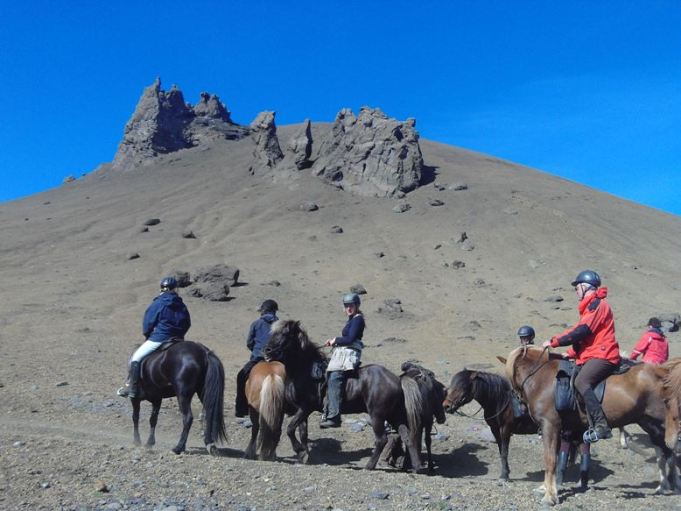
One of the riding days on the Egilstaðir riding tour takes us to Sanddalur, a remote sandy valley accessible only by foot, horse or 4×4, believed by the superstitious to be rich in elf life. Their troll-like faces are cut out in the jagged rock, blaring out from the steep, sandy slope, and while we take our lunch break there, the restlessness of the horses can only be explained by one thing – elf presence.

maxell Digital Camera

Sanddalur

Growing up in Iceland and Canada has given me a lot of privileges, but they say allergies are a bigger problem for the advantaged, since 30% of people develop allergies from having too much hygiene. I’m allergic to summer, all the pollens and freshly cut grass, even horses themselves and the sun-dried dust clouds a herd of them kicks up.  This was the coldest summer on record in 75 years for Iceland, and even the warmer east only saw summer fully bloom in late July so I survived more comfortably than expected. Still, I frequently suffered from a runny nose, snored from congested sinuses, and breathed a little raspy from asthmatic suffocation. Ironically, the hottest days were just this last week, with temperatures reaching 20 degrees even though the confused trees have started to golden. Now the rains will start to come, but with the darker skies come northern lights, a sight that makes the arrival of fall more welcoming.
The Íshestar Egilstaðir Tours

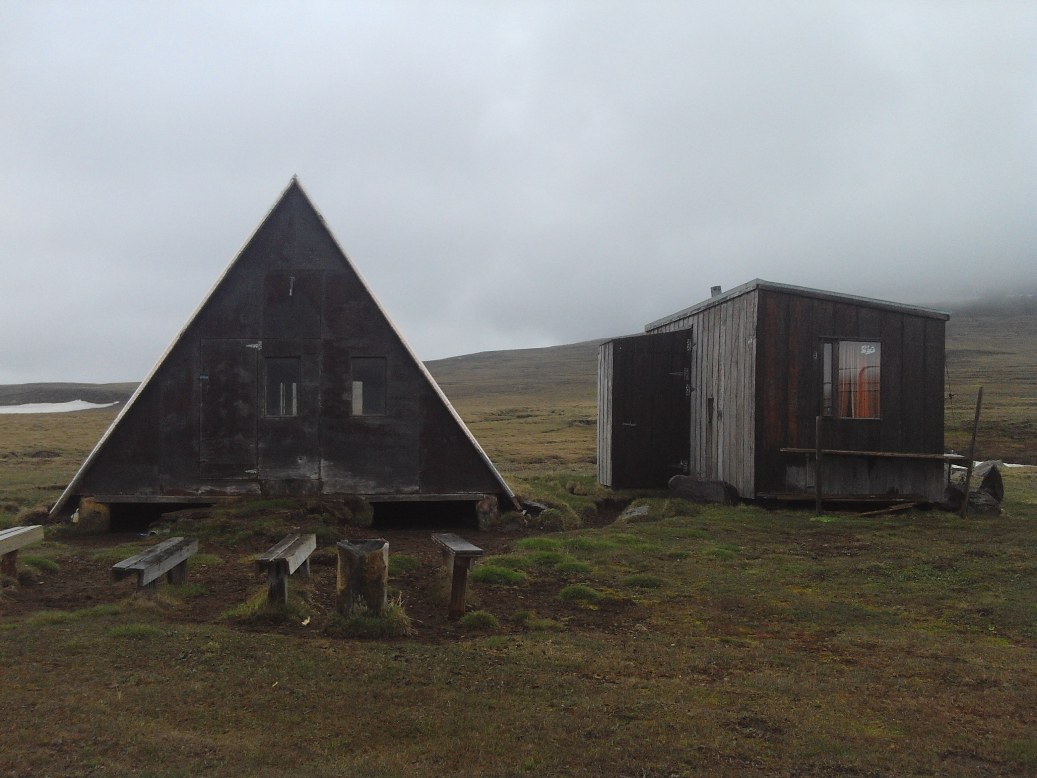
a turf hut, which used to be a sheep-house which we used for dining in and storing our saddles overnight at Fjallaskal

The horse trip season in East Iceland was only 6 weeks this summer, with 4 groups arriving for weeklong trips. I flew between Reykjavik and Egilstaðir between trips with Air Iceland, and thoroughly enjoyed the scenic flight over Þinvgallavatn, Hekla, and various different glaciers, still dusted black with Grimsvotn´s volcanic ash. The first trip started July 4th, and the highlands looked as if it was still early may. Snow still covered the ground, with grey skies, brown grass, moist earth and dismal signs of life. Not even the swan pairs you normally see in the snow-melt graced the ponds, and to believe

The first Fjallaskál we stay at, a mountain hut without electricity or running water as it looked on the first trip

reindeer and foxes could survive there was difficult. We delivered a few rolls of hay in the day prior to the trip, and the thermometer read only 3 degrees Celsius. I had heard the summer was better in the east, typically warmer and sunnier, but the temperature hovered around only 6 degrees or 9 degrees most days, though we barely had any rain or wind
The trips have 15 or 16 guests, 5 or 6 staff, and 65 – 75 horses. So 21 saddled horses and their riders follow a loose herd of 50 horses, up over mountains and across wetlands with very few roads or fences, and travel over 250km in 6 days riding anywhere between 5 – 12 hours a day. However we don’t ride straight – we stop to change horses once or twice a day, we stop for lunch and cookies and coffee, and we stop to rest the herd, let them graze or drink. Then we have to stop when people fall off, which has happened on every trip, including every staff person. Horses change between the trips as some fall ill, lame, or just too old, tired or prized to come again.

behind the herd, forming a perfect head-to-tail line up

The trip journey also changed from week to week. On the first week, snow and snowmelt prevented us from riding over the wetlands to Sauðárkofi, a primitive mountain hut near the dam. We also couldn’t drive to Vatnajökull for a glacier walk planned each tour, so we drove to the dam.
On the last day of the trip we drop back into Fljótsdalur, the valley where we

riding over some leftover snow in August

start, from Laugafell – a mountain at the end of the valley. Its up in the highland area where Snæfell is, the highest mountain outside of a glacier at 1836m, and where Vatnajökull National Park begins. This area is also home to the infamous Karahnjúkardam, the biggest hydro-electric power station of its kind in Europe and a source of contention for many environmentalists.
The trip journey also changed from week to week. On the first week, snow and snowmelt prevented us from riding over the wetlands to Sauðárkofi, a primitive mountain hut near the dam. We also couldn’t drive to Vatnajökull for a glacier walk planned each tour, so we drove to the dam and over the locks with a hair-raising drop down to what used to be a raging glacier river. However, we always try to ride the same way, and if its not weather conditions that divert us, we simply get lost. Herding 50 horses over rivers and ravines trying to find the path again is tricky, especially when Denni is always directing me to follow the track and without a track we make new ones and often reach a fork in the road that no-ones really sure which to take except Denni. Then there’s a difference between horse tracks, sheep tracks, and road tracks, so sometimes the hoof prints leave the car tracks or the paved road becomes a dirt road and its impossible to pay attention to where you’re going, what your horse is doing and where the herd is trying to go, and synchronize this all with the same end destination. We have walkie-talkies between the herd leader and herders, but trying to get it out of your pocket, hear and speak into it while riding and yelling at a herd proves difficult. Somehow, we always make it to where we’re going, with all the riders and horses, so that means its been a good day despite how many falls, turns or hours it takes.

riding at the front of the herd, towards Snæfell, along the easily visible horse tracks in a rocky desert


Austurland: East Iceland

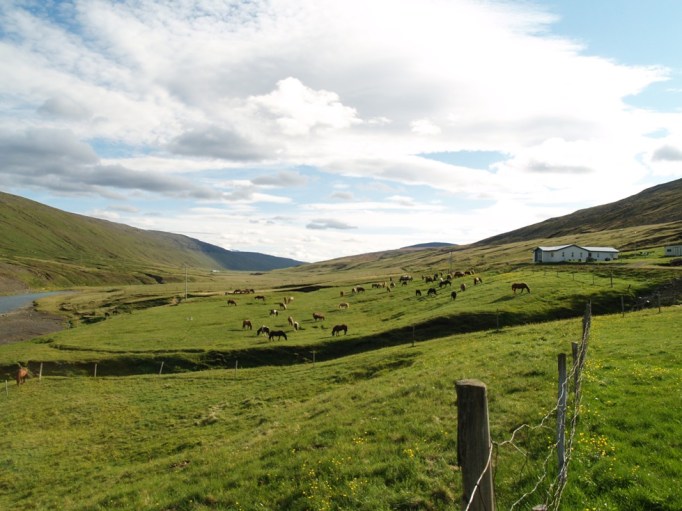
Returning to Iceland only gave me one day in civilization before flying directly to Fljótsdalur, a farm-filled valley in East Iceland where reindeer roam freely and sheep crossings are the only form of traffic control. The human population is less than a couple hundred, but there are hundreds of horses and more than a couple thousand sheep, nestled on either side of a never-ending glacier river that carved out the valley eons ago. Some farms have been abandoned, standing almost as lonely as the ones still inhabited, and unreliable cell phone service enforces the feeling of being left behind from the outside world.

Egilstaðir, the farm where I stay

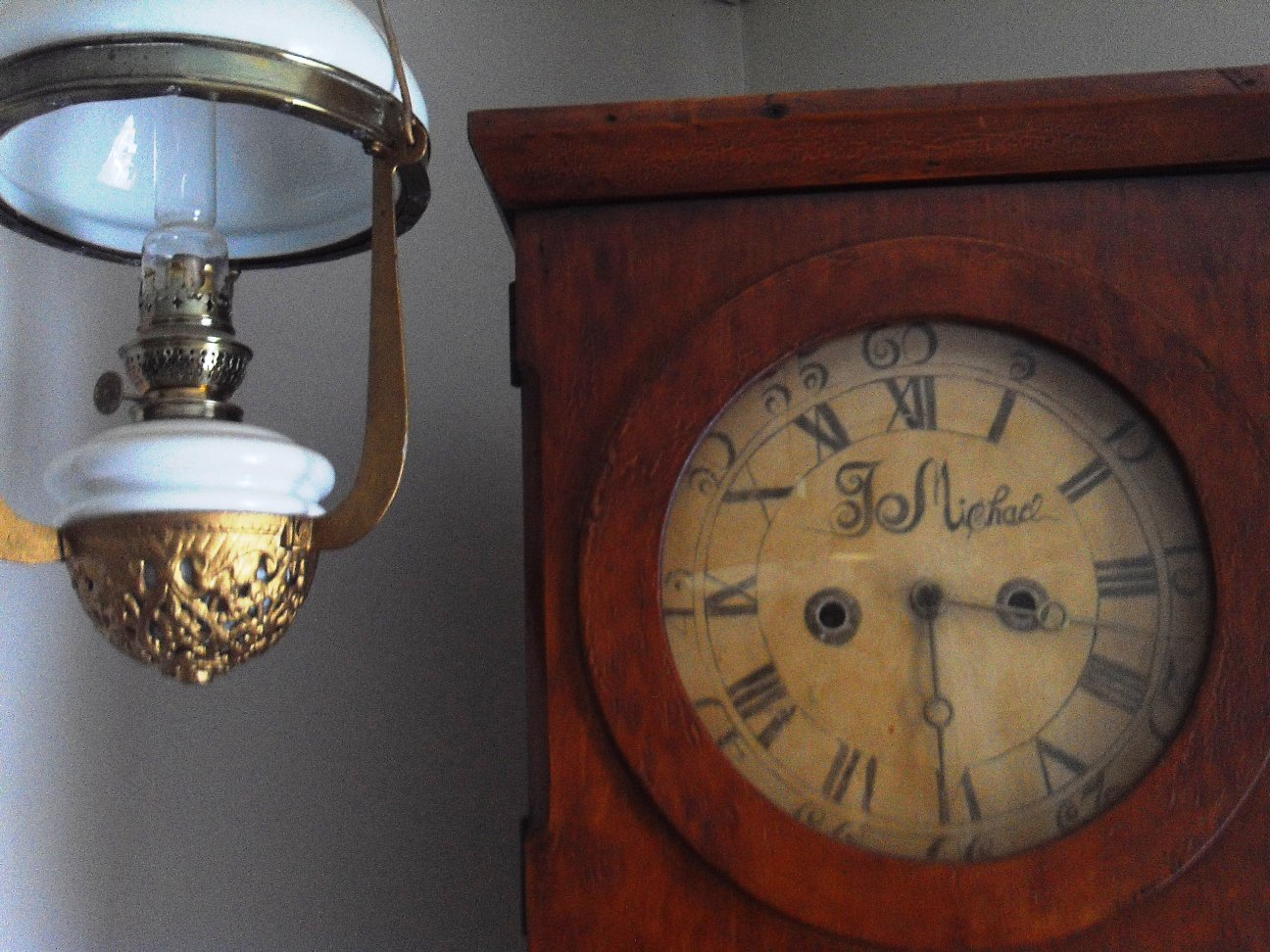
Ironically enough, the farm I’m staying on has the fastest internet I think I’ve ever used, but still my phone roams endlessly. Im staying in a house built in 1940, full of antique clocks, furniture and décor from each the last 3 decades. There’s an iron made in 1815 and a grandfather clock from the turn of the century that has a hand-written clock face. There’s a phonograph from the

hand-written clock face

1920’s, and tons of nick nacks from the 50’s, 60’s and 70’s, many of them horse-themed. The room I sleep in has a very narrow, wooden bed, a horse lamp and some new toys from my friends’ 11 year old daughter.

I only stay here the two nights per week – the night before the horse trips start, and the night after the 6 days trek has ended. Its extremely cozy, with that natural feeling of home even though I had never been here before this summer. It’s the furthest functioning farm in the valley, with a couple abandoned barns a few kilometers deeper. A border collie named Leo wanders in and out of the house, keeping the sheep away from us… or us away from the sheep, I’m not sure.

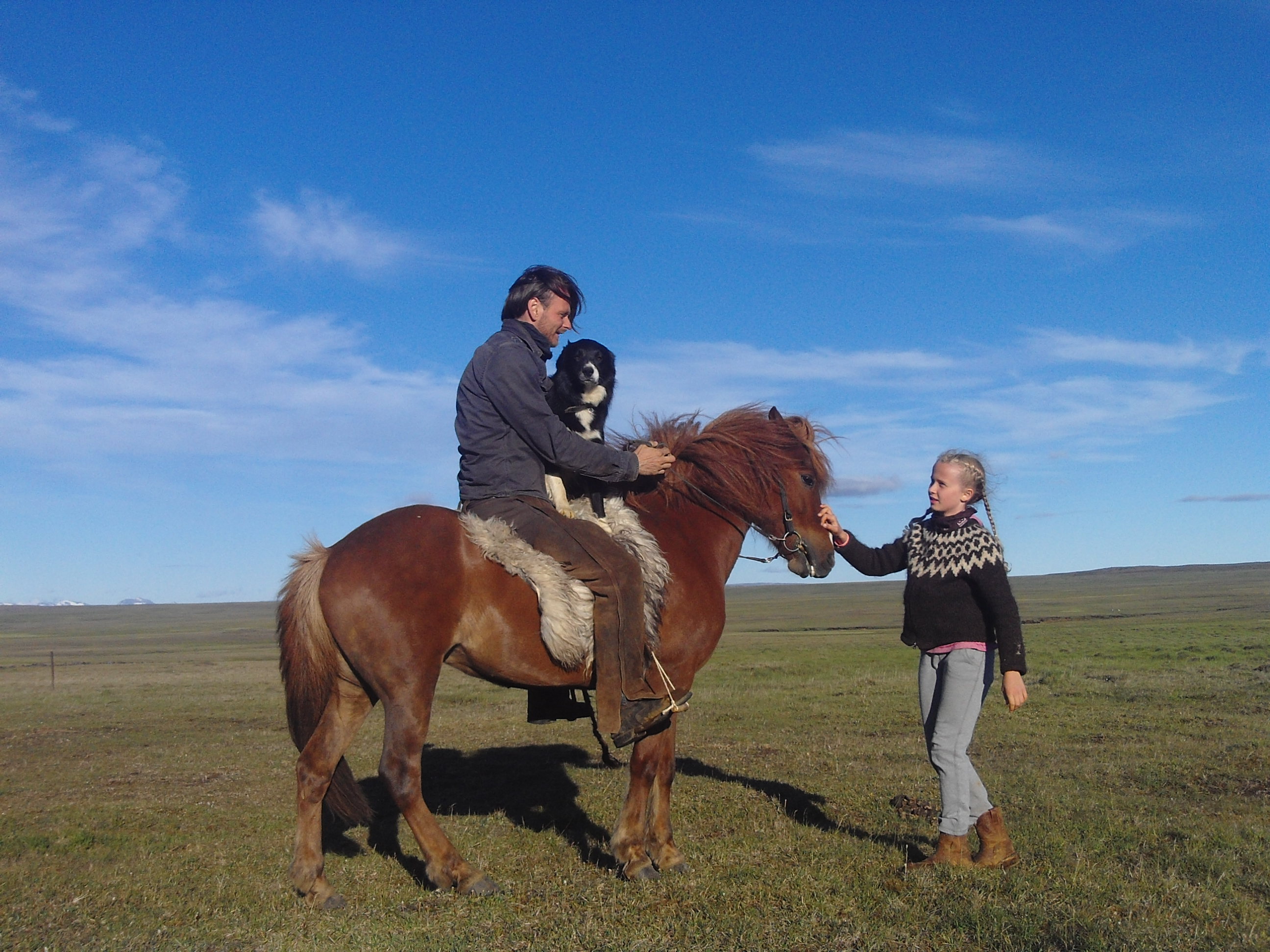
It’s commonly said the weirdest and most creative people in Iceland come from Egilstaðir and around the east, like the famous Icelandic painter Kjarval. My friend that lives here, aka the big boss of the horse trips, is leading these Ishestar highland riding tours for the first time this summer, but has been guiding horse trips all around Iceland each summer. He can miraculously catch and ride any horse, even while holding (and snapping) a 2m  whip, and sometimes rides with his dog. He must be some sort of an animal whisperer, since Leo only listens to him and the animals seem to let him do whatever Denni wants to do to them. He’s got bright blue eyes and disheveled hair that suits his film-maker identity he holds during the winter. He also has his quirks, a man of few words who knows horses really well but still forgets their particular names, having confused some for others, mistakenly caught (and ridden) the wrong horse, and then not having a clue who one or two even are. He almost accidentally bought the wrong horse, when he realized the farmer was trying to sell him the spastic brother who happens to look almost the exact same. He’s soft-spoken almost all the time, except for when yelling at his dog and the horses since they don’t always listen exactly to his whispers.
Denni, the horse and dog whisperer, his daughter Soffia, and Leo

Denni is from this area of Iceland, and happens to be related to almost everyone in the valley, so the riding tour is a bit of a family affair. Horses from ten or more farmers that are all his uncles and cousins and second and third cousins make up the herd of 70+ horses we ride with, and each farmer has his own quirky story. There´s Baldur, who has the longest sideburns I´ve ever seen, who lives on a farm full of turf houses and usually smokes a pipe. There´s another guy who´s super active on facebook and uses his manure-spreading tractor as his profile picture since its his pride and joy. There’s Jón, the former big boss of the horse trips, who always abides by the rule ´its always 5 oclock somewhere,´ which, unfortunately, eventually lead to his demise. There´s a farmer who owns a hobby farm, a kind of a petting zoo, full of the usual aves, dogs and sheep, plus some pet reindeer and arctic foxes. He speaks with a glottal, rolling “R” that makes you second guess if he’s trying to speak Danish, but its just regular Icelandic that’s slightly more difficult for me to understand. He met his wife by sending a picture of his kitchen window-view many years ago to the local midwife school advertising “this is what you could have.” One very lucky girl responded positively and now spends her time making arts and crafts out of reindeer leather on their farm, probably staring out that very same window.


Cigars and Horse-drawn carriages in Nicaragua

SONY DSC

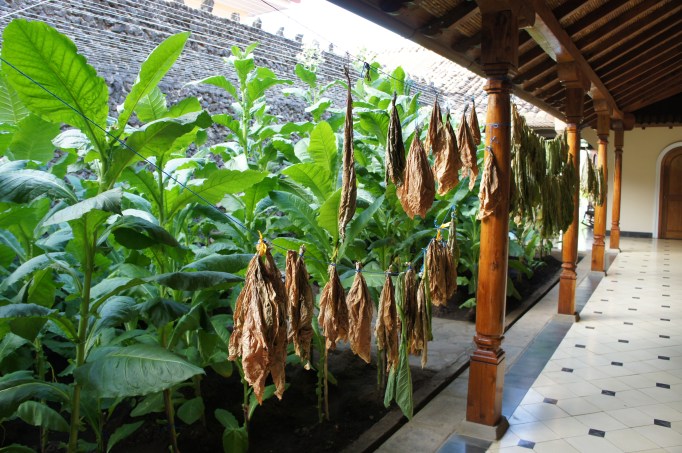
tobacco leaves growing and drying at Mombacho’s

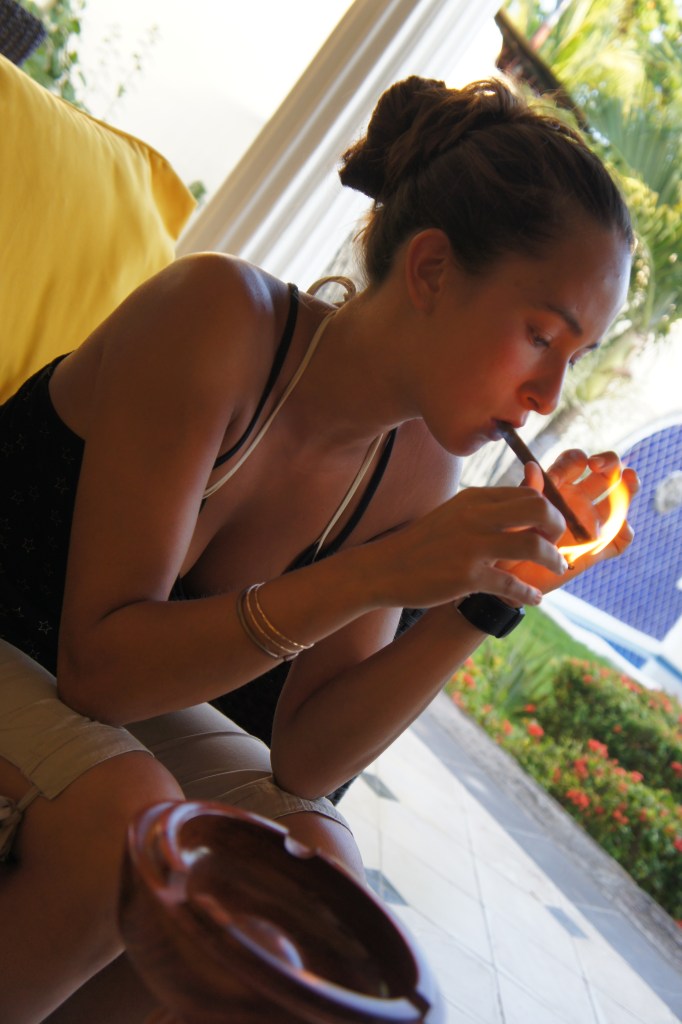
The best discovery I made in Granada was Mombacho Cigars, a brand new elite cigar company founded by three Canadian guys. They are hand picking and rolling tobacco from nearby Mombacho mountain, employing only locals and paying them well, and have established themselves on the main street in Granada in the most beautiful colonial house, complete with a cafe, restaurant and rooftop view. We almost walked right past it, but got enticed to come in when one of the founders Fraser asked us  ‘Would you like to see how cigars are made?’ and of course, I did. I love cigars. And Mombacho cigars are really, really good, proven by the fact that I probably smoked 5 in 2 days.

SONY DSC

tasting a Mombachito, a mini Mombacho premium cigar

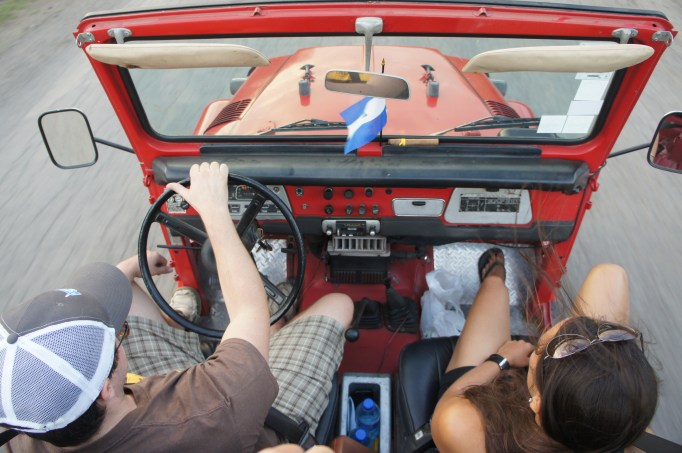
We made a good friend out of Fraser, and he was happy for the English-speaking company, so the next day we spontaneously decided to take a road trip to Leon, another tourist, colonial town similar to Granada. The best part was probably the road trip itself, since we took in in a topless 70’s Toyota truck through some marvellously scenic landscapes.

SONY DSC

no roof and no doors make an excellent road trip car

While I was in Granada I started thinking about how most forms of transport used to involve horses, either on horse back or with horse-drawn carriages. What a romantic and wonderful reality it would be, especially in a place like Granada, to have no cars, buses, trucks, tuck tucks, or dirt bikes.

SONY DSC

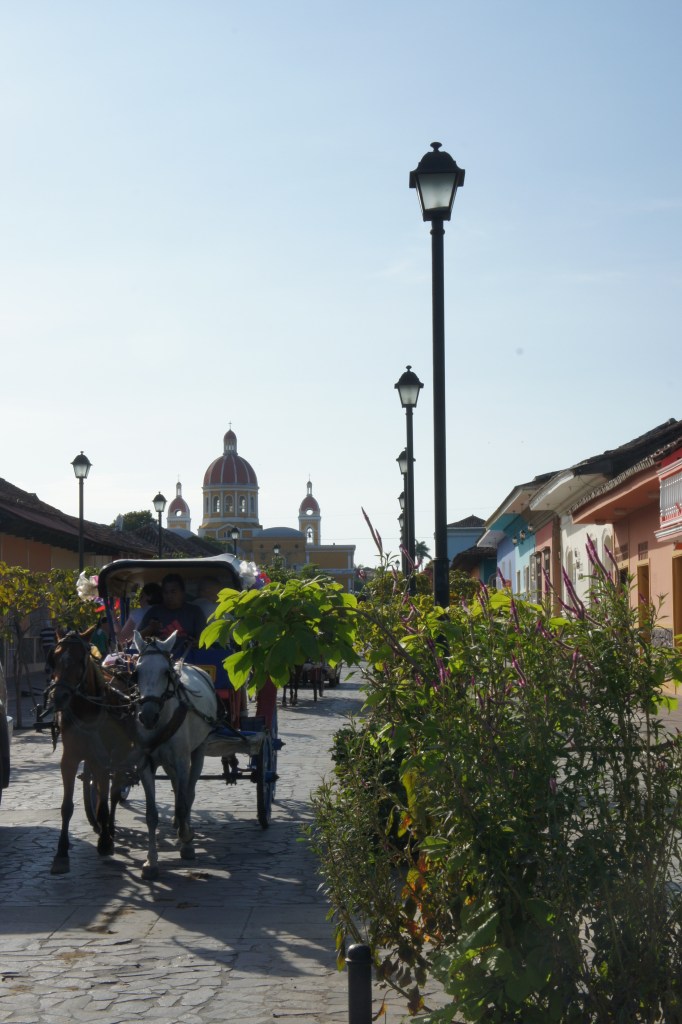
a horse drawn carriage strolls down Calle La Calzada

I thought about this while traveling around town with a carriage, but later decided I wanted to actually travel like that. Guy was up for it too, so it only took stopping a couple carriage drivers before one offered to take us to our next destination, a town called Chinandega reachable by bus in 1 hr. Instead, we took a 7 hr horse and cart into the night and quickly realised why vehicles are so much more efficient as hundreds zipped past us. However, it was still more enjoyable, we appreciated the scenery passing by so much more, interacted with all sorts of locals on horse back or pedal bikes passing by, and made great friends out of our 2 chauffeurs. And, it did only cost $10, expensive compared to the $1 bus but still incredibly underpriced.

SONY DSC

our cart driving out of Leon through some Market traffic

Horse life in the Fraser Valley

After riding horses every day for a month in Iceland, I was really starting to miss the smell or horses and the feeling of not having to use my own two legs so I had to get my fix of riding while’s back home. My family doesn’t own horses anymore, but a young nurse boards her 3 horses on my mom’s farm in Chilliwack. She has 2 enormous Percheron-cross yearlings and an untrained, hot-blooded rescue horse named Ellie she bought for $20. She (the Thoroughbred, not the nurse) is only 4 years old, but broke enough to ride, so I managed to get on her for a little spin and she’s definitely worth more than $20. We took her trail riding through corn fields and she managed to keep me on her back even though the yearling Suzy was walking alongside was way calmer than Ellie.

we could barely see over the cornstalks

Me and my older sister went to visit our younger sister Ruth in Langley, since she lives at the Trinity Western campus where she goes to school. We made the trip an entire day event by spending the morning watching horses warm up at Thunderbird Show Park for the summer finale competition going on that weekend. I still can’t get over how huge the horses were, all these big American and German warmblood show horses, western, jumpers and dressage style, and even the ones that were only 15hh looked like giants compared to Icelandic horses. But of course there were horses 17 and 18hh, and I could not stop gawking at them or the tiny people riding them, who, in retrospect, probably werent so tiny, they just looked so on top of the giant horses.

look at that rump! that’s a whole lot of horse muscle

I also visited an old time friend in Abbotsford, who I went to elementary school with in Surrey and now runs an equestrian center. Lisa graciously let me ride all her giant horses in their fancy indoor riding ring, padded with ground up nike runners. When we weren’t riding, we were in her apartment, which is actually in the barn beside the hay loft, and usually killing flies with one of their many flyswatters placed strategically around the house for killing ease. She has two dogs, a bunch of cats, two donkeys, a couple of her own horses, and then all the other horses that she takes care of. They’re a new equstrian center, but they teach and train horses there under the name Hobbit Hollows, but the barn is called Farpoint Farms – if you know anyone looking to board or take riding lessons.

Lisa with Lex, a $45,000 riding package once saddled up