I won’t criticise NWR any longer but Etosha is the most heavily visited National Park in Namibia and most tourists that visit the country make it here so I would still highly recommend it. However, there are a few different entry points to the Park and if you go through Anderson Gate, the gateway to Okaukeujo, there are a handful of lodges for you to choose from to stay in just outside the gate. I spent some time at Etosha Safari Camp, and even though I didn’t see any others, can give it my highest recommendation. It’s a cozy, quirky camp with luscious grass camp sites, with braii stands, lights and trees and you only pay $10US per night per person to stay (instead of $100/night at Okaukejo NWR). There are also hotel rooms, and the communal area is a big, open space with an elevated pool, an outdoor bar, a fire lit everynight with live music, a sports bar with a pool table and big screen TV, and a restaurant that is scattered throughout an alleyway of covered rooms and shack huts that they’ve decorated into a maze of brick walls with windows made out of vintage car doors. A lot of political posters and decorations display thought-provoking messages, and also an interesting insight to the history of colonial Africa. There’s an old train cart inside acting as the food storage room, and all the other old, wooden furniture almost makes it seem like a Wild Wild West Disney Park setting. The food is served buffet style, and coffee and tea sit out all day with cake for guests. And then with their tour guides, you can take day drives to visit the park and still have a great experience of Etosha without giving your money to NWR or paying too much for very little.
We spent a couple nights at Etosha Safari Camp to watch world cup games at their sports bar. The first was a great success; me and 4 German-Namibians cheered our hearts out and blew German-coloured vuvuzelas as loud as we could to watch Germany beat Argentina 4 – 0. The second game, Germany’s semi-final against Spain, was a bit more grim, and the Germans were much more quiet with their vuvuzelas. Oh well, it was a good run for Germany, and now we got to watch Netherlands and Spain contend for the World cup, two teams who have never previously won. Good for them
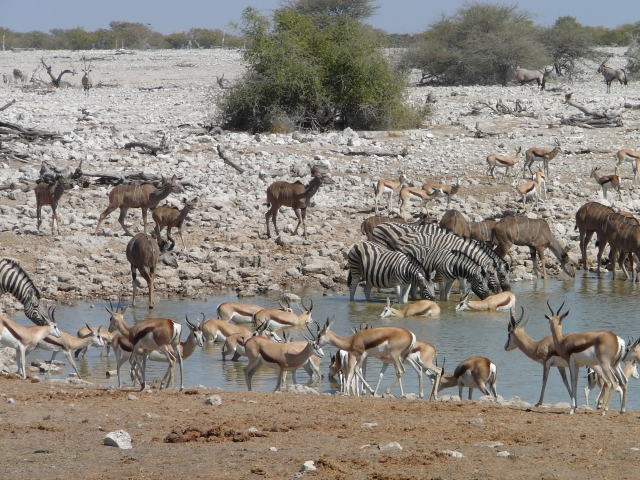
All the reindeer, ahem, i mean pretty hooved animals drinking at Okaukejo waterhole
The great thing about Etosha National Park is that it is absolutely full of animals and it doesn’t really make a difference if you see it by day or night since you can’t leave camp at night anyway. However, there is one waterhole at each camp that is spotlighted so that would be the only thing you miss out not staying overnight within the camp.
During the day you still have a pretty good chance of seeing all the animals in Etosha, especially early morning or late afternoon. You have access to one of the healthiest population of Black Rhino, a species brought back from the brink of extinction against all poaching odds for its very valuable horn. There are soooo many different types of ungulates in the park, what my cousin Sara might call all reindeer, but they’re mostly different types of antelopes. There are tens-of-thousands of zebra and springbok, thousands of gemsbok, wildebeest, eland, impala, hartebeest, ostrich, jackals, vultures, mongooses, giraffe, and elephant, a few hundred kudu, bat-eared fox, wild cats, lions, hyena, white rhinos, and who knows how many cheetah and leopard, but there are some although spotting them is a stroke of luck. You can drive up to around 40 waterholes, and the bird-life here is a haven for bird-watchers, especially since it’s so flat and theres never a cloud in the sky during the dry season. After 3 weeks here, only going on drives about every other day, I’ve seen all of the above numerous times except white rhino, cheetah and leopards. Ive also seen a lot of spiders, skinks, other lizard things, and a dead puffader snake – all less exciting events. One evening I almost stepped on the cutest, tiny spotted owl that was camoflauged perfectly into the grey stone ground, and once we knowingly scared a wild cat out of its hole in the ground we saw it dart into, but then got more of a freight watching it jump out in lightning speed even though we knew full right that would happen. There are no mosquitos this time of year, but there are so many barbed bushes and spiky trees that you almost always have burrs or thorns on your clothes.
Since the park is fenced, migratory animals like elephants and wildebeest instead become resident, and even though the occasional animal digs itself out (lions), jumps the fence (eland, kudu) or bulldozes it over (elephants), animal populations seem to stabilize at very high densities. As much as it locks the animals into an area, it also locks out people from hunting or illegally poaching, so many animal populations are flourishing at much greater successes than they would without the fence. But, there are many problems and arguments against fencing, and the few stories I’ve heard of animals escaping from a fence but not being able to get back in (ie. Due to fence repairs) are grim – lions end up getting shot since they wander onto farmers private land and that’s their right, and one lonely hartebeest I saw on the wrong side of the fence beside the road will probably thirst to death since all the water is inside the park fence.
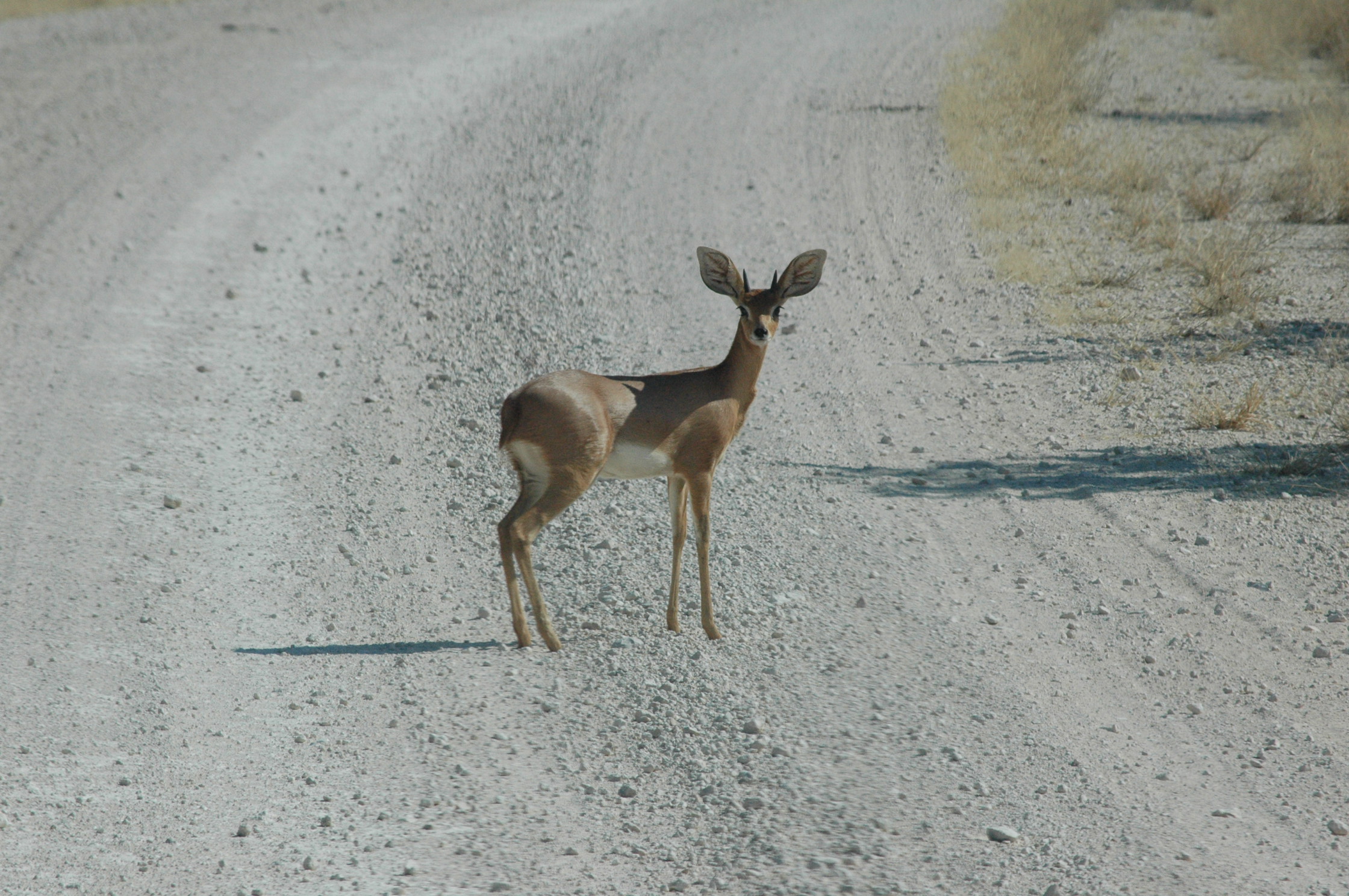
a tiny steenbok, looking like a deer in headlights – but don’t worry, we stopped in time
Even though a place like Chobe National Park operates without any fencing at all and I thought it was just great that way, there are convincing arguments that fencing has its pros and may be necessary for the park. However, the road infrastructure in Etosha seems very unnecessary. First of all, the roads marked on the map that’s given to tourists show a lot fewer roads than there actually are. There are a bunch of staff only roads, gravel pit roads, and old blocked roads that have become undrivable from flooding, fine dust or simply not being maintained. You can easily spot the 60 or 80 gravel pits dug all around the park to make these roads, which have been contemplated sources of anthrax spores, and sometimes the main roads are wide enough for 4 lane traffic. The speed limit is 60km/h, way too fast to avoid daily roadkill, and there’s something wrong about seeing a BMW sedan taking a speedy ‘safari-drive’ through the park whose roads cater easily to any type of car – even 60-passenger coach buses. Strangely enough, the most common roadkill are birds in flight – the silly things fly right under your wheel, or in my personal experience, into the side of the car or into the car antenna poles.
After becoming intimately connected to Kubublanco, it was comforting to see that the majority of all trucks both in and outside the park are Toyota Hiluxes, with the occasional Land Cruiser or Isuzu in the mix. At the research camp in Okaukuejo, UC Berkeley has 3 hiluxes, all with 400,000km+ on them, but still trucking, although very unreliable in an early-morning, cold start.
Links: http://www.namibiareservations.com/etoshasafaricampe.html


 nomadic cosmopolitan