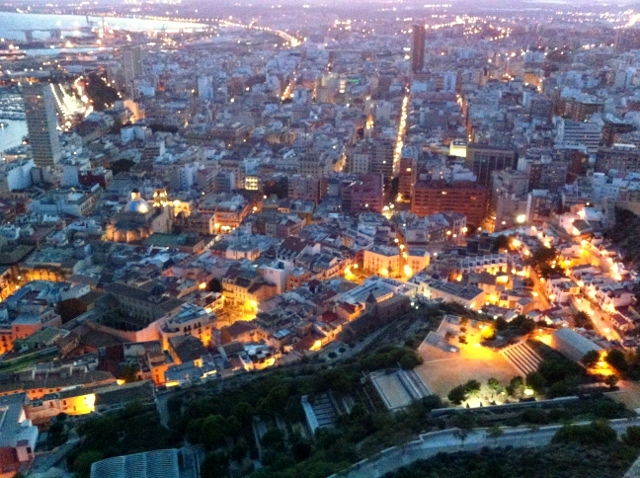
The Holy Land at Christmas

Even if you’re not religious, everyone has heard of the Holy Land, including especially Jerusalem and Bethlehem. Everyone also knows about the conflict between Israel and Palestine, although one or the other may not be recognized by some, and it seems impossible to have an opinion on the matter without being considered anti-Semitic, anti-Muslim, pro-Israel or pro-Palestine. The most confusing thing is to have both Israeli and Arabic friends, despite what religion they practice or if they even identify as Jewish or Muslim, since the Holy Land is also filled with Christians and atheists. Then there are also Arabic Jews, like the Yemeni’s who have a huge presence in Israel, and the Christians are divided between Orthodox, Protestant, and Catholics from all over Europe, North America and the Middle East. The land is considered holy by all these groups, but slight differences in beliefs and customs still make some hate eachother with a vengeance I’d never thought religious groups could tolerate.
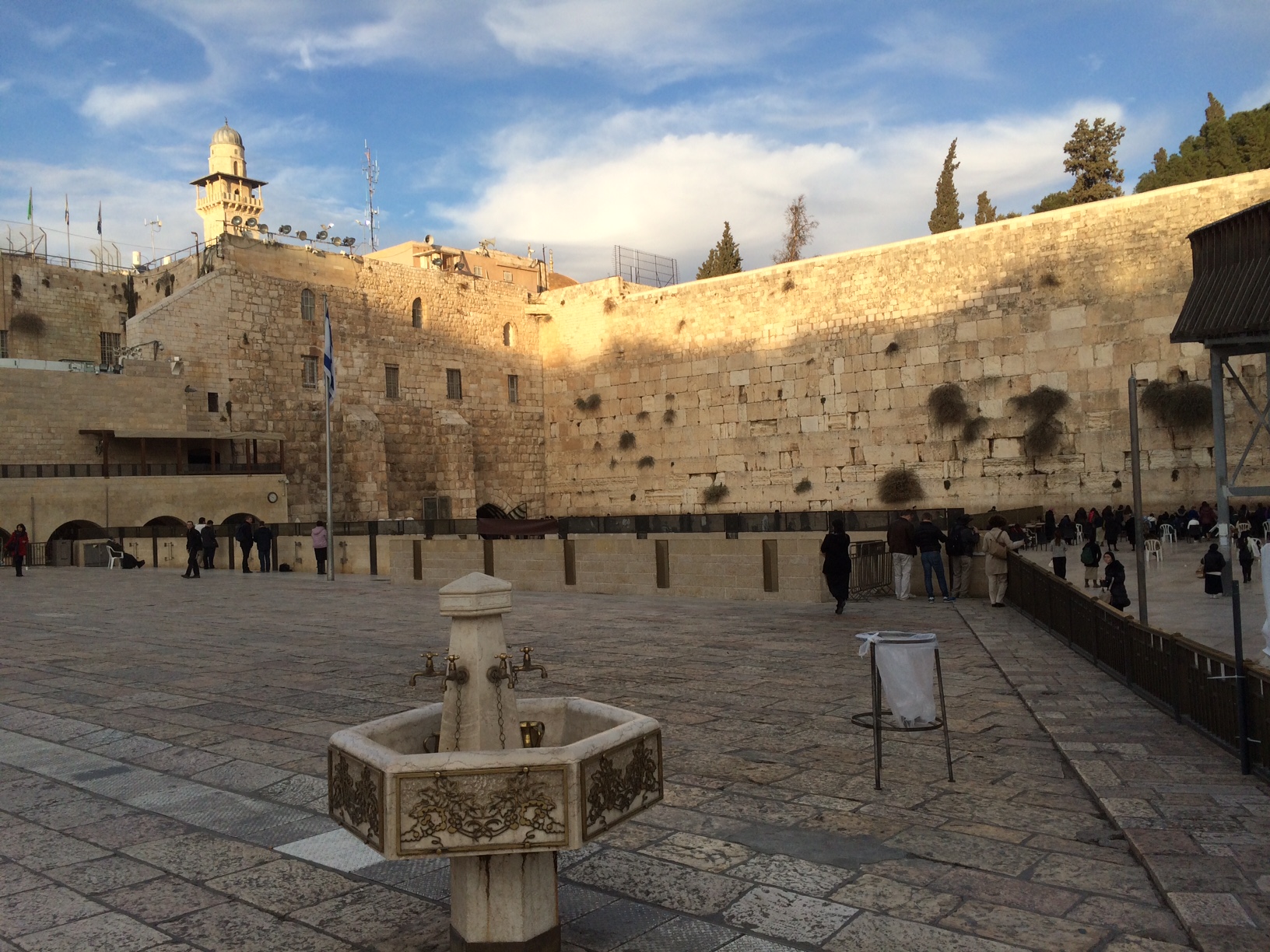
the Western Wall

the Western Wall

Despite the tensions and daily threat of terrorism, I still felt uneasy with the extreme Israeli security. I was questioned and searched both on my way in and out of Israel with utmost scrutiny, as if I had already been targeted as guilty of something dangerous but neither of us knew what. Traveling by public bus and walking around the pedestrian streets, I crossed paths with visibly armed civilians and 18 year old female soldiers carrying M16’s, yet Palestinians were stopped, searched, and detained if they even had so much as a kitchen knife on their person. I was never sure if people could see I was a tourist, or if they suspected I’d be Israeli or Palestinian, but so much artillery out in the open never made me feel safer. The Israeli police and soldiers, who are everywhere, especially in Palestine, would sometimes have their guns pointed on my from barricaded roof tops where I saw nothing but deep down the barrel of a rifle. It was always unclear who was protecting or who was suspecting.

the fortress of the Tower of David at night

the fortress of the Tower of David at night

Jerusalem is primarily in Israel, although East Jerusalem has a Palestinian town that you can only enter through a checkpoint. A part of touristy old Jerusalem, the Dome of the Rock, is a shrine that Muslims control, but still you have to enter through an Israeli check point and I couldn’t enter because it was the wrong time of day. I could visit the 19m high West Wall, the only part of the Temple Mount complex left standing and thus considered the most holy place in Judaism.
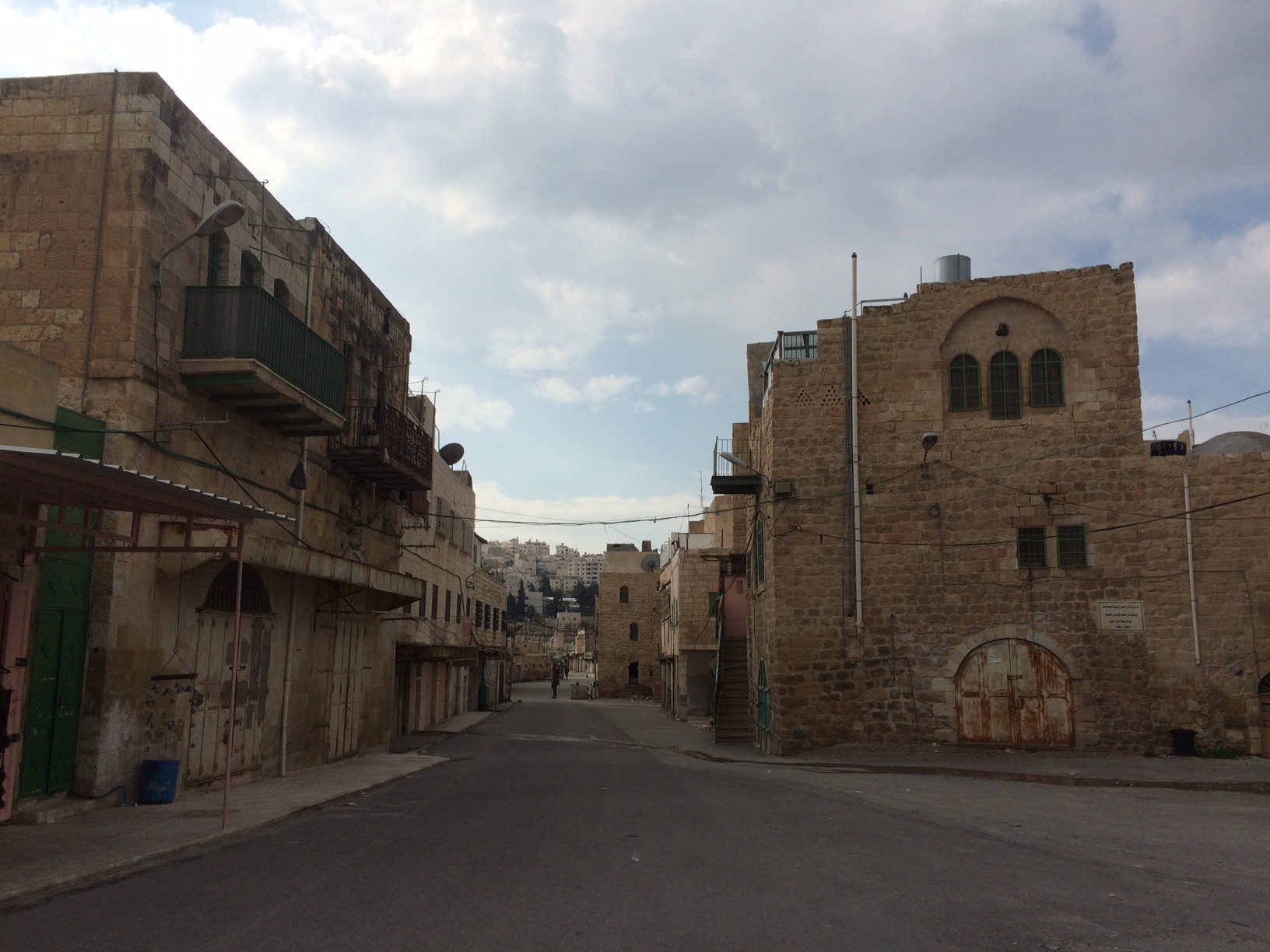
empty Shuhada street

empty Shuhada street

I was also allowed to visit the Tomb of the Patriarchs in Bethlehem, the burial place of Abraham who both the Jews and Muslims consider a fore-father. The building around it is split in half between a Mosque and a Synagogue, and both entrances are controlled by Israeli’s, similar to the whole city of Hebron which the tomb is located. Its a city of 11,000 Arabs surrounding a fortified settlement of 500 jews protected by 1,600 Israeli soldiers. Still the Israeli’s control where the Palestinians can walk, open shops, worship, or run businesses, and the old town of Hebron and Shuhada street, once bustling market places, are ghost towns today.

a checkpoint in Hebron

a checkpoint in Hebron

Only in Tel Aviv was the city free of checkpoints, but instead there were random searches by security guards to enter any public spaces like bus stations or markets. Besides that, the city felt like a bustling neighbourhood in Manhattan, or a Mediterranean sea-side town filled with artsy cafes and high-fashion shops. It was amazing to me it was the same country as Jerusalem, a city plagued with constant terrorist attacks and an uneasy feeling of racism and religious strife. It was even more hard to believe that Palestine doesn’t exist to many, in a place where there were clear boundaries and lines drawn between them and the others, even as extreme as an 8m wall being built around the West Bank. Its not even possible to enter the Gaza strip, making it seem more of an intentional prison than a part of Israel. But who am I to judge, when much of the world still doesn’t understand, so I certainly couldn’t wrap my head around any of it, although something about it all seems very very wrong.
Morocco: Part I

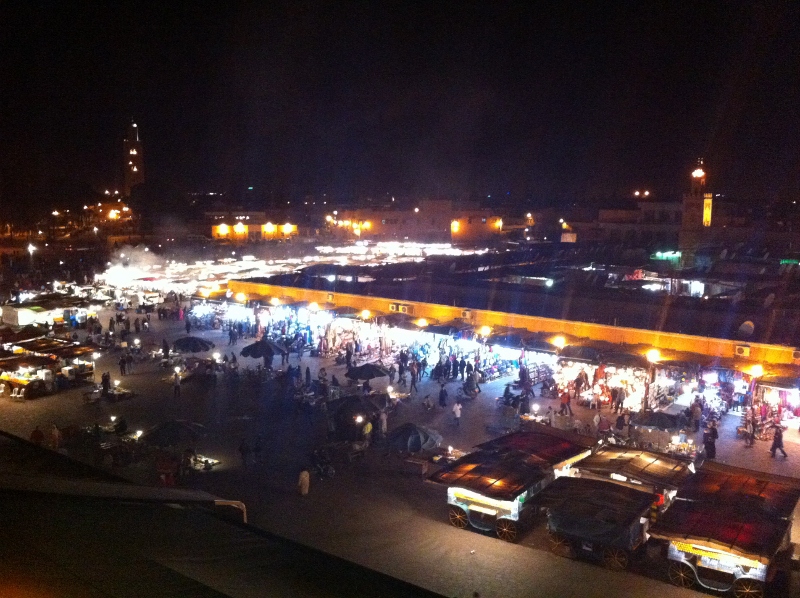
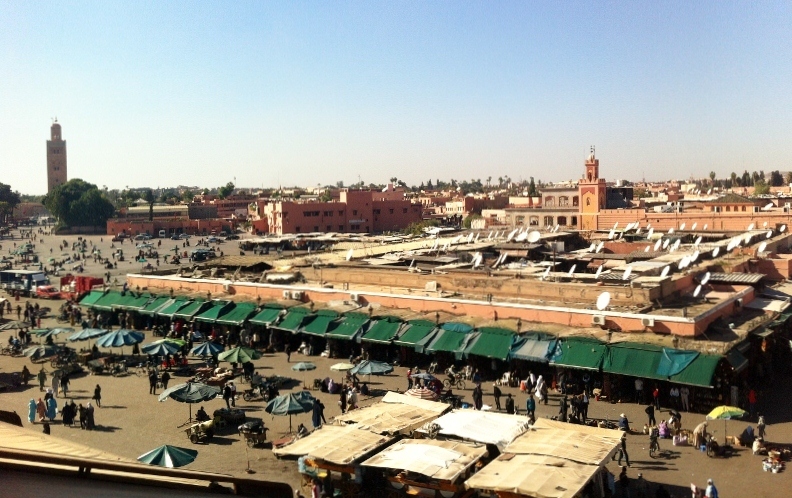
Djemma el Fna by day

I’ve been in Morocco for a week now, but every day it feels like I’m getting further and further away from home. The lone road south to the Sahara has felt like a never ending journey, and knowing that I have to turn right back around and come back north once I get there makes me not really want to get there. I started in Marrakech, a city that I imaged to be something like Cairo or other great Arabic cities, but was pleasantly surprised by how small, inviting and colourful it was.

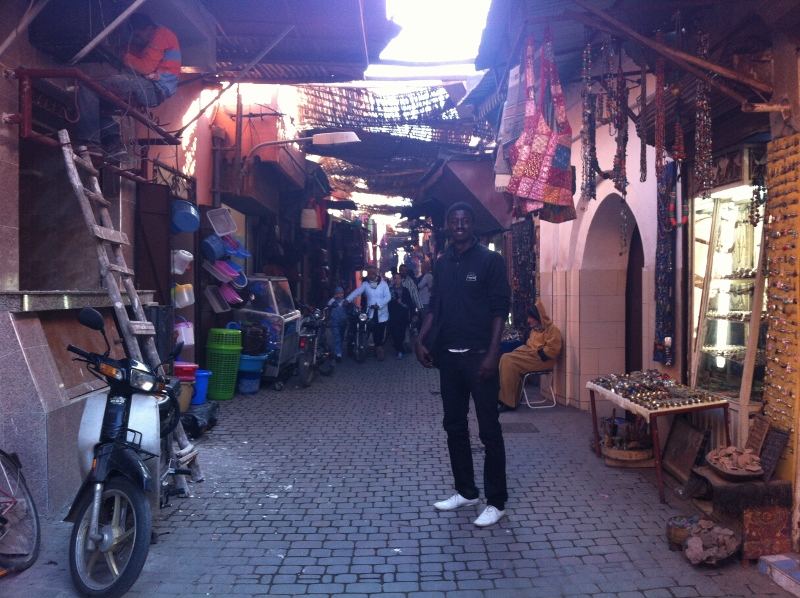
Adams guiding me through the souks

I spent my first day wandering into town alone and was met by a Senegalese man named Adams. He was tall, thin, and dark as night, but I welcomed the male company to guide me through the maze of souks we ended up hopelessly lost in. He helped me bargain for the right prices and towered over me like a guard from unwanted harassment, and visited two palaces with me also for his first time. We sat on the sidewalk for some fried bacalou and eggplant that Adams argued should have cost 50 euro cents, not 60, but I didn’t care – it was delicious and cheap and the toothless woman who served us provided endless entertainment every time she tried to speak the Berber neither of us could understand.

spices for sale near the medina

The medina, the walled- old town, was a labyrinth of narrow walk ways, sometimes covered, sometimes barely wide enough for a donkey and his carriage to pass, and always required you to move out of the way for motorcycles zooming past. The buildings rose up on each side of you, in shades of pink or beige, totally sealed and shut from outsiders. But once you entered a building, it always opened up to a sunny courtyard, the source of their light and fresh air, proving they weren’t as dark or secret as they seemed.

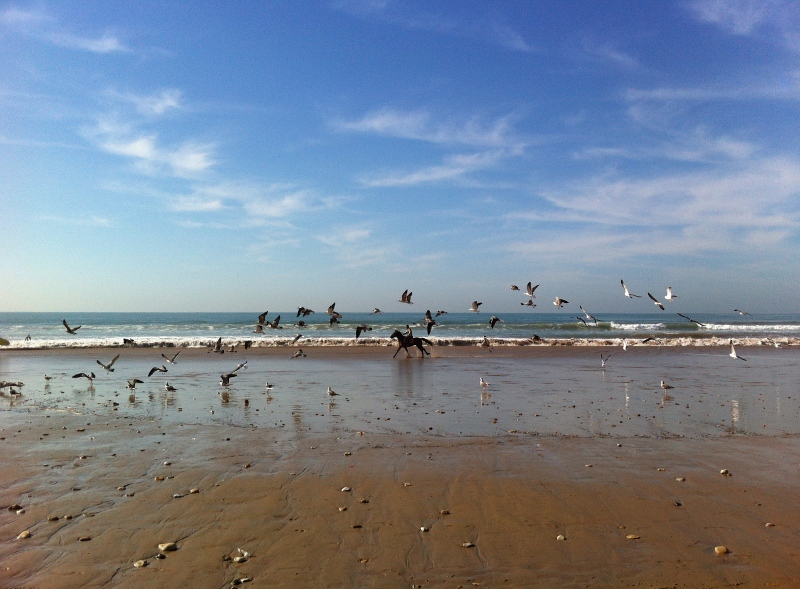
Taghazout, where i found camels and a horse on the beach

As I traveled south, through Agadir and onto Guelmim, I took grand taxis between towns. The grand taxis aren’t any bigger than the petite taxis, but their routes are longer, a hundred or more kilometers, and they don’t leave unless they have 6 paying passengers – two in the front seat beside the driver, and 4 in the back. It’s always a struggle to strategically plan which seat you take and beside who you sit, since you have to choose if its more comfortable to be squashed against the hard door and have window access or be sandwiched between two people who may be hard or very soft (which usually means too big). I always got suckered into being squashed between the women if there were two, and their many layers of flowing cloth always spilled over me and their chatter across me kept me both comforted and stuck. I once got unlucky and sat beside a man who insisted on pivoting to face me with his arm around me and his stinky breath breathing down my neck asking me incessant questions. After 20 minutes of this I asked the taxi driver to stop and he thought I wanted to get out there and then in the middle of a mountain pass, and I started to explain I just wanted to change seats but the two women already knew what was wrong and had started shifting for me to get sandwiched between them. They held my arm and smiled knowingly, and then yelled at the man and the taxi driver for the rest of 1 hour drive.

Moroccan mint tea, always poured from great heights

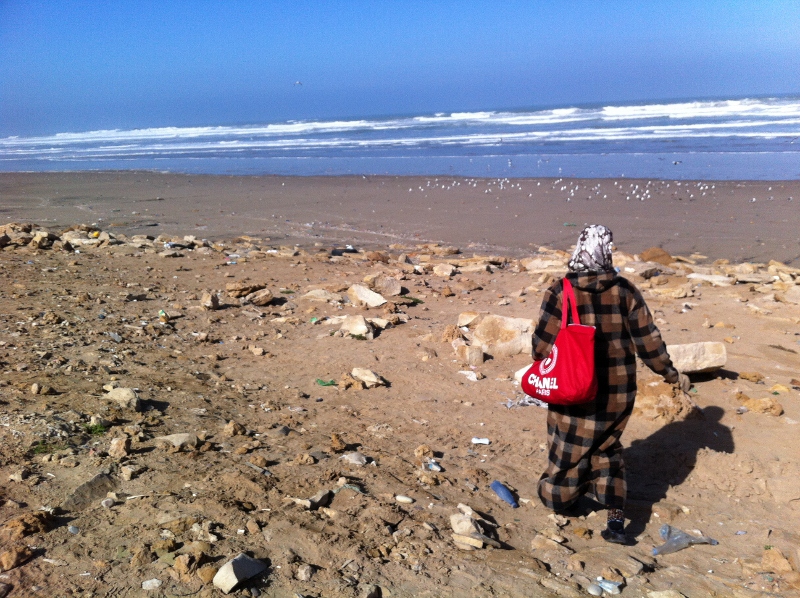
In another grand taxi, I thought the woman wanted to take me home with her, but she just wanted me to get out of the car to hold my hands for a moment, muttered some words, nodded her head and bowed many times – Im still not sure what the gesture meant but it was nice. In the last grand taxi I took, the 300km long haul to La Ayoune, I shared the backseat with 3 very large Saharan women, which meant I was only left with half an ass cheek on the seat and could only lean back if I lay on one of their breasts. Thankfully we stopped halfway for a lunch break and I was summoned by one woman to walk down to the beach with her to share her lunch. We ate bread and tangine and oranges, and sat in silence taking in the sight and serenity of the polluted beach around us. She showed me the henna on her ankles and arms, and jingled the bangles on my arm in an approving way. When we returned to the grand taxi, the other woman took turns walking up beside me and just standing close in a protective motherly way, and they also jingled my bangles. One sprayed me with 10 or more sprays of perfume, all over my neck and arms, which may have meant I stank or it was just a normal thing to do after we’d eaten.

All of these run ins would have been so much better understood if I could speak Arabic or Berber, but I still enjoyed the game of experiencing one another without a common language. My Arabic has still increased from 3 words to about 20 words, all of which have some in handy at one point or another for me to need to learn them. The administrative language is French which meant I could always talk with police men, which turned out to be useful for the many road checks we got stopped by. The more comfortable and cheaper bus refused to take me the last 300km to La Ayoune because of the road blocks, since foreigners always warranted unwanted attention by police officers.

the woman I shared lunch with

The last police check was just outside La Ayone, and the police officer asked some basic questions and walked away with my passport (which is always cause for cold sweat). He returned and let me grab the passport, but wouldn’t let go unless I told him what hotel I was staying at. The greasy smile by which he asked me this made me sure it wasn’t part of the routine police check, but I still felt I had to answer him. I couldn’t lie either because I didn’t know the name of any other hotel or if there even was more than a handful of them, so I told him ‘Tafoukt’ (which means sun in Berber) and he said ‘Of course, I should have guessed, since you have no sun in Iceland now’ and winked. (to be continued and pictures added later…)

The Tale of the Traveling Freewaters Sandals… coming soon!

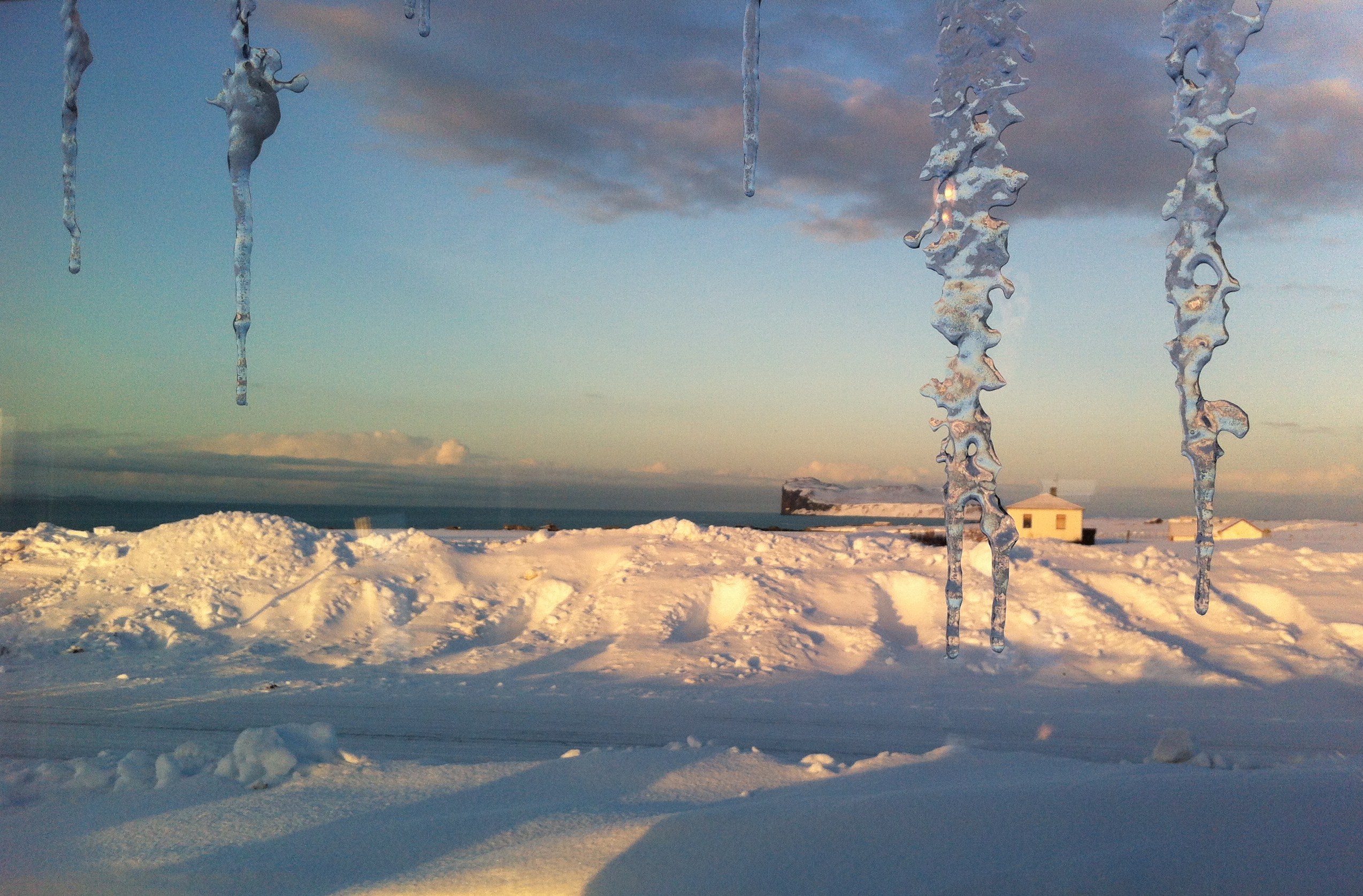
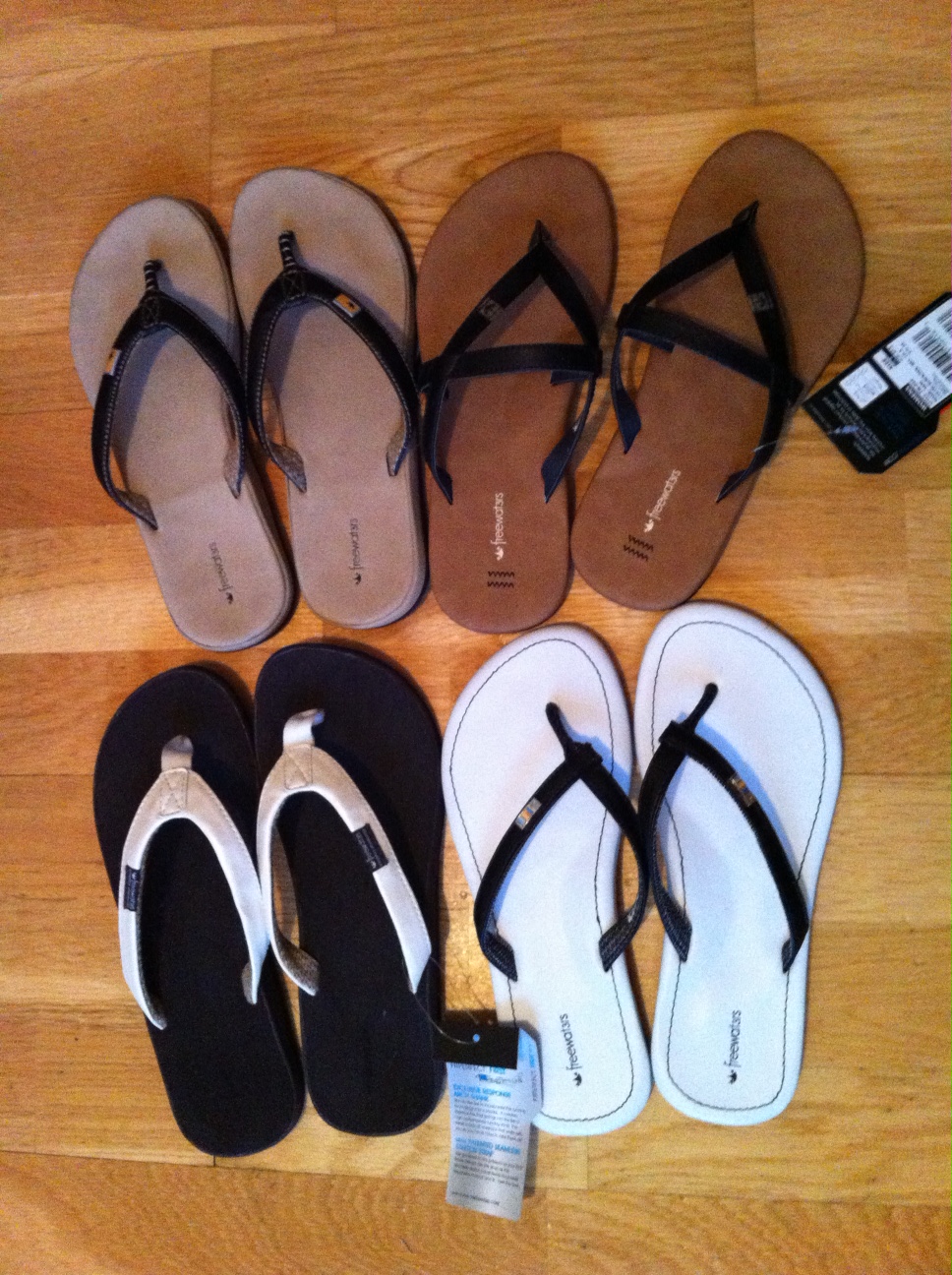
Eli from Freewaters sent me my second ‘installment’ of sandals, from the 2013 line coming out in January, and it was a little ironic to open a box of 5 shiny new flip flops while a windstorm blew outside with -2` temperatures in Reykjavik. I realized I wouldn’t get much use out of them here, at least not now, but I have a trip coming up in December to Morocco and Portugal to look forward to. Although, I am flying with some (dreaded) cheap airlines with all sorts of carry on baggage restrictions, and doubt Ill pack all 5 pairs with me. How to choose which ones to take and which ones to leave? My goal has sort of been to get as much mileage out of each pair in as many sandal-friendly places as possible, letting each pair tell a story from the wear and tear of all my steps.

freewaters sandals

Then, I had this marvelous idea – do you remember the movie ‘The Sisterhood of the Traveling Pants,’ based on the novel by Ann Brashares? Why not have one pair of sandals travel between travelers and us correspond among eachother about where they went and what happened in them? It could be the backpackhers hood of the traveling sandals… or something like that… Im going to keep a logbook of everyone that wears them, where they go and how far they walk, until the traveler who is unlucky enough to see their last day finally buries them. Then Ill be sure to write a blog about it.

IMG_0522

the Marigot harbour, where my Capetowns retired in February

From my first few pairs of sandals, most are still in perfect shape, minus a few scratches here and there, but I buried my only pair of Freewaters in St. Martin in the French West Indies. I was standing in Marigot harbour, rushing to pay for my ferry ticket to St. Barthelemy, and as I ran to board the ferry, my right foot Cape Town sandal tore between the toes. I stood there for a lamenting second, feeling sad and sorry for the perfectly good left shoe I now had to leave behind too, and then slipped them both off and jumped on the ferry bare foot. As we pushed off, I saw the ticket validating guy stroll casually over to the pair of shoes, pick up the right one, and start to try to fix it. He looked up at me and waved at me with my broken shoe, and yelled something in creole french I don’t remember. But I yelled back, ‘Good Luck, you can keep them!’

Eli sent me a new pair of Cape Towns, and they will become the Traveling Freewaters Sandals, since those were the shoes who made it the furthest, and so far, created the best stories. I already have one traveler lined up to break them in; my friend Solveig from Iceland is taking them to Brazil for Carnival in Feburary. She gets back in the beginning of March, and will hand them back over to me. Then I’m thinking of taking them skiing in the Swiss Alps (to wear inside the saunas of course) or wine tasting in Italy, but they’re always up for grabs again between trips. All you need is to have shoe size 37-38, have a trip planned to somewhere flip-flop friendly, and send me your name, mailing address, and promise to return them with an accompanying travel story. So, if you’re going somewhere now or before February, or after March, send me a message!

(… or you can always buy your own pair http://www.freewaters.com . Learn their whole story at http://www.projectfreewaters.org )


Iceland Airwaves 2012

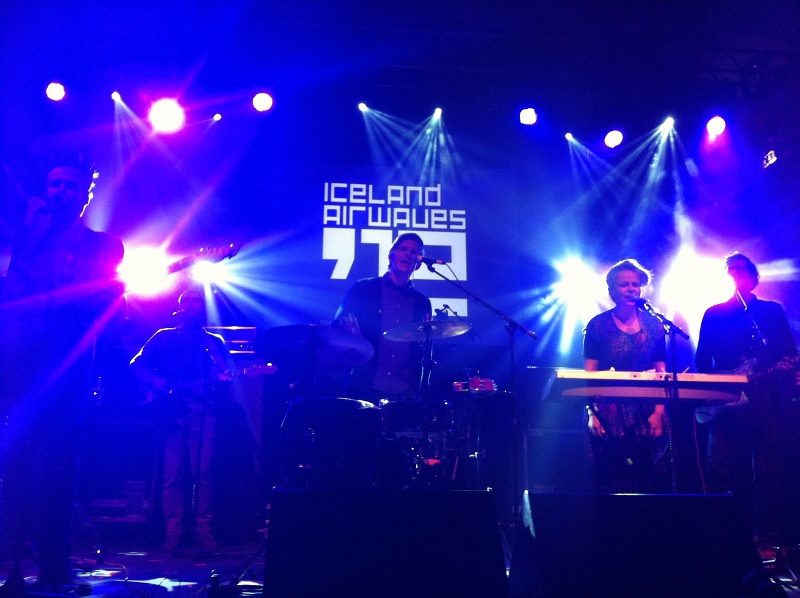
Prins Pólo perform at Listasafn for Iceland Airwaves 2012

Sóley, the ´must-see´ artist

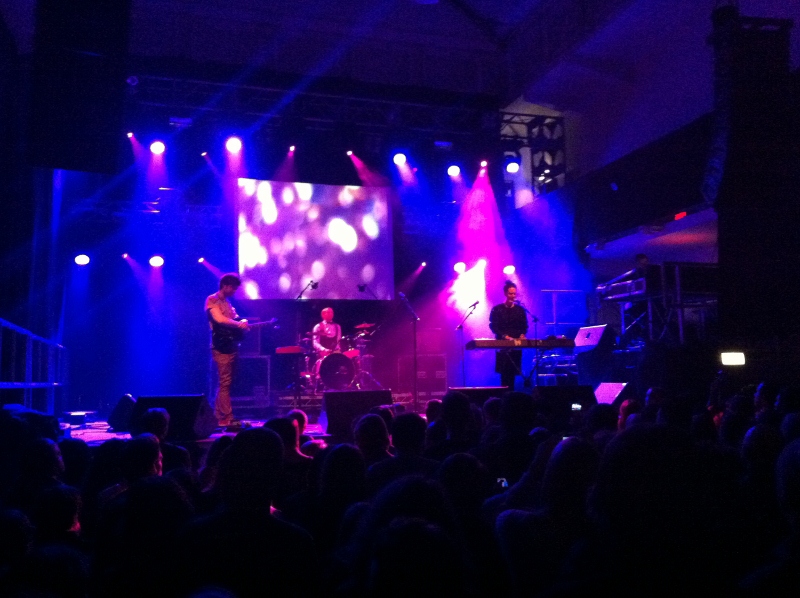
This was my first Airwaves, despite it starting in 1999, since I’m usually making excuses to travel outside of Iceland once the cold and dark starts to set in. The weather this weekend was definitely cold, with crazy windstorms on Friday and Saturday, that blew me over once, into oncoming traffic on the street once, and otherwise just pushed me around and made me look like a drunk trying to walk in a straight line. At least other countries issue hurricane warnings, but we just keep on going as if this is totally normal weather… which, I guess, it is, but not the safest. It would have been a hassle to wait outside in some of the long queues, but with a little luck and random chance, a friend of a friend from LA came to the festival with a VIP ticket +1, and crowned me the other darling. With the “darling” pass, we could jump the lines, in and out of all the official venues, which got us into a few places like the Reykjavik Art Museum in-time to see Sóley, one of the heavily advertised ‘don’t miss’ artists.

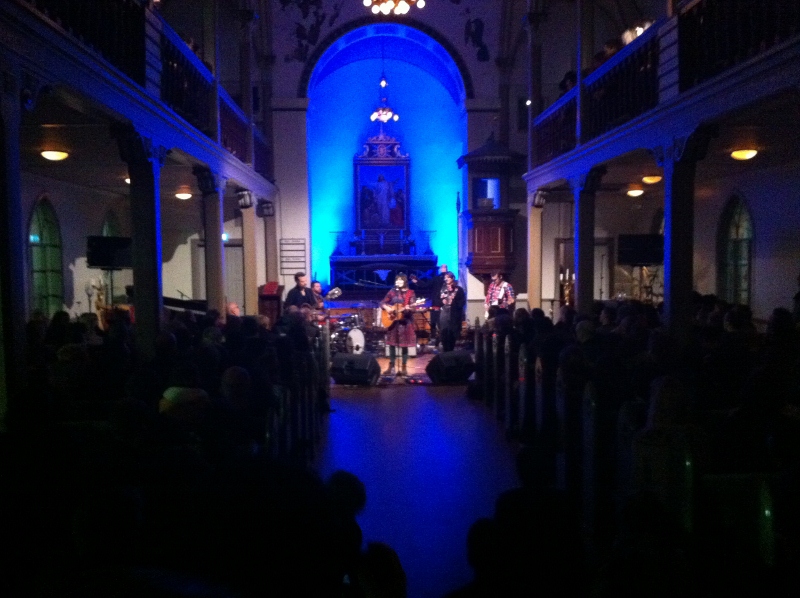
Lay Low at the church

The festival started on Halloween, and we fell in love with Myrra Rós´ voice at the Deutsche bar. Then there were 3 artists in a row that were on the top of my list to see, and from 10-1 we enjoyed Mammút, Sykur, and Ásgeir Trausti (I love him). On Thursday, we also saw Phantogram at Listasafn. We checked out Lára Runars and the Leaves, then settled in at Harpa to see Dikta, Bloodgroup and Of Monsters and Men. It was our most conservative night, since I had a midterm Friday morning, but on Friday we saw music from 4pm to 4am at probably 10 different venues, off and on venue. Highlights where Retro Stefson in the big white tent behind Hressó, Lay Low in Fríkirkjan (a beautiful church beside the pond), Mugison at Netagerði, and FM Belfast at Harpa. In between we bounced around for a little variety, listening to some death metal rock at Amsterdam, became hypnotised by Valgeir Sigurðsson´s classical violin at Iðno, and squeezed into Kaffibarinn to listen to Retrobot, an electrical-indie rock bank with a dash of 80´s vibe.  I also saw Ásgeir Trausti play again, in the smallest venue of Airwaves – a little red summerhouse big enough for 5 people in the middle of Ingolfstorg.

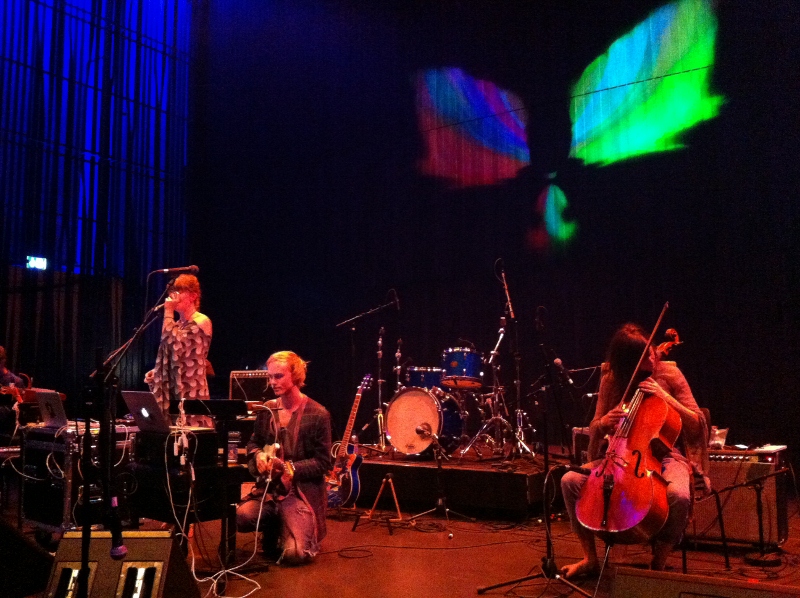
Kira Kira

On Saturday, our line up wishlist was tightest, with no time between bands (sometimes even an overlap) and each one in a different venue. Prins Pólo at Listasafn, Beni Hemm Hemm at Silfurbeg, Kira Kira at Kaldalón, Ásgeir Trausti in Norðurljós, I break Horses at Iðno, and finally Gus Gus to finish at Harpa. Kira Kira was incredible, I don´t even know where to start to explain her music, but the guitarist played kneeling down most of the time, the celloist was wearing a sweater that gave her wings everytime she bowed the cello, a lizard man played an instrument I have no idea what to call, and the singer Kristín Björk swayed around barefoot showing off her super soprano voice every once in a while. For Ásgeir Trausti´s set, I managed to get front and center in the audience, and stood under him with googly eyes wishing he would just open his eyes once to look back… but he never does.

Ásgeir Trausti at Harpa

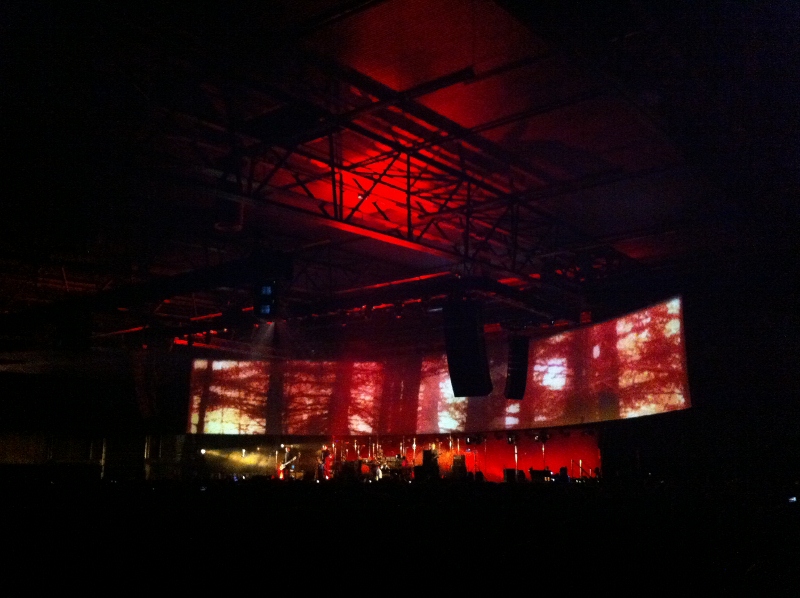
Sigur Rós´ amazing stage

The last day of the festival was slow but cosy, and I managed finally to get my greedy hands on a Sigur Rós ticket and stood awestruck by the bigger-than-life-sized visuals surrounding the stage. I heard Ylja at Eymundsson, a symphony play at Munnharpan, My Brother is Pale at Dillon, and, of course, Ásgeir Trausti one last time. He sounds the same everytime he preforms, and sings the same songs, always with his eyes closed, and barely says anything other than ‘takk’… its amazing how shy he can be after being the most played Airwaves artist of the 2012 festival.


Southern Spain, Sangria and Sunshine

In my search for more summer sun, I took advantage of a return flight voucher from Icelandexpress. I used it in October not only because it was expiring soon, but because there had been rumors of the airline going under. I had a week off school, a “reading” week, so I decided to justify the trip by reading on the beach in Alicante.

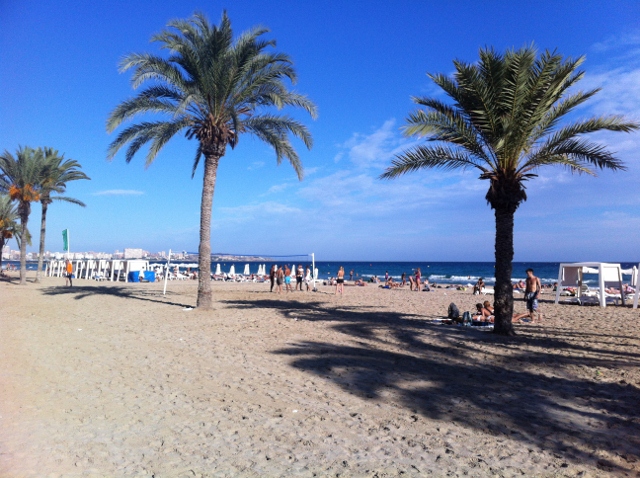
a perfect place to read

Alicante’s city center is a stones throw away from the beach. And its  a proper, sandy beach with chairs and umbrellas to rent, right beside the main bus stop. On the other side of Plaza del Mar is the harbour, parked full of yachts and sailboats, one of which was supposed to be my first couchsurfing host place. I had to meet the Spanish sailor at 9pm in the Regatta Club, but instead a strange fireman approached me and asked if I was Katrin. He had replaced the sailor, who was stuck on a boat in Amsterdam, and asked if I would like to join him for dinner and crash at his place. I accepted his dinner offer first.

We had red wine and tapas to our hearts content, eating course after course and I slowly decided he was couchsurfing material. But, this was before I found out he lived in an apartment undergoing construction. This is partly due to my Spanish not being fluent enough (he didn’t speak english) and partly due to me thinking he was joking when he said “my apartment’s kind of a mess, but atleast it has one light and one running water source.” The light was a spot light, and the water hose came out of a hole in the wall where the shower would eventually be built. There were no doors or finished floors, and one huge open space where a window was still missing, but because he lived on the top floor, he had 2 beautiful rooftop balconies. And, most importantly, he had an extra mattress and a pillow which I could get a good nights rest on.

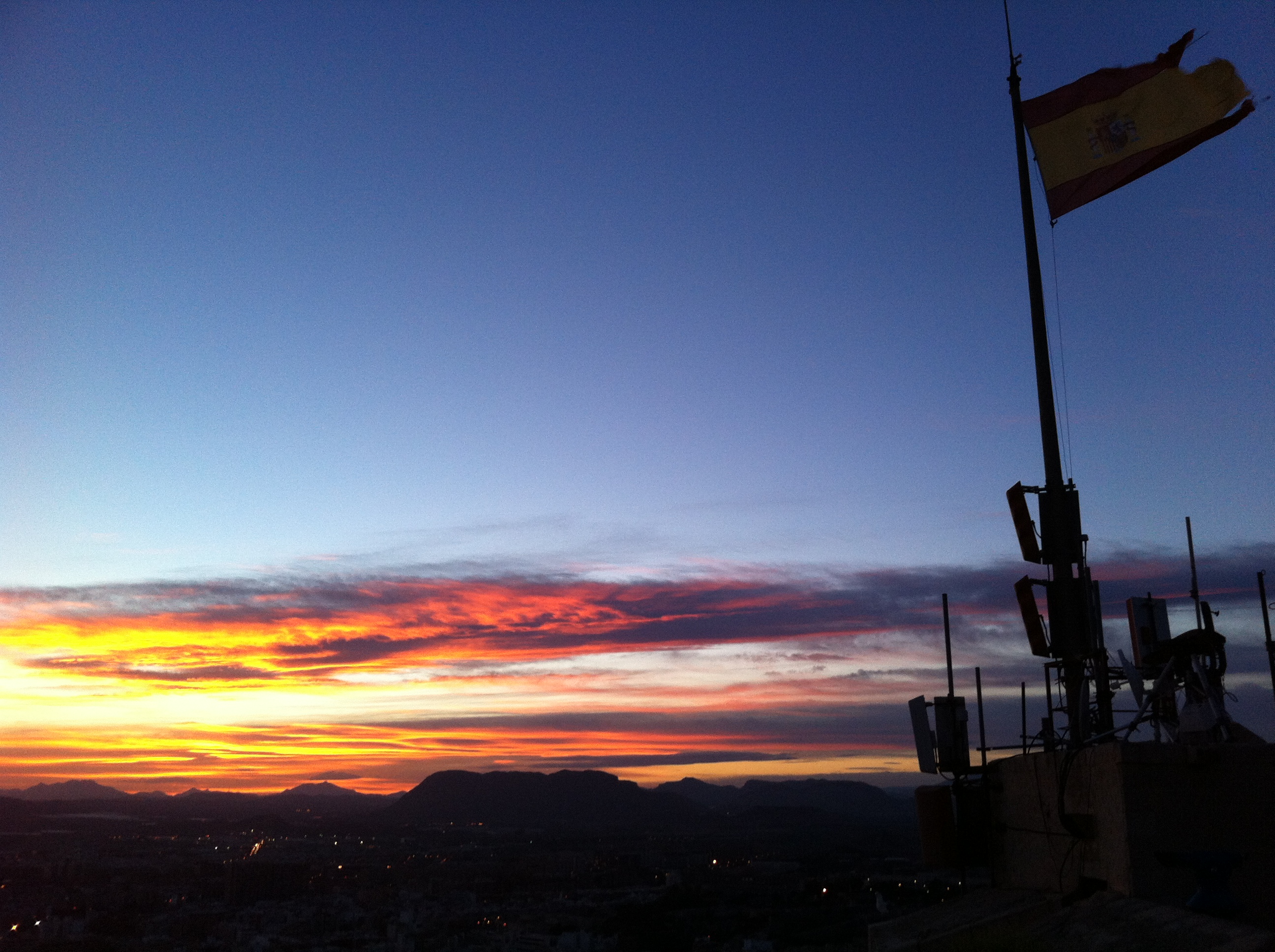
sunset from the top of el Castillo

I spent my couple days in Alicante wandering around the beach and the old City Center, and finally made it up the massive fortress that looms over the city and sea. The Castillo de Santa Barbara is a castle that changed hands between the French, Spanish, Moroccans, and maybe even British, Im not sure, but I don’t know who figured out how to build a castle at the top of a cliff in those days, somehow get overtaken or invaded, and then add on even more castle to the cliff, before the overtakers were overtaken. I could barely get up there without guards or guns pointed at me, but luckily my next couchsurf host had a car and a free evening to catch the sunset from the top with me.

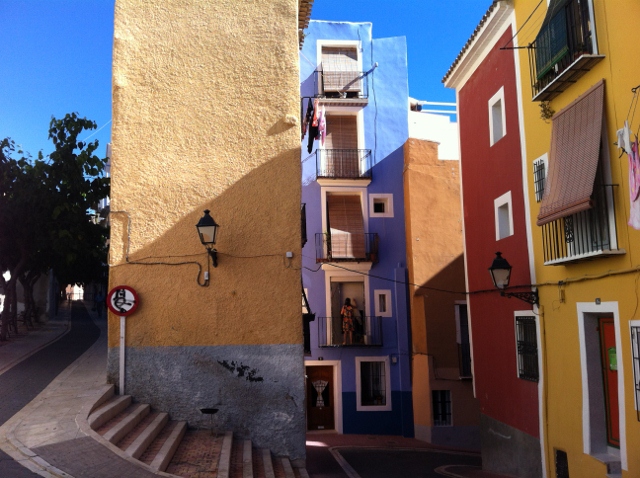
Villa Joiosa

I traveled north with the local tram, an above-ground subway-like transport that can’t quite be regarded as a train. It takes you along the coast all the way to Benidorm, where I was headed, and stopped half way at Villa Joiosa. Its a colourful little walled village, also on the beach, with only sleepy dogs and old ladies to be encountered on the staired and narrow streets.

In Benidorm, I barely saw anyone else but elderly, half-burned British people and a handful of European students. The beach was lined with highrises, and the streets were tourist shops and tapas bars followed by more tourist shops and cheap tapas and wine bars.

Benidorm

The beach, or beaches rather (there are 2 long stretches divided by a peninsula) were beautiful, packed with people. Apparently the hundreds of tourists sunbathing now didnt compare to the thousands normally packed like sardines on every square inch of sand from June – August.

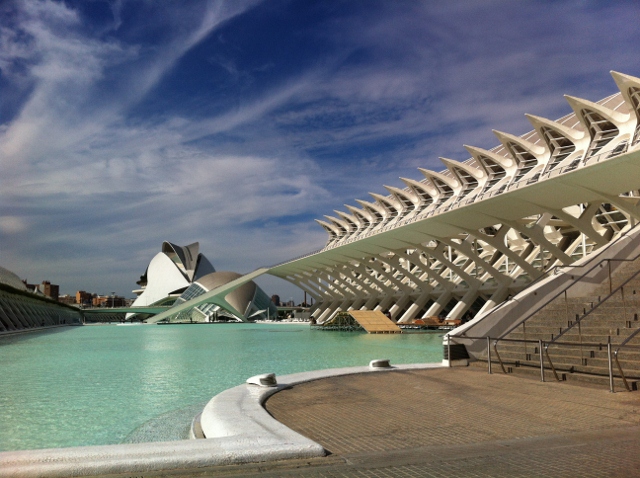
the art palaces

I made it further north and a little away from the coast to Valencia, the second largest ERASMUS University student town in Europe (after Bologne). I couchsurfed at a very international house, with a Brasilian marine biologist, a Spanish architect student, and a Hungarian linguist. We hung out for 3 evenings (I stayed 2 extra nights) despite it being midweek, finding lots of other students to enjoy nights out and cheap wine. They gave me a bici card so I could use the public bicycles to get around (Valencia is so much bigger than I thought), and I rode along the river canal park that surrounds the old city, past the Art Palaces, all the way to the beach a few kilometres away, and even through the old city center, zig sagging through the pedestrian only streets that wind around old churches and cobble-stoned squares.

cats in Tabarca

My last night back in Alicante, I couchsurfed with an architect who lived on the 10th floor of a beachfront apartment, with a 180 degree view through floor to ceiling glass walls. He is also a diver, and had just spent 2 weekends in Tabarca, an island off the coast of Alicante that I took a 1 hour ferry to visit. The island has been overtaken by cats, and all the so called inhabitants leave when summer is over, so it was mostly me, some cats, and the seagulls braving the wind and some strange sort of African dust storm prematurely darkening the day.

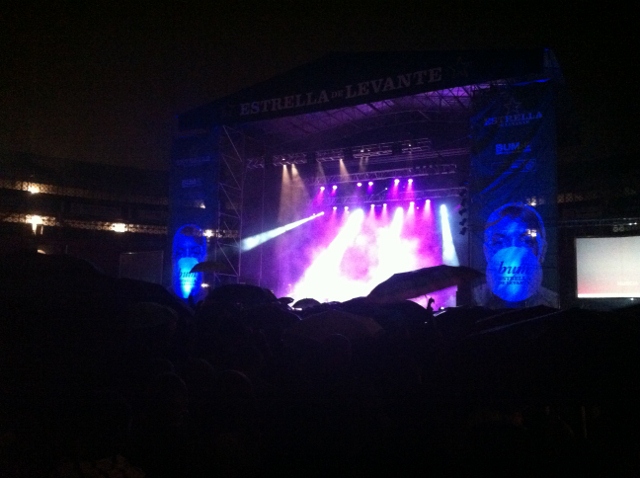
Concert in Plaza des Toros in Murcia

My last night in Spain, me and Dani the architect packed his car full of friends and roadtripped to Murcia, where we watched an open-air concert in a bull fighting ring. The headliner was Wilco, an American band, and a ridiculously good rock n roll Spanish sensation I still don’t know what his name was. I kept day dreaming about how days and centuries before, this ring was used for a matador to death dance with bulls, and now we stood there under umbrellas in the dark jumping around  to great music. Imagine trying to predict that kind of future to a Spaniard 300 years ago…