House Drinks in Reykjavik

My blogs are typically about the places I visit but when I’m in Reykjavik I have to be a little more creative since I don’t really consider myself a tourist here. After being inspired by chef friends and Bocuse d’or, I thought it’d be fun to write about cuisine in Iceland, but there are a lot more qualified food critics out there, as well as tons of articles on Icelandic dining. Instead, I chose to do a little bar hopping, tasting some of the signature, house-specialty drinks those same restaurants or bars offer.

The rating scale we came up with was a likert-like letter scale from K to V. K stood for Kryptonite, V for VaVaVoom, and between the two extremes, Funky, Dousie, Quirky, Perky and Stupendous. The rating order is still not 100% certain, and for a while I was sure Kryptonite should be the best rating since I thought it meant explosively great; for those like me who don’t know what it is, its actually a fictitious element (the only one in the comic world) that can overcome Superman.
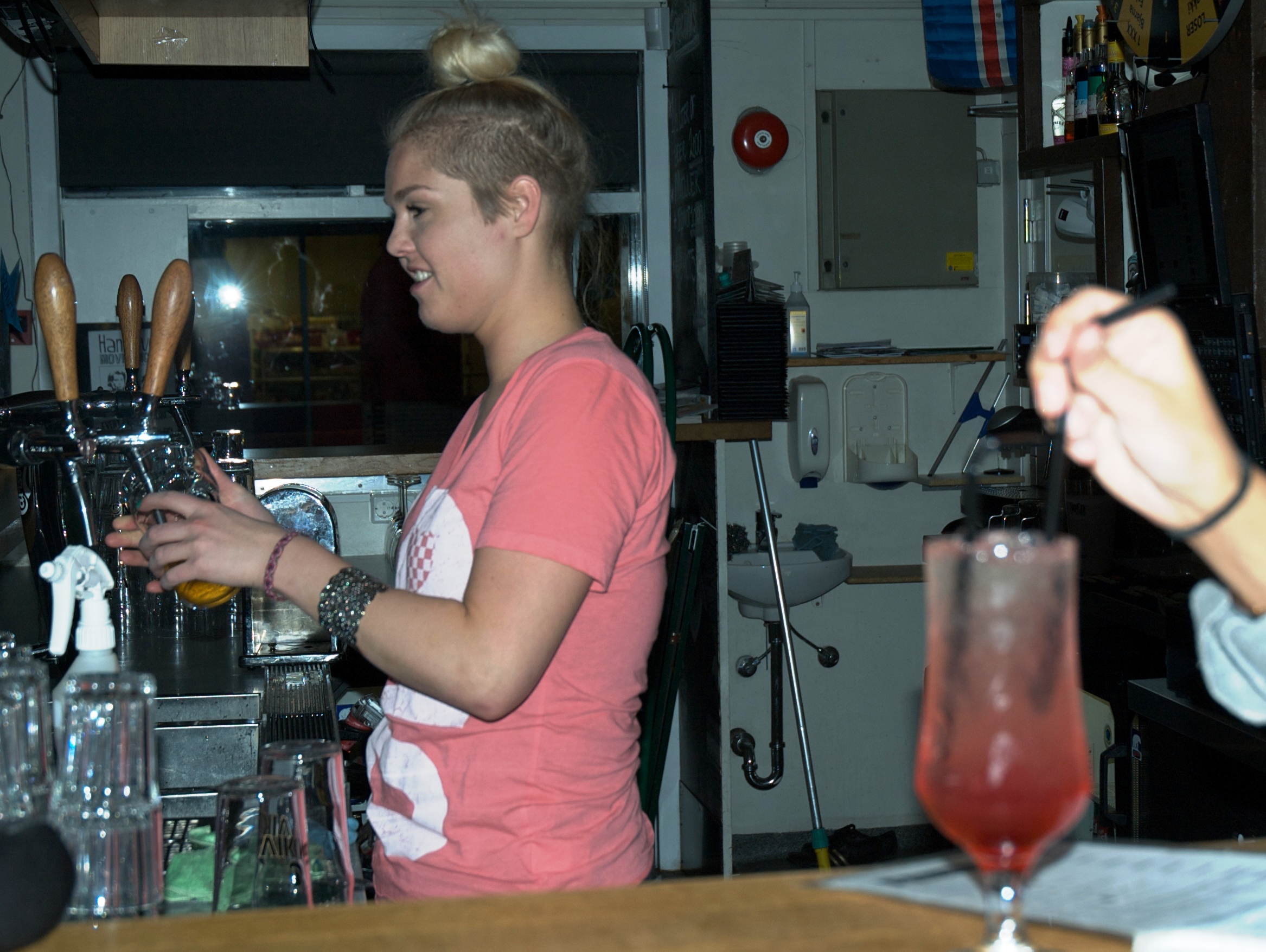
Annika and the Pole Vault

1. Bjarni Fel

Bartender: Annika

Drink: Pole Vault

Ingredients: Raspberry rum, apple schnapps, fizzy lemonade and grenadine.

Verdict: Kryptonite

Their other house specialty drink is called Bench Press (whiskey, triple sec, orange liqueur, martini bianco, lemon and coke) and both are 1700kr. Id say stick to beer, both because its a sports bar and because Annika says she’s never drank it and rarely makes them.

2. Ensku Barinn/ The English Pub

Jói and Steven Segal

Bartender: Joi

Drink: Steven Segal

Ingredients: Rum, Passoa, Strawberry Liquor, Pineapple and Cranberry Juice, Grenadine

Verdict: Perky

Jói explained the bar doesn´t have a house specialty per se, but he (as the manager and award winning fastest bartender) makes up his own house drink. This particular drink was inspired by a customer who asked for a strawberry cocktail, probably because of the sunny Sunday afternoon enjoyedsitting outside on the patio. He also mentioned it changes from day to day, so this drink didn´t even have a name until after he made it. Extra points for coming up with a great name.

.
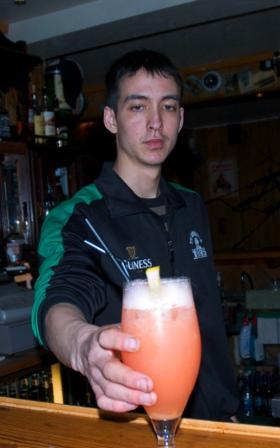
Bjarki on the Floor by Oddur

3. The Dubliner

Bartender: Oddur

Drink: Bjarki on the Floor

Ingredients: Orange juice, vodka, peach schnapps, banana schnapps, brown sugar, grenadine, lime juice, and sprite

Verdict: Funky

picking the right orange juice

Halfway through mixing this cocktail, Oddur realized he didnt have orange juice, so actually went out and bought some just to make this house specialty, known to knock guys named Bjarki down to the floor and a big favourite among the female staff at Dubliner.

.
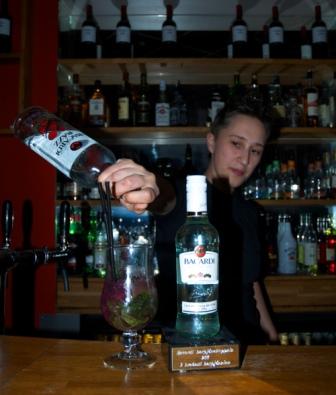
Marija making the perfect mojito

4. Thorvaldsen

Bartender: Marija

Drink: Thorvaldsens Mojito

Ingredients: Rum, Raspberry Rum, mint, blueberries, strawberries, brown sugar, and sprite.

Verdict: VaVaVoom

We spent about an hour at Marija´s bar, keeping her from closing, picking her brain about the perfect way to mix a mojito. We also got a geography lesson, talked about all the specialty alcohols available from all over the world, and discussed salsa and tango dancing (which happens to pair very well with Mojitos on Thursday nights at Thorvaldsen)

all the citrus goodness getting mixed in

5. Radisson (Saga & 1919)

Bartender: Kris

Drink: Sour Mix

Ingredients: Orange bitter, grapefruit soda, tequila, vodka, triple sec, malibu, lime, orange, and lemon

Verdict: Stupendous

The bar and lounge at this downtown hotel doesn’t have a specific house drink, but Kris makes specialty drinks according to the tastes of his customers. His usual question is “do you like sweet or sour?”, and whips up an appropriate concoction according to their answer. This sour mix was his personal favourite. At Radisson Hotel Saga, the bartender Erol makes a drink called Delek, winner of the Finlandia cup a couple years ago, and is a mix of vodka, strawberries and soda. Also delicious.
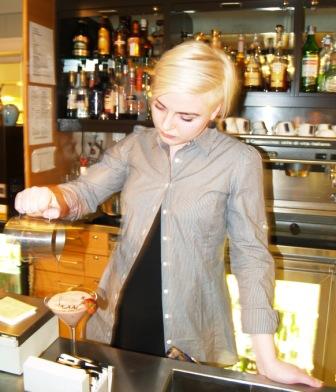
Heiða drizzling the melted chocolate

.

6. Hotel Reykjavik

Bartender: Heida

Drink: Forest Martini

Ingredients: Vodka, Cocoa liquor, cream, strawberries, topped with warm melted chocolate.

Verdict: well, its more like a desert in a martini glass, and definitely the first martini I´ve ever had to eat… so I would say quirky. Also a little deadly, since its only a 6 oz drink and 3 of those ounces are untasteable vodka shots.

.

7. Fish Market

David and his Volcano

Bartender: David

Drink: Volcano

Ingredients: Absolut vodka pear, crushed berries, butterscotch vanilla schnapps, passion fruit puree, pineapple juice, vanilla flavor, grenadine, and edible lava rocks

Verdict: VaVaVoom.

an assortment of passionate drinks

The theme of his bar was definitely passion, as he made two more passion fruit drinks called Chili Passion and Passion Caiprinhia. Those were thought up by the owner Águst, and the chili one was really spicy. Just before I left, he made me blind taste the drink he´ll be using at an upcoming bartending competition, and Im not sure what it was but it involved a lot of rhubarb and deliciousness. David explained at Fish Market they are always trying to make new drinks that challenge stereotypical taste profiles, and I would certainly agree they are accomplishing this goal with all their exotic fruits and creative toppings.

The best part about writing this article wasn’t actually the great drinks, but the accidental travel experience I felt like I got from chatting to all the bartenders. Only a couple were Icelandic, and the others represented Hungary, Ireland, Panama, Turkey and Serbia. I feel like I heard a lot of great stories and made some new friends, so hopefully one day I can invite them all for a drink made specially by me 🙂

Oh, and also, if you’re a bartender in Reykjavik reading this article and have a great drink I should try, I know an aspiring drink critic, so be in touch…
Status Update

In my earlier travels, I always wanted to start a blog so that I could avoid spamming mass e-mails to a bunch of friends and family, but that was pretty much the only way I shared stories and pictures before facebook and dohop came along. Now that I have this blog, there´s a bit more pressure about how to write and when to write since I basically have little or no idea who reads it or how often people check it, except for a few googlestats. Ideally, I´d want to write every day, and keep a detailed travel diary for myself that others can read, but its so difficult to get regular internet access in some of the places I travel, and its not actually that appealing to sit in front of my computer when I´m in some new beautiful, beachy, or exotic place. However, I´ve been a lazy writer the last few weeks and wanted to give a slight summary of my year so far and a break down of my future plans.

In January, I was in Lyon for a week for the Bocuse d´or World Culinary competition, and Berlin for a week making Germany my first new country of the year. It was cold, grey wintery weather in both places, so I took the opportunity to soak in some heat and sun at an Indian wedding in Bangalore. I traveled around India for two weeks before flying to New York via London, and met up with one of my most adored friends for a week vacation to the Dominican Republic. We were meant to be in Haiti for 3 days first, but American Airlines crushed our Haitian dreams and we found a different dream to live at Salinas. Then back to New York for my 24th birthday celebration, and a last-minute flight change to extend my North American travels by another month. First I showed up in Berkeley unexpectedly for a week, did some wine tasting in Livermore Valley and met up with old professors and colleagues from UC Berkeley. Then, I was part of the most epic, amazing surprise birthday party you could ever imagine in Vancouver, reuniting a bunch of old UBC friends and making my friend Zoe the happiest girl ever. I stayed in Canada for a couple weeks, saw family and friends there, a lot of concerts and shows (VSO, Cavalia), and then back to Berkeley to eat at potlucks and smoke cigars with some of my most favourite people in the whole wide world. I then went back to Vancouver for body healing and wisdom teeth pulling – oh how I love Canadian healthcare. I flew back to Iceland via New York, and spent a week at home for my cousin Sara´s birthday and to see my dad who hasn´t been in perfect health lately.

May 1st in Iceland

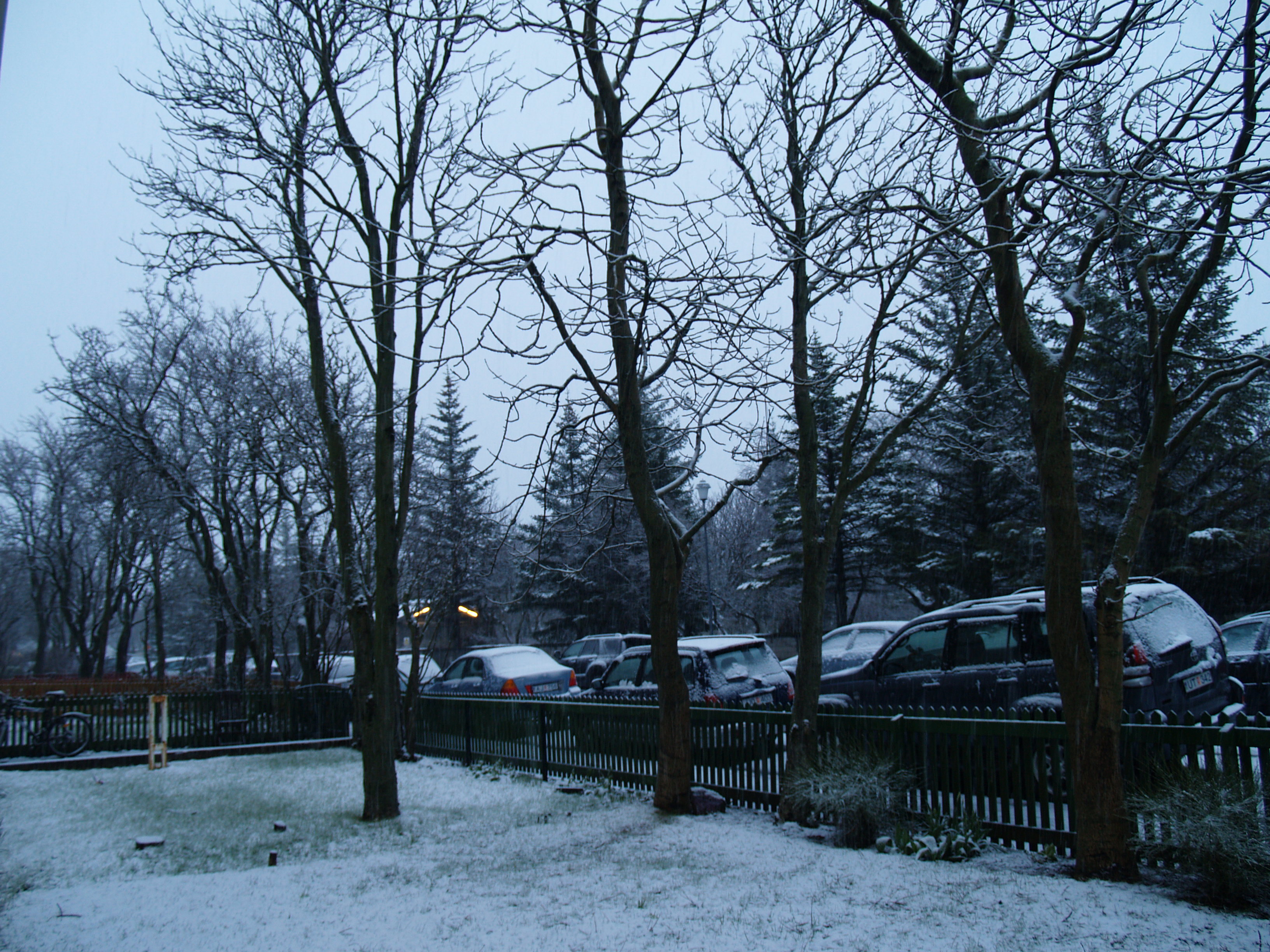
Within a few days of being home, I was convinced to go back to California for Coachella music festival, so a week later was back in New York for a few days, then in Berkeley, then roadtripping to Los Angeles, partying my face off in the desert, dancing to really great music, and flying back to New York where I got an interview with Dr. John Mutter at Columbia for a potential Phd program. I came back to Iceland at the end of April expecting summer to be just around the corner, but instead we had a white out weekend cozier than Christmas day.

So, 8, err, 7 countries (stupid AA), 19 flights, $4000 and 3 months later its maybe forgiveable I haven´t had the focus or chance to write much. But, thats all in the past, with lots more travel coming up and a revamped dedication to my writing. Next up is a couple of weeks of travel in Iceland as summer slowly creeps up, then a couple weekends in London on my way in and out of Africa for 5 weeks. Im attending a conference on Sustainable Tourism in Kampala, Uganda, where I’ll have the chance to speak on Ecotourism. July and August I’ll be in east Iceland doing a little bit of ecotourism myself, riding horse tours with Ishestar, and also spending some time around Reykjavik to host a bunch of awesome visitors (ie. my older sister!!!) Im thinking of writing a book too, not sure on what, but something travel related. If anyone has any ideas, publisher friends, or wants to collaborate, holler.

Tourism of my body

(disclaimer: this whole blog seems a tad inappropriate for some reason, but I can´t quite put my finger on it to tell the stories differently so excuse any unintended raciness)

I´ve spent a lot of time in the last 2 months exploring my body, learning about all the ways it works and breaks. In January I had the New Year´s resolution to be more flexible and to learn how to do a handstand, so through yoga and other excercises I´ve been trying to accomplish both.

Going to India in February was inspiring for my yoga hobby, and I discovered ayurvedic massage.  Its supposed to do wonders for your body and well-being, and I´m sure it does when done correctly, but its also created the perfect tourist trap for any entrepreneur who has a massage table, some oil, and two hands. I woke up one morning after a 10-hour overnight train ride and discovered the hard way how uncomfortable third class beds are; my upper back was all out of wack so I paid the $9 it cost for a 30 minute “authentic massage,” but it ended up being a wooden table, laminated with that plasticy kitchen counter stuff, a moldy pillow, and cooking oil lathered all over me by a hefty little Indian woman in the back of her shop shack. Needless to say it didnt help much, but when I got to Canada a few weeks later I saw a massage therapist, a chriporactor, and a Chinese/Japanese homeopath all for the first time.

The homeopath walked me through a series of excercises I should do to correct my over-arched lower back (too many years of horse backriding makes me stick my ass out and chest up in a very latina way), said I may have mild scoliosis, and taught me my right leg is slightly crooked from my hip joint being “unsettled.” Then he stuck a bunch of needles in my back for my first acupuncture treatment, which wasn´t that painful except for the fact I had gotten both my left side wisdom teeth pulled that morning and I couldn´t think about anything else.

Then I saw a chiropractor who got me butt naked to look at my spine and said I didn´t have any abnormal curvature, but that I did have flat feet and would need orthodics for a cool $700. Then he cracked me all over, including my pelvis to make my right hip straight, before taking my feet prints for my new orthodics.

The massage therapist was a big English guy who taught me I had tight hamstrings since I couldn´t touch the back of my legs to the bed when laying on my back. He taught me excercies to fix that, and then suggested I sleep with my feet tied together to keep my pelvis straight. The massage he gave me was actually the most wonderful release of tension in my lower back and around my neck, and I felt noticeably better when leaving his office instead of bruised and battered.

I´ve got my new orthodics in my favourite shoes now and hopefully something good is going on in the inner workings of my ageing body… although I don´t notice any $700 differences. Getting an ergonomic desk set up was one thing they all told me to do, as well as have lumbar support when I´m sitting or driving for long periods. Sadly most of my sitting for long periods occurs infront of a piano or my laptop and I´m not sure how to make them more comfortable. I learned I shouldn´t sit cross legged since itll make my right leg crooked again, carry heavy bags on my back, or sit on horses or stand in dance posture because its bad for my lower back, but unfortunately, I dont think giving up my favourite yoga pose, backpacking, riding, or dancing is going to happen anytime soon… but I have learned a lot about my body and perhaps when I´m old and broken one day I´ll atleast know why and how to fix it 🙂

Freewaters Sandals and Water in Kenya

What do these two have in common? Freewaters is a footwear company that just launched in California, debuting 10 mens and 7 women’s sandals. Their shoes are innovative sandals and flipflops stylishly designed with ergonomic support, creating a very high-tech, comfy place for your feet. Why do I care? Because I’m one of their women’s product samples and have 4 shiny new pairs of freewaters flipflops that Im going to wear and tear in my upcoming travels.

women's sandals Sola, Vezpa, Capetown and Bossa Nova

I’m pretty excited about this after my recent trip to India, because when I was there I had the perpetual problem of my shoes breaking. The flipflops I wore there were only a few months old (Hawaianas), but since I walk so much when I travel, one broke after the first day on India’s less-than-navigable sidewalks. I then bought a pair of flipflops for 100 rupees ($2.25), which broke the following day on a hike around Hampi’s Hindi temple ruins, and I realized very quickly that Indian-made sandals are far from duarble; throughout the rest of my barefoot walk home, I probably saw 10 odd sided, broken shoes scattered along the trail. Luckily I managed to find one functional right-sided shoe, and a few meters later, the broken left sided one which I fixed and had another pair of sandals… which broke the next day.

I doubt these Freewaters sandals will give me any trouble, and in fact, I may have a hard time even wearing them out since they’re so well made. But, the best part about these shoes isn’t that they look great or are super comfy to wear, but the mission behind the product: Freewaters is trying to design the best sandals while finding solutions to the global drinking water pandemic. Their first humanitarian initiative is a project in Dago, Kenya, where they are digging a series of freshwater wells to provide safe and reliable drinking water in an area of the world where water-borne disease is a serious problem. For every pair of Freewaters sandals one buys, it allows them to provide clean drinking water for one person for one year. Since March 22nd is World Water Day, perhaps now is a good time to get involved.

For more information, to see how you can help, or to buy your own pair of sandals, check out www. freewaters.com.

For more information on the grassroots organization implementing the Freewaters direct cause initiative, go to http://www.ProjectFreewaters.org.

Life as part of the Working Class

It has been strange being in one place for almost a month now, just living and working like a settled local. I have managed to get two full-time jobs since returning to Vancouver, but still feel a little distanced from truly ‘localizing’ myself; the latest and longest memories of Vancouver have always been of my life at UBC, being on Campus all school year and enjoying the city as a starving student. Now, when I go to Campus, I feel strangely foreign, and even though noone else knows I am no longer a UBC student, there is this pang of ‘outsiderness’ that I feel walking around campus without a class to go to or a study group to attend. Even more bizarre is not living on or near campus, so when Im there, I feel like I have nowhere to belong, since my home refuge is gone, as well as a full time class schedule. I have also been coping with the reality that this is the first semester in 18 years that I am not going to school this spring; I have no classes to register, text books to buy, or homework to do. Very, very strange, but comforting. My master’s thesis is almost done too, so I’ve really got very little to do in terms of academic life as of now.

Being downtown is a bit more familiar, same scene, same people, same activities. I would still say I fit the starving student profile since Im tecnically still in grad school until I defend my thesis and officially graduate, but now I’ve joined the ranks of the working class to having that secure, 9 – 5, Monday to Friday Job, in addition to serving at a bar 4 or 5 nights a week. Working two full time jobs is exhausting, and all I have time to do is work and sleep. It’s great since I have no time to spend the money I am finally making, but paying off my upcoming trip and the debt I’ve incurred from both studying in the states and my obsessive cumpolsive traveling habit is a slow process. I have yet to see if I’m actually back to square 1, which would just be an account balance of $0, since my hourly paychecks lag a few days and are paid bi-weekly, but now I’m about to go off on a 3 week trip where Im sure I’ll quickly jump into the negative account balance again. However, not to worry, for after I return back to BC the Olympics are coming to Vancouver, and so are alot of people, all their money, and alot of work – all reasons why I (and my travel habit) may personally benefit from the games.

Why travel to the Southern Hemisphere?

worldI’ve been realizing just how much a difference exists between the ‘north’ and ‘south.’ These are often terms to distinguish between the ‘developed’ and ‘underdeveloped’ nations, synonymous with terms that divide the first-world/third-world and western/non-western countries, since a poverty divide is strangely apparent geographically.

Even crazier to understand is that most of the earth’s landmass is in the northern hemishpere, and 90% of the human population inhabits this land north of the equator. Two-thirds of Africa, almost all of asia, the entire continent of Europe and North America, and even a part of South America sit north of the equator, hosting 5.7 billion people, while the other HALF of the world only houses about  650 million people. This also leads the Southern hemishpere to be significantly less polluted than the north, with less industry, development or infrastructure.

Less people means less crowding, less tourists, and less traffic, and also means more natural habitat, more ocean, and milder seasons. And, when we are in the middle of blistering winter, somewhere north of the 49th parallel, we could fly to the same latitude south of the equator and be in the middle of summer again with long, bright days! So interesting and complex, the way of the earth – rotations and axis and all that jazz. I would have considered myself a genius if I had been the first to figure this out – one could literally have summer all year long if they traveled in sync with season changes and the angle of the earth on its axis. Or, I guess you could just live in the tropics all year round.

It is just after the winter equinox in the Northern Hemisphere, so thankfully the days are slowly getting longer. However, it is still pitch black at around 5 pm, and I couldn’t imagine a better time to travel South. Tomorrow I fly through Houston (which, crazily enough, is not having normal sub-tropic weather and they could benefit from heading further south) enroute to Buenos Aires, where the temperature will be around 30 degree highs and 14 hours of daylight. After I’ll go further south, to Patagonia and the Antarctic Peninsula, where days will be nearly 24 hrs long, but, unfortunately the temperatures will drop a little in exchange.

Tips on Traveling Light

Photo by malias

Photo by malias

By “light,” I mean two things; first, you should try and reduce your ecological footpring from travel, and second, pack lightly. Trying to get away from mass tourism, over-consumptive all-inclusive, package deal vacations is something every responsible tourist should aim for. Long-haul flights to some resort in Mexico or Spain or cruising through the carribbean from tiny island to island on a floating city are some people’s ideas of travel, but this is quickly becoming an outdated, carbon-heavy form of travel appealing to people who think of a vacation as a time to party, buy lots of things (souvenirs, food, drinks), get escorted around on an air-conditioned coach bus, and be surrounded by common, western luxuries and english speakers. This has gotten us and traditional tourist destinations used to seeing sun-burnt, sometimes over-weight white tourists (retired elderly or young party folk), speaking english to absolutely everyone no matter where they are.

I would urge us all to be more responsible, immersed tourists; do not contribute to these types of waste-ful, energy-heavy, carbon emitting forms of travel. Get off the beaten track, travel slowly, see more places than just your hotel room and the beach, and, interact with the local community by learning more about their culture, traditions, and even their language if you’re brave. wander around, never stay at the same hostel or campground, take one way trips, and remember that the travel experiences is not always in the destination, but in the journey.

Being mobile is alot easier to do if you dont bring too much stuff. Its hard to bus, ferry, or drive from place to place with a huge, rolley suitcase, so stay true to the nature of “backpacking” and only bring a backpack. And, unless you are camping or hiking and need alot of equipment, simply bring an average, regular type of back pack (not a $200, 80L heavy duty bag that screams “im a tourist!”) with the bare essentials. You do not need more than a couple changes of clothes, basic hygene supplies, a camera, a good book to read or write in, and maybe a cell phone. I always find I get frustrated with having too much “Stuff,” a load of stuff I end up carrying around with me for the sake of having it, a disconcerning realization of the material dependency alot of us have developed. Remember to leave a bit of room for souvenirs, but dont buy exotic things that you suspect may harm the local environment (turtle shell jewelery, teak wood carvings, etc) and remember the best thing to take with you from your travels are simply memories.

Succingtly put, leave nothing but your footprints, take nothing but photos.

Fly Fly Away!

how do those thousand ton machines actually float in mid air anyway?

How do those thousand ton machines actually float in mid air anyway?

Language is basically a facet of communication, a way to express our thoughts, but it’s often been said that language is a limitation to thought. Language is constantly in flux, with new words being created or borrowed within the thousands of existing languages. Words are often closely related, either because of meaning or etymological history.

Think about the words we use for flying: fly, flights, etc. Its a verb, an adverb or adjective, a noun… but then we have a different name for things that fly, like airplane or helicopter. Similarily, in French, ‘voler’ is to fly, ‘vol’ a flight, (vuelo in spanish) and ‘avion’ an airplane in both French and Spanish. In other languages, flight and planes are much closer related words, where the title of an object that flies is clearly built on the word ‘to fly’. In Icelandic, fljuga is the verb to fly (flug is the noun), and a plane is simply a ‘flugvel’, loosely translated as ‘flight-engine’. In German, an airplane is a ‘flugzeug’, and a flight is ‘flucht’. Further eastern european countries lose the resembling ‘flyvning,’ ‘flygning’ or ‘vlucht’ of Indo-European languages, and in Latvian, airplane is lidmaš?nu, and flight is lidojumu, with Finnish meeting somewhere in the middle between the nordic and slavic languages with airplane said as ‘lentokoneeseen,’ and flight as ‘lennon.’

Etymologically speaking, the word ‘flight’ is said to have originated from low German ‘fleugan’ (circa 1300’s), and was first used to describe skittish horses and then defined as “an instance of flight,” as in ballooning. Before the Wright brothers came around with airplanes, flight really was a supernatural event, which only winged animals and insects could partake, but who could have know that today, millions of people and planes fly in the air every day, defying the laws of gravity and even reaching the frontiers of space!

3 Ways to Get Lost in a Major City

San Fransisco Trolley with the Bay Bridge in the background

San Fransisco Trolley with the Bay Bridge in the background

Whenever I visit great cities, like London or New York, it’s overwhelming how much there is to do and see in one place in too little time. Arriving in east bay California means I’m only 20 minutes away from San Fransisco, a fairly small city (in square km’s), but still offering a lot to explore. I’ve come up with a few little things I like to do (instead of reading guide books and calendars of events) to fill my time.

First, don’t carry any sort of map. Just use your well-travelled self to have a good enough sense of direction to find your way back to where you started. Just make sure you never look too lost, to avoid every nice person coming up to you and asking “are you lost? Can I help you find something?” since, you should have no idea what you’re looking for.

Then, walk in the direction that your senses pull you, and when you get to an intersection, turn in the direction you feel like. Whatever looks prettier, smells yummier, or sounds more interesting, go there. Get off the shopping streets and walk through some neighbourhoods, wander through an industrial area, or even end up in a poorer section of town to see the not-so-touristy picture perfect images of a city.

Finally, try and take a random bus/metro/trolley a few stops in an unkown direction, without asking any questions…try to blend in and act like a local, and get in a little bit of people watching. Just get off when you feel like it, or when most of the other people get off. Just make sure you know how much bus fare is and have exact change, or else everyone will still know you’re that lost tourist 🙂

Basically, try and get totally lost, and along the way, you will discover all sorts of treasures and surprises a lonely planet would have never predicted.

UC Berkeley, my disenchanted dream

Me, mom and older sister Kristjana at the UC Berkeley entrance gates

Me, mom and older sister Kristjana at the UC Berkeley entrance gates

I have always wanted to go to UC Berkeley, and my third time around, I got in. I applied both to an undergrad program, and last year to an LLB program, and finally, as an exchange student from my current master’s program at the University of Iceland. This time, to my relief , I finally got in without having to pay their horrendous tuition since I’m just there on exchange. However, this “free” exchange has cost a lot of time, money and energy.

It began back in April, when I first got my acceptance letter. It was 12 pages long, outlining all the paperwork, procedures and fees I would have to complete before my arrival. First, I needed to get my student visa. The Berkeley office had to prepare some fancy form called DS-2019 for my to even be eligible to apply for the visa, and to get them to process that I first had to prove financial security of $1600/month (since Im forbidden to work under my student visa) for the 5 months I would be in California (what grad student has $8000 in their savings account halfway through a masters program?). Then I needed 2×2 inch passport photos scanned into digital format at an exact resolution; also, reference letters from employers or professors, tax slips, and/or proof of family ties outside of the USA so they believed I wasn’t trying to seek refuge in California. Finally, I needed health care that met the US department of State’s standards (now we all know what an issue health care is in the US) and since my coverage for repatriation of remains is $5000 instead of their minimum $7500 with my health insurance in Canada, I’ll probably need to buy the ridiculously overpriced healthcare the campus offers now that I’ve arrived.

Once I got that special DS-2019, I had to pay a SEVIS (Student and Exchange Visitor Information System) fee for $180 US, then direct deposit $131 US visa fee into a Scotiabank (which, doesnt actually exist outside of North America, a slight problem when you are an International Exhange student), pay $8 cdn to schedule a visa appointment at the embassy to apply for the visa, spend 6 hrs in their dark, silent, surveilled office without any guarantee it would be processed, and then come back 3 days later and wait in an hour line to pick up my passport (at which point I found out I did get the VISA).

Upon my safe arrival to Berkeley, my first orientation consisted of a small welcome, alot of forms (one legal document which waives my rights to any ideas or inventions I may have during this semester to be the full property of UC Berkeley), and $410US (payable in cash only) for that one page, good old DS-2019. I now owe $200 for my “registration fee”, even though they informed us at the orientation meeting that exchange students are NOT registered Cal students, nor do we have any recognised status as UC students for campus benefits like bus passes or gym admission. That also means I cant register for classes online, and will have to run around all week to actual class rooms, begging professors to let me audit their already full classes. I won’t get a transcript at the end of all this either, so let’s hope I actually get credit at all for the work I’ve put into realising my Berkeley dream. Moral of the story: It’s a lot easier to travel to California as a tourist than a student. Try to avoid “researching scholar’ student visas to the US unless you’ve got plenty of time and money to waste!