Here´s the list I made during quarantine of what was actually happening, day to day. I hope it´s at least amusing, if not relatable, to some of you.
Counting grey hairs. Looking too closely in the mirror and realising I´m going grey. I´ve gone from none to multiple.
Making amazing brunches, with all kinds of liquids, including champagne. It´s a great reason to get out of bed.
Baking banana bread. Lots of it, and a different recipe each time to keep it fun. I tried normal, chocolate gluten free and vegan.
Playing in the kids park on the handle bars, hanging upside down. In running clothes.
Avoiding people on my bike, trying to keep a 2m passing space and almost always running into the curb or onto the grass.
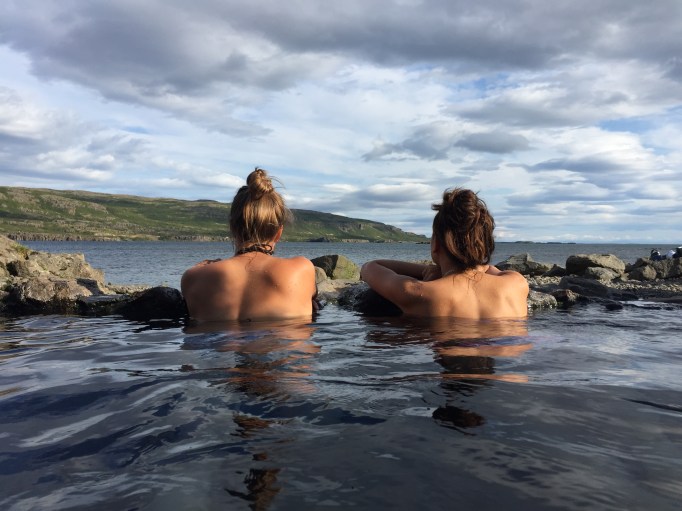
Dreaming about going to the pool, but they´re all closed. Thankfully I have access to a hottub in the backyard of an empty house in Kopavogur.
Sitting on my yoga mat, mindfully thinking about doing yoga. It’s a form of meditation.
Opening 30 bottles of wine, of which 15 were off. Then drinking the good ones. I´m best at that.
I made an advertisement on the Icelandic online classifieds to find horses to ride. (If you or anyone you know is in isolation that has a horse, I can go to the stable for them!)
Looking for dogs to walk and finding out that everyone is walking their own dog these days. Hiking without a dog is almost as much fun. But if you or anyone you know has a dog they cant walk, let me know!
I’ve been working with Backroads for a couple of summers now, and this was my second winter. It’s been a good winter – snow storms, minus 10 degrees and plenty of northern lights. The day light is short, with sunrise after 11 and sunset before 4, so there’s a small window of opportunity to be active outside. We’re meant to hike, snowshoe, glacier walk or horseback ride, and the weather doesn’t always cooperate. But when it does, its a winter wonderland out here.
Ion Adventure Hotel, the first night of our Northern Lights trip
I had a week of trip preparation, where me and the trip expert practiced all the hikes and visited all of our vendors. Hotels, restaurants and farms took us in with open arms and we had luck with weather almost every day. Once the first trip started, we lucked out with northern lights 5 out of 5 nights, and the trip couldn’t have gone better.
our hike at Skalakot Boutique farm comes with free dog company
The second trip ran over the worst storm Iceland has seen in years, with power being cut off across the north of Iceland, and up to 4 meters of snow burying horses alive. We were on a small spit of the south coast where the only open road in the whole country was a 10km stretch of highway 1 exactly around us. It was incredible to be able to stick to the plan, hiking and glacier walking despite the rest of the country being on lock down, and our only inconvenience was staying an extra night at Hotel Ranga since we couldn’t get to Umi Hotel.
a nearly completely frozen Oxarafoss, a special site even for Icelander’s
The third trip was over New Years, and we rang in the New Year together at Hotel Ranga with our group and the staff that have become more and more like family after so many nights at the hotel. There were two guests with birthdays on January 1st, so there was plenty to celebrate, and we saw Northern Lights in the morning before sunrise on our way onto Solheimajokull.
Thorsmork covered in White and a sunrise turned sunset to make it even more beautiful
The next trip won’t be until March and April, when the daylight hours are triple what they have been so far. It’s better for flexibility and certainly makes driving thru snowstorms easier, but there’s a certain charm in visiting Iceland in its darkest hours, and the feedback from guests has always been rewarding – what a magical country we live in to be able to enjoy it in the midst of horrible winter storms and still come home smiling.
New Years eve, and the few days leading up to it, are very explosive, literally. Icelanders buy hundreds and hundreds of tons of fireworks and explode them downtown, in backyards, harbours, farms, you name it. Reykjavik is the only city in the world where I can actually hear midnight coming, as the fireworks get more and more intense around Hallgrimskirkja, the loudest climax is the moment when the New Year has arrived.
The Christmas Market in Hafnafjordur
With 26 days of Christmas, there are a lot of traditions that Icelandic people keep up to fill the dark winter season. There’s even a small Christmas Market ´Jólaþorpið´started in Hafnafjordur, and free ice skating in Ingolfstorg downtown for all the days in December. Then of course there are the famous, or infamous, Yule lads, the 13 Christmas elves who each have a special, mischievous role to play. There´s the hungry ones: Sausage Stealer, Skyr Gobbler, Pot Scraper, Bowl Licker, Meat Hook, who loves smoked lamb, and Stubby, who likes eating pan crusts.
There´s the creepy ones, Sheep harassing Sheep-Cote-Clod, Door Sniffer and the Window Peeper. Then there’s the annoying ones: the noisy Door Slammer, Gully Gawk who likes to jump out and scare people, and Candle Sneaker, who’s also hungry because they’re used to stealing candles made of animal fat and eating them.
ice skating in Ingolfstorg
These fine examples of Icelandic folklore are the sons of a large, ugly, child-eating troll named Gryla, and her black cat eats Children who don’t receive any new clothes for Christmas. The Yule lads are not all bad – they bring down a present to put in your shoe, one by one, for the 13 days leading up to Christmas, unless you misbehave – then you get a potato or a piece of coal. Then 13 days after Christmas, the Yule lads return back to Gryla in her mountain, and the last day of Christmas is Jan 6, but its only a few weeks to wait until Thorrablot, Icelands other, rather unappealing, winter tradition.
Thorrablot used to be a pagan festival, dedicated to pagan gods in the fourth month of winter, previously known as Thorri. It’s basically a midwinter party (end-Jan to mid Feb in the modern day calendar) dedicated to eating sour and fermented foods, the same ram testicles, sheep head, rotten shark, liver and blood sausages as the vikings ate before the modernisation or Christianisation of Iceland. Its also a drunken time, when farmers and fishermen and city folk alike gather in huge groups (a dinner for hundreds of people sometimes), organising with the next county or community to make sure they don’t hold the festival on the same night, so that everyone can go to more Thorrablots and drink enough beer and brennivin to wash all the sour food down and hangover away. Sounds like a blast, right?
midday in midwinter
My favourite Þorrablóts are happening around Feb 1st in the north of Iceland, be sure to check out Varmahlíð or Hunaver´s schedule, or just search Thorrablot in Facebook events to be sure to find the one closest to you. Or, if sour food isn´t for you, there´s always hottubs and the outdoor bathing culture we all love and need to get us through a long Icelandic winter.
Hornstrandir has been on my bucket list ever since I moved back to Iceland, and one overnight visit to Hesteyri a few summers ago didn´t really cut it. I wanted to hike Hornstrandir, with everything I needed on my back, sleep in a tent, meet some arctic foxes, and see the green cliffs rise straight out of the sea. My friend Gudny was down too, had a week off, and the weather forecast was perfect, so we set off in the plumber car to the westfjords, where we´d take 2 days to get to Isafjordur town.
Hellulaug
From highway 1, we turned towards Budardalur and picked up an Icelandic hitchhiker, and his dog Saga. We stopped for a bathe in Hellulaug, close to the Bjarnslaekur ferry port, before ending our day of driving at Reykjafjardalaug. There, we had another dip, made more Icelandic friends, and camped for the night in the plumber car.
Dynjandi waterfall
The following morning we stopped at Dynjandi waterfall, did some grocery shopping and ran some errands in Isafjordur town, and boarded the 17:00 shuttle boat to Aðalvík. Gúðny chatted up the captain while I napped, until we arrived at Sæbol and decided to jump off there and walk to Látrar (you can be dropped off there since both stops are considered part Adalvik). We expected 7 or 9 km of hiking along the shore, plenty of time when the sun doesn´t set til 11pm, but it was more like 16km, since hightide means you have to take the up-and-over route along one of the sea cliffs, and detour into the valley around one of the rivers thats only 2m wide at the coast but much too deep to wade (or swim). We camped at midnight, met the neighbourhood fox, after running into a local summer house family, who told us where best to wade the river inland, and slept like babies in our tiny Decathlon tent.
starting in Adalvik
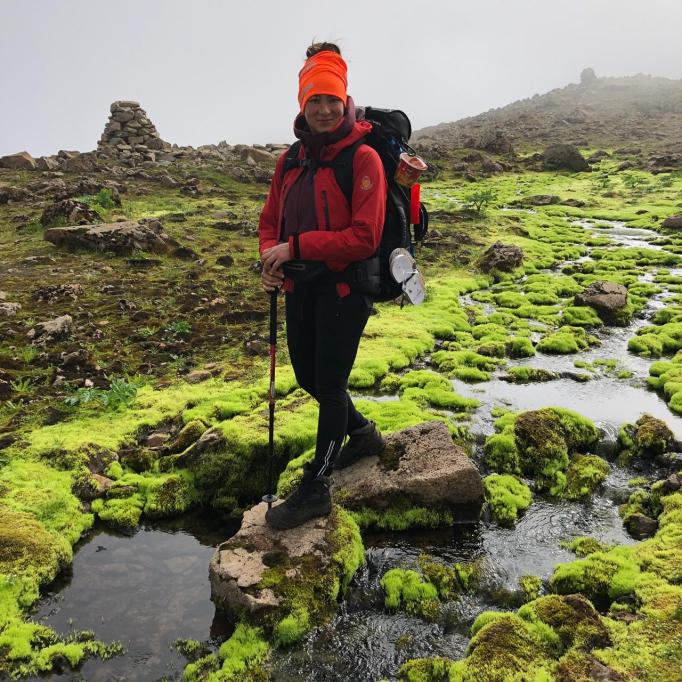
Day 2 brought us from Látrar to Fljótavík, over a highland pass covered in fog. The visibility was barely enough to get us from signpost to signpost, or between piles of rocks in a field of rocks, so even though it was also a 16km day, it took us all day to finally arrive in the right fjord. Once we were down from the pass, we ran into another summerhouse tenant, who told us where we should wade if we wanted to get to the Atlastadir campground, but we decided to go inland to the more private Glúmsstadir campground. The ground was damp but the view was gorgeous, and we had the place to ourselves.
helping out the ranger with signposts
Day 3 was slightly longer, more than 17km, from Fljótavík to Hlöðuvík, and the highland pass was wet foggy this time. We got damp thru our clothes and used the emergency shelter to dry our shoes and socks whiles we played games of cards and drank our rations of alcohol. We saw another fox, atleast 5 other hikers, and slept on the beach in a sanddune with two other tents pitched.
bays like this were an everyday sight
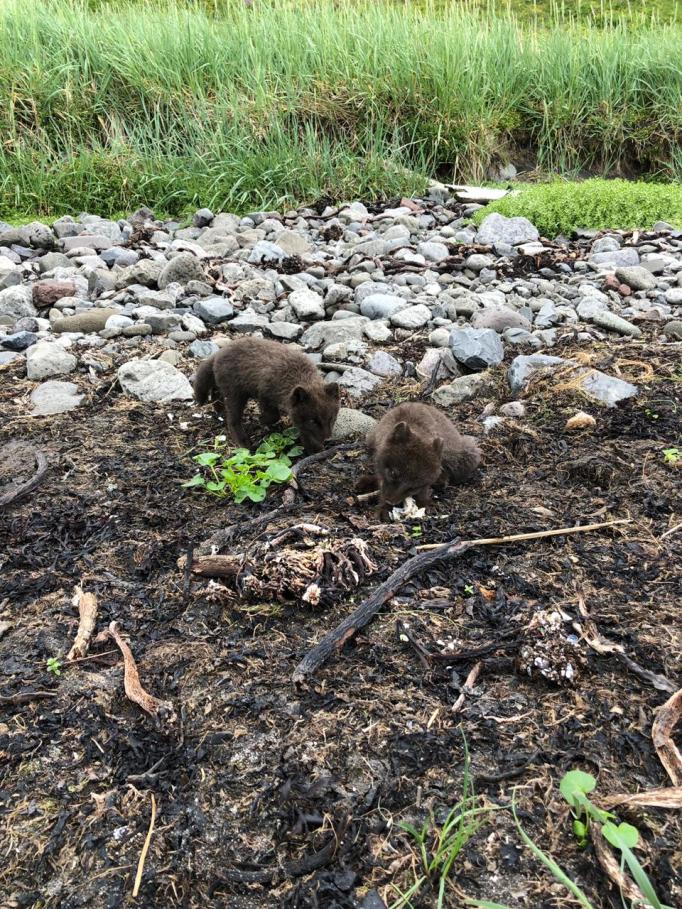
Day 4 was another 17km roughly, from Hlöðuvík to Hornvík, the main show, but the low clouds didn´t show us much of the seacliffs when we first arrived. Instead, we were greeted by a welcoming committee of baby foxes, still too young and playful to even notice us, and remained completely distracted by them and their antics.
baby Arctic foxes
We did, however, notice that the one and only ranger of the whole Hornstrandir reserve park system was not in, which was incredibly unfortunate, or unlucky rather, since we would only be spending a night there and her house was connected to the only flushing toilets we´d see all week, which were also locked. The door on the outhouse had broken, and with atleast 14 other people there, it got weird real fast. But we still had running water, and our cards, so we could cook, eat and play, and by the time we were ready for bed after a short hike around the fjord, the clouds miraculously parted and Hornvík mountain appeared before us, in all its glory.
the breathtaking colours of the moss in the highland pass
Our last full day of hiking would be the highest climb, getting over the 519m pass between Hornvík and Veiðileysufjörður. It was approximately 16km, in scorching sunshine, and though there were patches of snow at the top, there wasn´t a breeze or a cloud in the sky, and we probably got even more burnt from the snow reflection. We were to meet the shuttle boat between 5 and 7 pm at the bottom of Veiðileysufjörður, which sailed us into Hesteyri and Grunavík before returning us to civilisation in Isafjorður. There we went straight to the house “Husid” and ordered something hot and freshly cooked – I think I got fish and chips – and green and healthy (vegetarian Gudny got some amazing greens and vegetables) and a pint of beer. Such basic food and alcohol has never tasted so good, but we filled our bellies and gorged the whole while thinking, “the weather is still so nice… shouldn’t we go back to Hornstrandir and stay there a bit longer?”
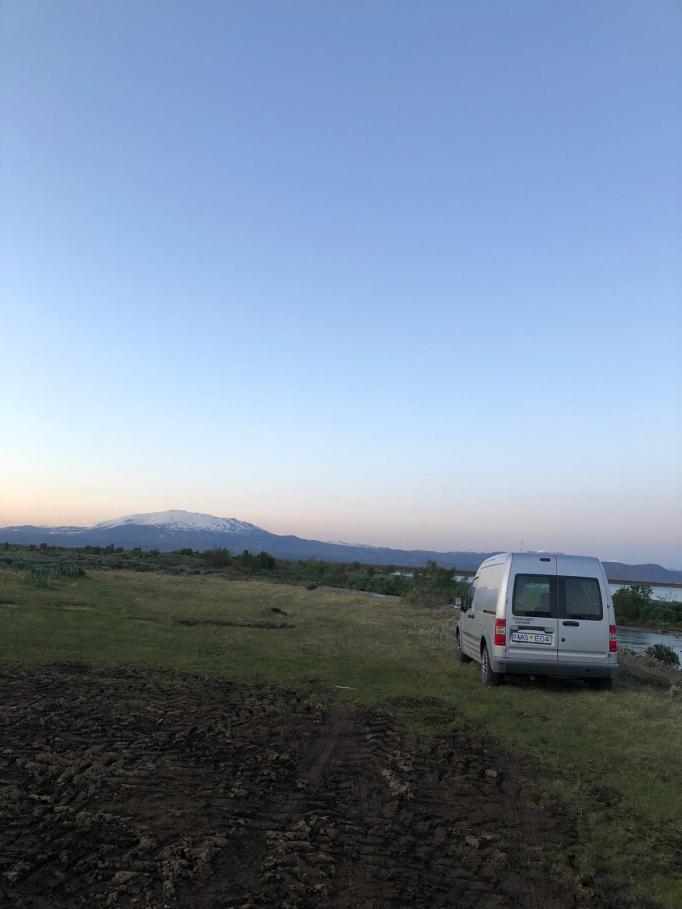
My new found home on wheels has offered so many opportunities for travel, and because of tour guiding work, I haven’t been outside of Iceland since before May, so roadtrips in Iceland where the greatest way to play. My 2-seater car, with a mattress, fridge and sink, has been fully kitted for an impromptu roadtrip thru Iceland at any moment; two friends have been lucky enough to become the plumber car’s first guests.
my home on wheels, under Hekla
I met a couchsurf host in Geneva who was on his way to Iceland for a few days, so we decided to test the home on wheels together for the first time. We drove the golden circle, had pizza and beer at Skjól, and hottubed til the wee hours of the morning at Hrunalaug, which hadn´t yet run dry. We met two Romanian workers from the Geysir shop who offered endless entertainment, and a yoga photographer from LA who I´ll probably see again in the future for a yoga workshop in Iceland. That night we slept near Fluðir on the banks of Thjorsá river, and carried on the following day on a hunt for more hot pools.
Hjalparfoss
We visited a pool that I´ve still never quite figured out why it got deserted, but it´s just there, all alone, rundown, perfectly swimmable. We went to Hjalpárfoss, which I hadn´t realized I´d never been to until I was there, looking at something I´d never seen. We drove south, under Eyjafjallajökull and Mýrdalsjökull until we reached Seljlanads country, and thought we´d be sneaky and sleep close to the sea on a dead end farmer´s hay field road a couple of km´s west of the infamous US Navy DC plane crash at Solheimasandur. On our midnight walk west, we realized there were a few too many unbridged rivers to make it. He´ll have to come back to see it net time.
the perfect secret lagoon
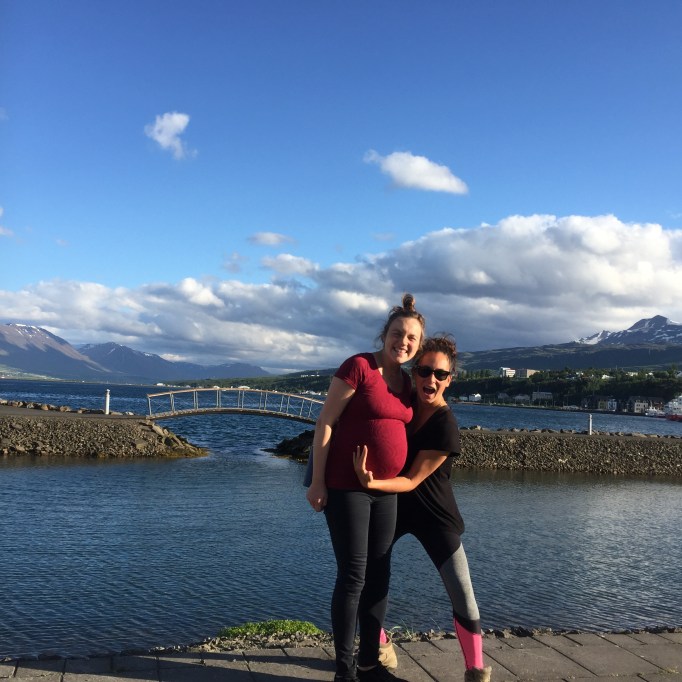
I made a friend in Thailand last November with a handful of Americans on a Travr trip, and she was coming from LA for a week long vacation to a place she´d never been, or even considered going, so I planned a full circumnavigation of the island for her… and my car. We left Reykjavik headed for the north over Kjolur, and spent our first night in Blondudalur. We arrived quite late, after a midnight dip in the Hveravellir hottub, so my pregnant friend Kristine was already sleep. When we woke up, she was gone, and her man, and it took some time to realize that they had left for Akureyri hospital, since she had gone into labour.
super preggers Kristine in between conractions, with permission to leave the hospital for a little photo shoot and virgin mojito action
We carried on to Husavik, where we visited Geosea until closing, and camped, illegally, in their parking lot, after having one too many beers at the swim-up bar. They woke us up in the morning with a knock on the car door, politely asking us not to “camp” in the parking lot.
Lauren and I at Geosea
The next night we went to Egilsstadir, my former summer stomping ground, where Nielsen Restaurant has been making waves. Run by a friend, the former head chef Kari of Michelin-starred Dill, it was a treat to eat so well, for so little, in a quiet, countryside town.
Head chef Kari at Nielsen restaurant
We drove to the bottom of Fljotsdalur to Egilsstadir farm, the last inhabited farm in the valley headed southwest to Snaefell and the foothills of Vatnajokull glacier, to stay at the Wilderness Center. My former boss and friend Denni runs a museum, guest house and viking sauna there, surrounded by horses and reindeer. We ended up, fireside, sharing stories and grass, before falling asleep in the back of the campervan, a place that had started to feel more and more like home.
at the end of the world, Obyggdasetur Islands, aka the Wilderness Center in East Iceland
The next morning we had intended on sleeping in Vik, but one of the first and worst rainfalls of the summer had started coming down like hell on earth, so we just kept driving to Reykjavik and crawled into my warm, dry bed in Reykjavik, feeling slightly as if we had cheated on the plumber car. Its hard to say, but I´m sure my apartment was happy to finally have some cuddles too.
Most people can agree that summer in Iceland isn’t much of a summer event. I’ve always said that my annual winter season is June-September in Iceland, and summer happens the other 8 months of the year in warmer, tropical countries south of here. But lo and behold, June came as a surprise.
the last of the snow hanging on after an early onset of a warm summer
Compared to last year, when it rained basically every single day of the month of June and the recorded sunshine hours for the whole month had already been surpassed in May this year, this June was hot, warm and dry, day after day. It was so dry the bugs didn´t make it out – there were no midge flies to be seen – and the dust clouds in the highlands would blow all the way to Reykjavik. We’re also talking about 24 hours a day of this – the sun never set so it went on and on and on and still, I woke up every day with a rain jacket and woollen lopa peysa ready to put on when the weather would finally crack.
Thingvallavatn
June saw the highland roads open early, but an emptiness remained on the well-beaten tracks of tourist trails, since tourism was still reeling from Wow air going bankrupt in April. Hotels and restaurants were still not at 100% operation, but finally there was breathing and playing space for Icelander’s to enjoy the best summer on record in over 40 years. The number of hotel rooms and tour operators may actually have been enough, for the first time since 2008, this June.
a beach day, under the glacier
However, there are always 2 sides to a story, and June was the worst month in 40 years for the salmon rivers. The most popular, productive fishing rivers had no water, and thus, no fish, and men who had paid over $1000 per day in fishing permits had resorted to just sitting in the fishing lodges drinking fine wine and smoking cigars on the patio. Some didn’t even bother to go, and fishing lodges all around Iceland sat empty for days at a time. But think about the salmon – where did they all go? Or didn’t they come at all? I hope they managed to spawn… or at least I hope they didn’t all die.
oh the places you’ll go… in a nice Icelandic summer!
I have to admit that the best part of the summer wasn’t the weather, but my life in it. I finally have a home I can call my own. It’s a wonderful place to keep all my stuff, although I still feel very little need to be there with it all. That’s why I bought a second home on wheels – a Ford transit connect that used to be rented out as a campervan, fitted out with a sink, water pump, solar-powered fridge and a couch that folds down to a double bed.
my home on wheels, the plumber car!
It kind of looks like a plumber’s car from the outside, a non-descript grey with no windows except at the front and back. I’ve added a table and chairs, a permanent stash of drinks and food, a yoga mat, hiking shoes and poles and a bathing suit and towel to make the car travel ready at the drop of a hat. I have probably spent as many nights in the car as in my own bed, and I’m still not sure which I prefer. Perhaps the winter will bring me back indoors a bit, we shall see.
Iceland is a deceiving name – we don’t have that much ice, or even snow, and our mild, sea-tempered winters barely keep anything white or frozen on the ground. People may think it’s a skiing destination, but we don’t really have mountains worth writing home about either, but a few big hills around the north are still definitely worth a visit.
Tindastóll, just outside of Sauðárkrókur, is now home to the longest run in Iceland, thanks to a new T-bar lift opening a couple of weeks ago. A few kilometers further north is Ólafsfjordur, home to arguably the shortest runs you can find in Iceland, but the only ski area that’s actually right in town, walking distance to the city center.
Siglo t-bar
Next door is Siglufjordur town, a great valley with four, excellently-planned t-bars. During easter, there’s even an apre-ski feel when the ski hut gets an alcohol license during the Siglo Freeride festival and thru til easter.
Dalvik has a couple of t-bars, but Id say, as a snowboarder who tried, the second one is only accessible by skiers. The view down to the sea and fjord is spectacular on a clear day, and you’re only a few km’s away from Akureyri. There you’ve got Hlíðarfjall ski area, which is open more days a year than other skislopes, with consistent snowfall and a large enough community to support its running costs.
skiing Dalvik is much easier than snowboarding
All of Iceland´s ski spots charge a similar price, with passes sold by the hour (around 1500-2000kr per hour) or day (4000kr). The 5×5 skiiceland.is offer sells you 5 days to 5 resorts (Olafsfjordur, Siglo, Tindastoll, Hlidarfjall and Dalvik) for around 20.000ISK. If you’re feeling really spendy, and prefer to ski privately, there’s always Deplar Farm hotel, where checking into the all inclusive resort includes all activities – even ski equipment and helicopter time to take you heli-skiing anywhere you please.
heli-skiing helicopter ready for take off at Deplar Farm
If none of that sounds worth it, then just take the short 20 min drive from Reykjavik to Blafjoll (if and when its open) where you can run up and down the same runs half a dozen times before getting bored, so long as you’re willing to wait longer for the lift up then it takes to ski down.
In an interview taken by Björn Þorfinsson, he claims I may be the most traveled person in Icelandic history. Whether or not that´s true, I definitely enjoyed his take on my mission. Here is a translation of the article, which you can find on dv.is:
It´s possible that Katrín Sif Einarsdóttir is the most widely traveled Icelander of all time. Despite being only 31 years old, Katrín Sif has traveled to 217 countries on the globe. It is worth mentioning that there are 195 recognized United Nations countries, but by, for example, counting Greenland and the Faroe Islands as countries instead of Denmark, it is possible to list about 230 countries.
Katrín Sif started traveling at a young age. Her father is Icelandic but her mother is from the South American country of Guyana. After her parents’ divorce, she grew up in Vancouver, Canada, but visited Iceland regularly. Just over a year ago, DV covered Katrín Sif’s milestone in being able to travel to 200 countries before the age of thirty. She succeeded when she stayed in the Mauritius over her birthday but then realised that she had thought wrong and was actually traveling to country number 201!
A journalist took the opportunity when Katrín Sif was in the country the other day to sit down with her and discuss the travels and lifestyle that she doubts she can ever give up. She is at a turning point because her father, Einar Óskarsson, died this summer. “Of course it was a big shock and it has taken a long time to complete all the loose ends.”
It´s not about competing in checking off countries It is very unusual for Katrín Sif to be in Iceland during the winter months, as she says she is not a big fan of the Icelandic winter or the darkness that covers most of the day. “I often experience Icelanders as semi-bears, who go into hibernation in the winter but then play extra hard in the summer,” she says. Despite loving Iceland, she is more fond of following the sun. “Iceland has the biggest place in my heart. The more I travel the world, the more I love the country. Despite the fact that I have connections in many places, Iceland is always the place I call my home and that will never change, “says Katrín Sif.
For the past twelve years, Katrín Sif has taken on various types of tour guiding, especially horseback treks, during the summer months in Iceland, but then leaves the country in the autumn and travels around the world for 8-9 months. It is far from being a “check list” of countries by only stopping a short time. She takes her time in each place and tries to get to know the natives and their culture.
“I’m not in any particular competition to try to travel to all countries in the world in the shortest possible time. Of course I think about the number of countries and places I have visited, but I am doing this for myself, first and foremost. I often experience that others are more excited about the number more than I am, “says Katrín Sif.
She says she plans her travels so that she stays in similar cultural areas. “I do not jump between continents as it is expensive and very cumbersome. Not only the journey but also the thought of constantly adapting to different languages, customs and habits. For example, I traveled around West Africa on one trip, North Africa on another trip and so on, “says Katrín Sif.
I still have left to visit a handful of recognized countries, including Libya, Uzbekistan, Turkmenistan, the Central African Republic and South Sudan. “I have been having trouble getting a visa for the first three. The situation is unsafe in the other two, so I have only waited to visit them. I don’t mind “says Katrín Sif.
Her annual income never exceeds one million Asked if she never gets enough of these trips, she says: “No, I really appreciate this lifestyle. I love to be free and do not invest much in worldly goods. ”According to Katrin, her paid annual income has never exceeded one million Icelandic kronas, so she has to travel very sparingly. She says she almost has a doctorate degree in finding cheap flights. “I am often hired to help family and friends find cheap fares. The thing is, major search sites often do not have a contract with the same low cost airlines. It is therefore necessary to search on several pages and in this way it is possible to put together a trip in the best way, “says Katrín Sif.
Since she has to keep track of the finances of her travels, she often chooses the cheapest option, so she travels a lot by bus. “It has not been a luxury to go on long bus journeys in Africa and most recently in India. But it is a great experience and you get more insight into the lives of the natives. However, this is probably not for everyone, “she says with a smile.
When it comes to accommodation, Katrín Sif takes unconventional paths. “I usually stay free with the locals through couchsurfing. It all depends on how conditions for hosts are, but in my opinion this is a very fun way to travel, “says Katrín Sif. For example, she visited Bangladesh for the first time recently and stayed with a Turkish pilot who lived in the country’s capital, Dhaka. “I had only been staying in his apartment for a few days when he was suddenly called to work. Then he just handed me the keys and asked me to lock them when I left, “says Katrín Sif and smiles. She says that such trust and friendliness is the rule rather than the exception in her travels and that is one of the reasons why she appreciates this mode of travel.
She expects to take on even more tasks as a tour guide abroad in the coming years. “This is what I know and live for, to travel. I took a group to South Africa a while ago and it went very well. I will work in some way in tourism in the future, “says Katrín Sif.
Backroads, the worlds #1 active travel company, has recently expanded its activity horizons by adding yoga to their trips! There is still biking and/or hiking and the multi-sport type trips haven´t been dropped or changed, but Backroads has simply added yoga as an extra option. In fact, Backroads has always been a yoga friendly company, with free yoga classes at lunch time for their head office staff and dozens of existing leaders already being certified yoga teachers. But now, you have the opportunity to book an active-packed adventure in one of the many countries Backroads is working on incorporating yoga into.
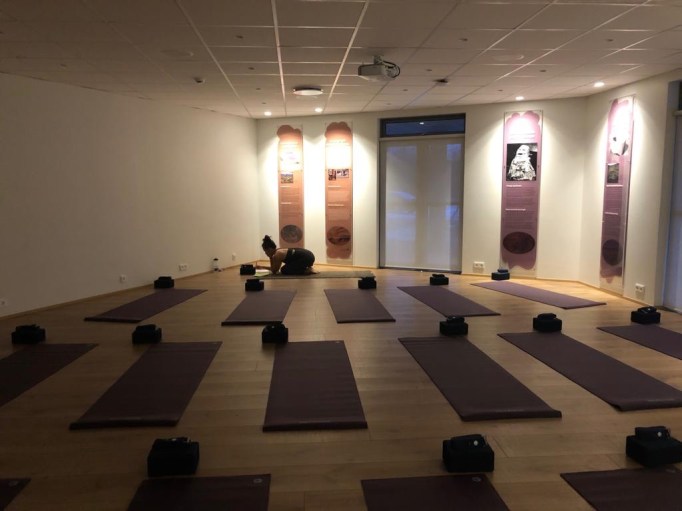
the yoga space at Hotel Húsafell, Iceland
The yoga classes will usually be offered in the early morning or late afternoon, getting in hour of yoga after big meals, and somehow connected to sunrise and sunset times, theoretically (hard to do in Iceland with only 4 hours of daylight). The yoga is Hatha style, a slow flow intended to stretch and strengthen the body. The yoga is not just seen as its own activity, but an exercise to help increase and improve the experience of the other activities offered on trip, since a little bit of yoga never hurt a cyclist or hiker! After the yoga classes, guests (and teacher) felt relaxed and better prepared for the next days activities, and I even noticed I was sleeping better.
Dark and wintery Iceland offers lots of time for cosy indoor yoga
The first ever yoga trips started just this year in Costa Rica and Iceland, and I was grateful to be the yoga teacher leader on Iceland´s two yoga departures this January. The first Iceland trip was a shining success, and more yoga-enthused guests means more yoga options with Backroads in the future. So far, we have California, Florida, Hawaii, Utah and Arizona in the US, plus Costa Rica, Iceland, India, Italy, Mexico, Bali, Indonesia and Mallorca, Spain. If those segments go well, who knows where the yoga will stop – perhaps it will slowly creep into trips in all of the 60+ countries Backroads operates at!
your Backroads yoga teacher leaders have all gone through YTTC training
Check out your active adventure dreams at backroads.com, especially if you´re thinking of traveling with a bit of yoga in your future. Or if you´re a yoga certified teacher and have ever thought about teaching yoga as a Backroads leader, why don´t you try applying for the 2019 season?
Backroads, the World’s #1 Active Travel company, is seeking seasonal Trip Leaders to lead and support our award-winning biking, hiking and multi-adventure vacations in Iceland and throughout the world. Our leaders enrich each trip with their personality, drive, passion for travel and the outdoors, while providing outstanding customer service and sharing their love and knowledge of the area. Multilingual and well-traveled applicants are encouraged to apply.
Benefits of a trip leader:
1.Potential to lead internationally and year-round, including Latin America, Asia and South Africa.
2.Food & Housing Allowance
3.Competitive Daily Rates & generous Gratuities
4.Holiday and Vacation Pay
5.Outdoor Gear & Clothing Discounts
6.Medical Benefits
7.Personal &Professional Growth










 nomadic cosmopolitan